


A Guide to Real Estate Private Equity: Unlocking Institutional-Grade Deals
- Ryan McDowell

- Oct 30, 2025
- 13 min read
Reading Time: 8 min | Good for: Novice (A), Informed (B), Sophisticated (C)
You've likely heard the term real estate private equity, but what does it actually mean? Put simply, it’s the practice of pooling capital from private investors to acquire, improve, and ultimately sell real estate assets that aren't listed on a public stock exchange. This approach allows investors to partner with expert sponsors on substantial projects—like developing a new multifamily community or overhauling an underperforming office complex—opening the door to opportunities typically out of reach for individual buyers.
TL;DR: Key Takeaways
What It Is: Real estate private equity (REPE) is a direct investment model where a professional sponsor (General Partner) uses capital from passive investors (Limited Partners) to execute a value-creation strategy on a specific property or portfolio.
Who It's For: Ideal for accredited investors, family offices, and institutions seeking portfolio diversification, inflation hedging, and higher potential returns than public markets may offer, in exchange for lower liquidity.
Why It Matters Now: Following a period of price discovery, transaction volumes are rebounding. This creates a window for well-capitalized sponsors to acquire quality assets at reset valuations and create value through operational expertise, not just market lift.
Next Step: Understand the key strategies—Core, Value-Add, and Opportunistic—to align a REPE allocation with your specific risk tolerance and return objectives.
Unpacking Real Estate Private Equity

At its heart, real estate private equity (REPE) is a hands-on, direct way to invest in property. It all happens outside the public stock market, which is what makes it fundamentally different from buying shares in a Real Estate Investment Trust (REIT).
Think of it this way: buying a REIT is like buying stock in a huge, diversified landlord. Your money is spread thin across a massive portfolio. But investing in a private equity deal is more like becoming a silent partner with a world-class developer on one specific, high-potential project. Your capital is put to work to actively create value, not just sit back and collect rent checks.
The Key Players and Structure
This partnership model is built on a clear division of labor. Understanding who does what is key to seeing how REPE works. You have two main players:
General Partners (GPs): These are the sponsors or fund managers—the seasoned real estate pros who are deep in the trenches. The GP is responsible for everything from sourcing the deal and conducting due diligence to securing financing, managing the property, and executing the business plan.
Limited Partners (LPs): These are the passive investors, which could be high-net-worth individuals, family offices, or even institutions. LPs provide most of the equity, but they hand off all the day-to-day decisions to the GP. This limits their liability to the amount of money they put in.
This GP/LP structure is the engine that drives private equity real estate. It marries the sponsor's operational know-how with the investor's capital, creating a powerful team ready to tackle complex projects. We dive deeper into this structure in our guide to limited partnership real estate investing.
Novice Lens: Why It MattersReal estate private equity provides a structured way for passive investors (LPs) to access institutional-grade properties by partnering with an experienced operator (the GP) who manages the asset from start to finish. This structure aligns interests, as the GP typically invests their own capital and earns their largest reward only after investors have received their initial capital and a preferred return.
Why Choose Private Equity Over Other Options?
So, why go this route? For savvy investors, the real appeal of REPE is getting access to deals and strategies you just can't find in public markets or through direct ownership. These funds take on ambitious projects like ground-up construction, major turnarounds of underperforming buildings, or building portfolios in niche sectors like medical offices or data centers.
This active management approach is all about generating returns by making the property better, not just by hoping the market goes up. The financial structures are also more sophisticated. You’ll see terms like a preferred return, which ensures LPs get paid a certain return before the GP takes a performance fee. The waterfall model then dictates how the rest of the profits are split. This setup creates a powerful alignment—the sponsor’s big payday is directly tied to delivering great results for investors. Learn more about the waterfall in private equity.
The "Why Now" Market Landscape for Real Estate
Knowing the "what" of real estate private equity is one thing, but understanding "why now" is where the real opportunity lies. The commercial real estate market is in a fascinating spot, navigating the ripple effects of changing interest rate policies and fundamental shifts in supply and demand. After a stretch where the market was largely frozen, we are entering a new cycle, creating clear openings for disciplined investors.
For a period, a wide bid-ask spread—the gap between what sellers wanted and what buyers were willing to pay—stalled transaction activity. That's changing. As clarity emerges around inflation and borrowing costs, buyers and sellers are starting to align on pricing. This is thawing the freeze on transactions, allowing well-capitalized sponsors to acquire top-tier assets at reset valuations.
A Rebound in Investor Confidence
This isn't just a feeling; the numbers tell the same story. After a challenging fundraising period, the real estate private equity world showed renewed vigor in 2025. Data from Alter Domus (as of mid-2025) shows that global private real estate fundraising shot back up to $110.54 billion in the first half of 2025. That's a 16% jump from the same period in 2024, a powerful signal that investor confidence is returning.
This was driven by several mega-funds closing and a pickup in direct investment. Global real estate deals hit $185 billion in Q1 2025 alone—a 34% increase from the year before. This flood of capital indicates that experienced investors see a prime moment of opportunity.
Market Signal Box (Data as of Q2 2025)* The Data: Global real estate transactions jumped 34% year-over-year in Q1 2025, reaching $185 billion.* Interpretation: The market is moving past the price discovery phase that sidelined capital. Transaction velocity is increasing as quality properties begin to trade more freely.* Investor Take: The window to acquire assets at reset pricing is open now but likely won't last indefinitely. Sponsors with ready capital and operational expertise are best positioned to act before increased competition drives prices up.
Positioning for the Next Cycle
In this new environment, success is less about financial engineering or relying on cheap debt. It is now centered on operational excellence and creating value at the property level.
This means focusing on:
Acquiring underperforming assets: Finding properties suffering from mismanagement or deferred maintenance.
Executing smart capital improvements: Renovating units, adding modern amenities, or improving energy efficiency to justify higher rents and lower operating costs.
Solving complex capital situations: Targeting deals where current owners face maturing debt and need a new capital partner or an outright sale.
Simply put, the market is shifting from one that rewards financial leverage to one that rewards genuine real estate skill. For passive investors, this makes it crucial to partner with sponsors who have a proven history of navigating these cycles and creating tangible value through hands-on management.
How Sponsors Create Value in Real Estate
In real estate private equity, you don't just buy a building and hope the market goes up. Instead, the sponsors (General Partners) actively work to create value through deliberate, strategic moves. This hands-on approach is the secret sauce that separates REPE from passive ownership.
Sponsors typically run one of three main playbooks: Core, Value-Add, and Opportunistic. Each strategy lives on a different part of the risk-return spectrum, akin to choosing between a low-risk bond, a steady growth stock, or a high-potential venture startup.
The chart below shows how a return of investor confidence is breathing new life into the real estate private equity market, opening up doors for all three types of strategies.
As you can see, confidence is the foundation. It leads to more capital being raised, which in turn fuels more deals for sponsors putting these value-creation strategies to work.
Core Strategy: The Foundation
Core investing is the most conservative play. Picture a new, fully leased Class A office tower in a major city, with a creditworthy tenant on a long-term lease. That's a Core asset. The goal isn't a dramatic makeover; it's generating stable, predictable cash flow. Value is created through excellent property management, minor operational tweaks, and contractual rent escalations. A key part of this is knowing strategies for negotiating commercial leases.
Risk Profile: Low
Leverage: Typically low (under 40%)
Primary Goal: Capital preservation and consistent income.
Value-Add Strategy: The Renovation Play
This is where many real estate private equity sponsors shine. A Value-Add strategy involves finding a property with correctable flaws and executing a plan to fix them. A classic example is buying an older apartment complex with dated units and below-market rents. The sponsor invests capital to renovate apartments, upgrade common areas, and improve management. This justifies higher rents, increases the Net Operating Income (NOI), and ultimately boosts the property's value.
Novice Lens: Think of it as a "fix-and-flip" on a massive, commercial scale. The sponsor is forcing the property's value to go up through sweat equity and smart upgrades, not just riding a market wave.
Success here boils down to execution. The sponsor must deliver the renovation on time and on budget to transform the underperforming asset into a stabilized, cash-flowing property.
Opportunistic Strategy: The Visionary Build
Opportunistic deals are the riskiest but also offer the highest potential returns. These projects often involve ground-up development, converting a property's use (like turning an old warehouse into loft apartments), or taking on a completely vacant building. For instance, a sponsor might buy a plot of land, navigate zoning and entitlements, and build a state-of-the-art data center from scratch to meet surging demand. These complex projects require deep expertise in development, construction, and leasing. The value is created entirely from the sponsor's vision and ability to execute.
Real Estate Private Equity Strategies at a Glance
Strategy | Risk Profile | Target IRR (Net to LP) | Leverage | Primary Value Driver |
|---|---|---|---|---|
Core | Low | 8% - 10% | 30% - 40% | Stable cash flow & minor rent growth. |
Value-Add | Moderate | 12% - 18% | 60% - 75% | Renovations, operational improvements, and re-leasing. |
Opportunistic | High | 20%+ | >70% | Development, major repositioning, and entitlement. |
Ultimately, there is no single "best" strategy. The right choice depends on an investor's goals and risk tolerance. Whether it’s the steady income of a Core property or the home-run potential of an Opportunistic development, the common thread in real estate private equity is that value is never an accident—it's actively and intentionally created by a skilled sponsor.
Deal Lens: A Value-Add Multifamily Example
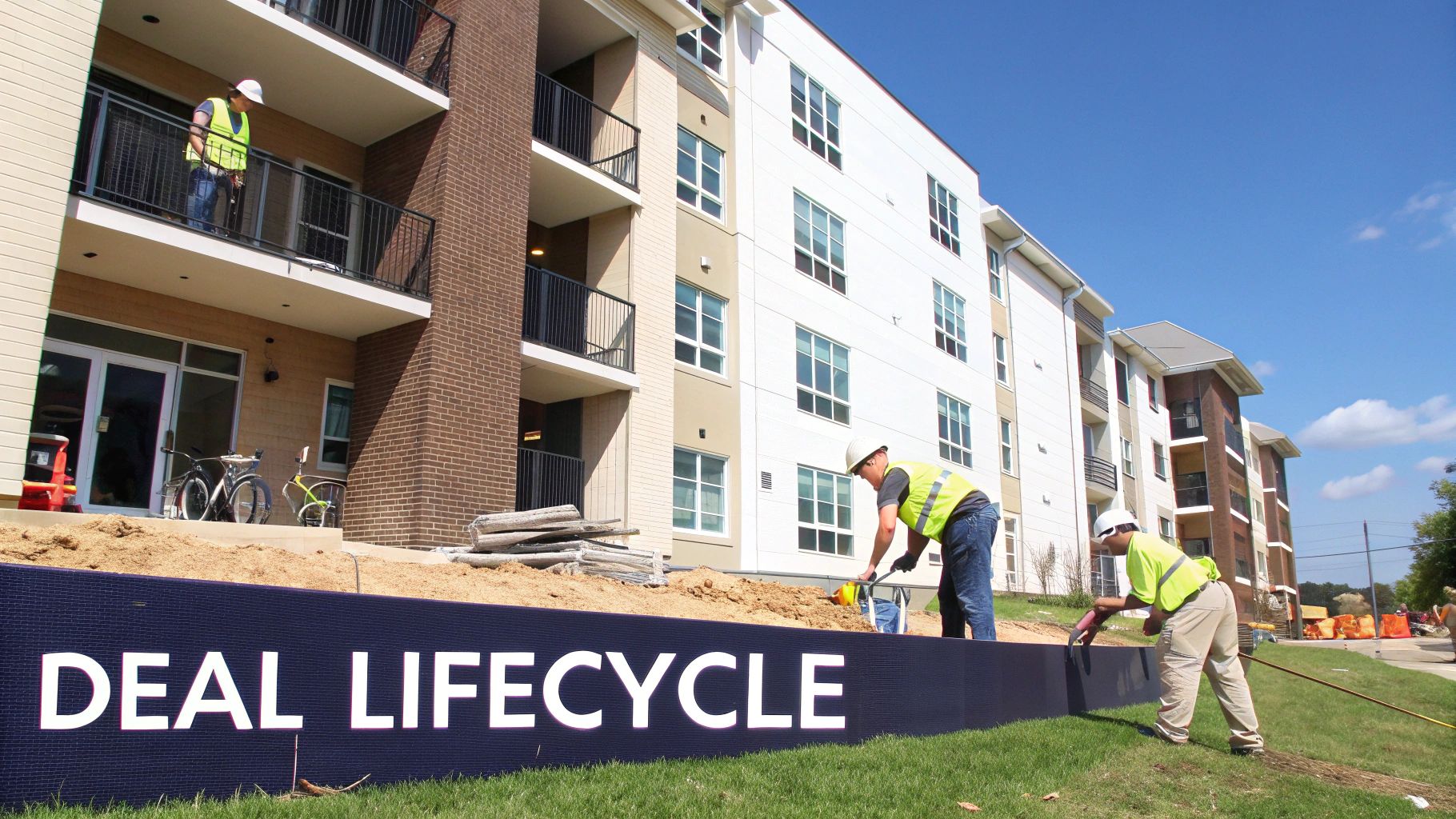
Theory is great, but a practical example makes it all click. Let's walk through a simplified "value-add" play to see how a sponsor turns an overlooked property into a significant win for investors.
Our target is a 200-unit, 1990s-vintage apartment complex in a growing Sunbelt city. The property is well-located but physically tired. The current owner has deferred maintenance, and average rents are 15% below market for renovated properties nearby. This is a perfect value-add candidate.
1. Identifying and Acquiring the Asset
The sponsor's team sources this property, "Vista Gardens," through their network. Their underwriting model shows that with strategic renovations, they can significantly boost its Net Operating Income (NOI). After due diligence, they negotiate a purchase price of $20 million.
To fund the deal, they assemble a capital stack:
Senior Debt: $14 million (70% of purchase price) from a bank.
LP Equity: $5.4 million raised from accredited investors and family offices.
GP Equity: $600,000 (10% of total equity) contributed by the sponsor, ensuring "skin in the game."
Renovation & Reserve Capital: An additional $2 million in equity is raised to fund the improvements and provide a contingency budget, making the all-in project cost $22 million.
2. The Value Creation Phase
With the property acquired, the three-year business plan begins. The sponsor executes a $10,000-per-unit renovation program, upgrading kitchens, flooring, and bathrooms as units turn over. They also enhance common areas by adding a dog park, refreshing the gym, and modernizing the leasing office.
These improvements make the property more desirable, justifying higher rents. Within two years, 85% of the units are renovated, and the average rent has increased from $1,200 to $1,500 per month. This directly boosts the property's NOI from $1 million at purchase to $1.4 million.
3. The Profitable Exit
By year three, Vista Gardens is a stabilized, cash-flowing asset, essentially transformed into a "Core" property. The sponsor determines it is the optimal time to sell. A new buyer, perhaps an insurance company seeking stable, long-term returns, acquires it for $28 million.
The sale proceeds first repay the bank loan, and the remaining profit is distributed to equity investors according to the waterfall structure. This deal generated a strong return, demonstrating how active management in private equity creates value far beyond market appreciation.
Navigating Risks and Performing Due Diligence

While the returns in real estate private equity can be compelling, a clear-eyed view of the risks is essential. Success isn't just about picking good properties; it's about partnering with sponsors who are masters of risk mitigation and transparency.
The market moves in cycles, and performance varies significantly by geography and property type. For example, a recent global commercial real estate outlook from Deloitte (as of mid-2025) shows that while some markets are recovering, others face headwinds, highlighting the need for careful selection.
Risk & Mitigation Table
Every investment has risks. In private real estate, the best sponsors identify, price, and manage them head-on. A huge part of this is knowing how to conduct risk assessment on any potential deal.
Risk: Illiquidity * Your capital is typically locked up for a 5 to 10-year period. You cannot easily sell your stake. * Mitigation: The sponsor clearly defines the fund's timeline and business plan upfront. Ensure this timeline aligns with your personal liquidity needs.
Risk: Execution * Value-add and opportunistic strategies depend on the sponsor's ability to complete a complex plan on time and on budget. * Mitigation: Vet the sponsor's track record. Have they successfully executed similar projects before? A proven history is your best defense.
Risk: Market & Cyclical Downturn * An economic recession, rising interest rates, or shifts in tenant demand can negatively impact property values and cash flow. * Mitigation: Prudent sponsors use conservative underwriting assumptions (e.g., modest rent growth) and focus on markets with diverse, resilient economies.
Risk: Leverage * Excessive debt magnifies risk. If the property underperforms, foreclosure becomes a real threat. * Mitigation: Disciplined sponsors use moderate leverage (typically 60-70% Loan-to-Cost) and seek favorable terms like fixed interest rates to hedge against volatility.
Actionable Investor Checklist: Questions to Ask a Sponsor
Before investing, you must conduct a deep dive on the General Partner (GP). You are investing in a team as much as you are in a building.
Track Record: Can you provide your full, deal-by-deal track record, including both successes and failures?
Alignment of Interests: How much of your own capital is invested in this deal? Is the GP co-investment significant (e.g., 5-10% of total equity)?
Strategy & Underwriting: What are the key assumptions in your financial model, and how did you stress-test them? What has to go right for this deal to work?
Fee Structure: Can you provide a clear, comprehensive breakdown of all fees, including acquisition, asset management, and disposition fees?
Reporting & Transparency: What is your investor reporting cadence and format? Will I receive detailed financial statements and progress updates regularly?
For a deeper dive, review our complete guide to commercial real estate due diligence.
How REPE Can Fit Within Your Portfolio
When building a durable portfolio, any new asset class must serve a strategic purpose. Real estate private equity is not a speculative bet; it's a strategic allocation intended to help build resilient, multi-generational wealth.
For sophisticated investors like UHNWIs and Family Offices, REPE is a powerful diversifier. Because private real estate is not publicly traded, its valuation has a low correlation to the daily volatility of stock and bond markets. This can act as a stabilizing force, particularly during periods of public market turbulence.
A Hedge Against Inflation and a Source of Tax Efficiency
Private real estate also plays a powerful defensive role, particularly as an inflation hedge. When the cost of living rises, so do construction costs and, crucially, rental rates. Real assets, like the buildings in a REPE fund, tend to appreciate in value alongside inflation, protecting your capital's purchasing power.
Furthermore, direct ownership offers significant tax advantages. Investors can benefit from depreciation, a non-cash expense that can shield a significant portion of the income generated by the properties. This often results in highly tax-efficient distributions, a critical benefit for high-net-worth portfolios.
The Institutional Shift Toward Private Markets
This strategy is why many global family offices and institutions are steadily increasing their allocations to private markets. The entire private asset space has grown significantly as large investors seek long-term, return-generating assets to match their long-term liabilities. Real estate has firmly established itself as a core holding in these portfolios. You can discover more insights about the future of private markets at BlackRock.com.
The Stiltsville Capital Perspective: We believe that disciplined underwriting, conservative leverage, and true alignment of interests are the keys to long-term success in real estate. We view each asset as an operating business, not a financial instrument. We invest significant capital alongside our partners because we succeed only when you do. By partnering with specialist operators, investors can add a durable, income-producing, and tax-efficient engine to their wealth strategy.
Common Questions from Investors
It’s natural to have questions when exploring a complex asset class. Here are straightforward answers to what we hear most often.
What’s the Typical Buy-in?
Minimum investments vary widely. For a smaller, single-asset syndication, minimums might start around $250,000. For larger, institutional-quality funds, the minimum commitment is often $1 million or more. These investments are structured for accredited investors who have the capital and sophistication for long-term, illiquid opportunities.
How Is This Different from a REIT?
While both invest in real estate, REPE and a Real Estate Investment Trust (REIT) are fundamentally different in structure, strategy, and liquidity.
Liquidity: REITs are publicly traded securities you can buy and sell daily on a stock exchange. A REPE investment is private and illiquid; your capital is locked in for the project's duration.
Strategy: REITs typically own and operate large portfolios of stabilized properties, acting as a landlord. REPE sponsors are operators focused on actively creating value through development or repositioning.
Access & Control: Anyone can buy a REIT. REPE is limited to accredited investors who gain more direct exposure to a specific asset and business plan.
What Kind of Fees Should I Expect?
The fee structure is designed to align the interests of the sponsor (GP) and the investors (LPs). The classic model is often referred to as “2 and 20.”
Management Fee: An annual fee, typically 1-2% of committed capital, that covers the sponsor’s operational overhead for sourcing, underwriting, and managing the assets.
Performance Fee (Carried Interest): Typically 20% of the profits, but—critically—it is paid to the sponsor only after investors have received 100% of their initial capital back, plus a pre-agreed minimum return (the "preferred return"), often in the 6-8% range. This ensures the sponsor is highly motivated to deliver strong performance.
At Stiltsville Capital, we believe a disciplined, transparent approach to real estate private equity can be a powerful component of a long-term wealth strategy. We partner with family offices and accredited investors to provide access to institutional-quality deals.
Schedule a confidential call with our team to explore how our strategy can help you reach your portfolio goals.
Information presented is for educational purposes only and does not constitute an offer to sell or a solicitation of an offer to buy securities. Any offering is made only through definitive offering documents (e.g., private placement memorandum, subscription agreement) and is available solely to investors who meet applicable suitability standards, including “Accredited Investor” status under Rule 501 of Regulation D. Investments in private real estate involve risk, including loss of capital, illiquidity, and no guarantee of distributions. Past performance is not indicative of future results.
Comments