


How to Invest in Apartment Buildings: A Complete Guide for Sophisticated Investors

Reading Time: 8 min | Good for: A, B (Curious Novices, Time-Pressed Family Offices)
Investing in apartment buildings is a powerful way to build wealth, but success requires a disciplined, repeatable process. It's not about winging it; it's about knowing your market, finding good deals, running the numbers with precision, securing the right financing, and having a solid plan to execute.
This guide is your roadmap. We’ll walk you through the entire institutional-grade process, from sourcing and evaluating deals all the way to a profitable exit.
Your Blueprint for Apartment Building Investing

This first section lays out the big picture, giving you a clear roadmap whether you're a curious novice or a seasoned professional. We’ll cover key concepts like owning a property directly versus investing passively in a syndication, setting the stage for the practical details to come.
Our goal is to pull back the curtain on the entire process. We want to equip you with the strategic mindset needed to confidently tackle your first—or next—apartment building deal. The journey from identifying a market to managing a stabilized asset is methodical, not mysterious.
Understanding the Investment Landscape
Before looking at specific deals, you must understand the broader economic picture. These aren't abstract ideas; they directly impact everything from rent growth and property values to your final return on investment. At its core, it all boils down to the timeless principle of supply and demand.
A critical number to watch is apartment absorption, which is the net number of units rented in a given period. To illustrate, in early 2024, the U.S. apartment market saw demand surge, with net absorption hitting nearly 39,000 units in Q1 alone, a significant rebound from previous quarters. This demand is expected to keep pace with the high volume of new construction. You can dig into these trends to see how they might shape future rent growth.
Market Signal Box (as of Q2 2024)* Data Point: U.S. apartment demand has shown surprising strength, absorbing a significant portion of the new supply hitting the market.* Interpretation: While new construction is at a multi-decade high, robust household formation and a strong job market are creating tenants to fill these units.* Investor Take: When demand outpaces supply, landlords gain pricing power, leading to strong rent growth and healthier cash flow. However, this same dynamic often drives up acquisition prices, making it tougher to find deals that meet disciplined underwriting standards.
The Two Paths to Ownership
For most individuals and family offices, there are two main ways to invest in apartment buildings. Each path offers a different level of control, risk, and time commitment.
Direct Ownership: This is the hands-on route. You find the deal, you secure the loan, and you manage the property yourself (or hire a manager). This path offers total control but demands significant capital, time, and real estate expertise.
Passive Investing (Syndication): In this model, you invest as a Limited Partner (LP) alongside an experienced operator, known as a General Partner (GP) or sponsor. The sponsor does all the heavy lifting—from acquisition to management—while you provide a portion of the equity and receive a share of the returns.
For high-net-worth individuals and family offices, passive investing through syndications is often the preferred strategy. It provides access to larger, institutional-grade properties without the burden of day-to-day management.
To provide a bird's-eye view, here's a summary of the core phases every deal goes through, whether you're in the driver's seat or investing passively.
Core Investment Phases Summary
Investment Phase | Primary Goal | Key Activities |
|---|---|---|
Market Analysis | Identify a promising investment market. | Researching economic trends, population growth, and job drivers. |
Deal Sourcing | Find a viable property that meets criteria. | Building broker relationships, analyzing off-market leads. |
Underwriting & Due Diligence | Verify all assumptions and uncover risks. | Financial modeling, physical inspections, lease audits. |
Financing & Acquisition | Secure debt and close the transaction. | Applying for loans, negotiating terms, managing closing process. |
Asset Management & Execution | Implement the business plan to increase value. | Overseeing renovations, managing property operations, leasing. |
Disposition (Exit) | Sell or refinance the asset to realize gains. | Marketing the property, negotiating sale, returning capital. |
Think of this as your repeatable blueprint for success. Understanding these phases helps you know what's coming and what questions to ask at every turn.
How to Source and Analyze Investment Opportunities
Finding the right investment property is where the rubber meets the road. Successful apartment building investing requires a disciplined, systematic approach to finding deals and rapidly assessing their viability. This process is a blend of strong relationships and sharp analytical skills, ensuring you only pursue opportunities with genuine potential.
Your deal pipeline will flow from two main channels: on-market and off-market. On-market deals are publicly listed, usually with commercial real estate brokers. Off-market deals are sourced through direct networking with property owners, attorneys, or other professionals who know of a discreet sale. Both channels have their place, but the secret is building a network that brings deals to you.
On-Market Versus Off-Market Deals
On-market deals provide excellent visibility and a structured process, but they come with intense competition. These properties are professionally marketed, meaning you are often competing against other savvy, well-funded investors.
Off-market deals can feel like finding hidden treasure. They often arise from situations like an owner retiring, a partnership dissolving, or a seller desiring a discreet, no-fuss transaction. Finding them requires more legwork, but you can often secure better pricing and more favorable terms without a bidding war.
Insight Edge: A common mistake is focusing exclusively on one channel. The most sophisticated investors we know employ a hybrid strategy. They cultivate strong relationships with top multifamily brokers to get a first look at premier on-market deals, while simultaneously nurturing a private network to unearth off-market gems.
The Initial Underwriting Sprint
When a potential deal arrives, speed and accuracy are paramount. You cannot afford to spend weeks analyzing a property that is a non-starter. This initial assessment, or "back-of-the-napkin" underwriting, should take no more than an hour and boils down to three key documents.
The Rent Roll: This is a live snapshot of the property's income. It details every unit, tenant, lease term, rent amount, and payment status. You’re looking for high occupancy, rents near market rates, and minimal delinquencies.
The Trailing-12 (T-12) Operating Statement: This is the property’s financial report card, showing all income and expenses over the last 12 months. It's how you verify the seller's income claims.
Local Market Comparables ("Comps"): What are similar buildings in the area renting for? What are they selling for? This context is critical. It helps you sanity-check the rent roll and project the property's potential future value after you execute your business plan.
**Novice Lens: Understanding Key Metrics*** Net Operating Income (NOI): The single most important metric in an initial review. It’s the property's total revenue minus all necessary operating expenses. NOI is a pre-tax figure, so it excludes loan payments, capital expenditures, or depreciation. It is the fundamental number used to determine a property's value.* Capitalization (Cap) Rate: Calculated by dividing the NOI by the property’s purchase price. A lower cap rate generally indicates a lower-risk, higher-priced asset, while a higher cap rate suggests higher risk but potentially greater returns.
Spotting Preliminary Red Flags
During this quick analysis, certain issues should immediately give you pause. Learning to spot these early will save you countless hours of wasted effort.
Here's a quick checklist of initial warnings:
Unusually High Vacancy: Why are so many units empty? Is it poor management, or is the neighborhood in decline?
"Pro-Forma" Financials: Be highly skeptical of financials based on a "pro-forma," which is simply a projection of future performance. Always insist on the actual T-12 statement to see how the property is performing today.
Major Deferred Maintenance: If photos or descriptions mention significant problems—like a failing roof or ancient HVAC systems—your renovation budget could balloon. You can learn more by exploring [a guide to the types of investment risk in real estate](https://www.stiltsvillecapital.com/post/a-guide-to-the-types-of-investment-risk-in-real-estate).
The current economic climate, with higher interest rates and increased operating costs, makes this initial scrutiny even more critical. Careful market selection and conservative underwriting are completely non-negotiable. This underscores why a rigorous, data-driven approach to every potential deal is so important.
Mastering Due Diligence and Underwriting

So you've found a promising property and have it under contract. Congratulations. Now the real work begins. This is the due diligence period—an intense, non-negotiable window where you must verify every single assumption made during your initial analysis.
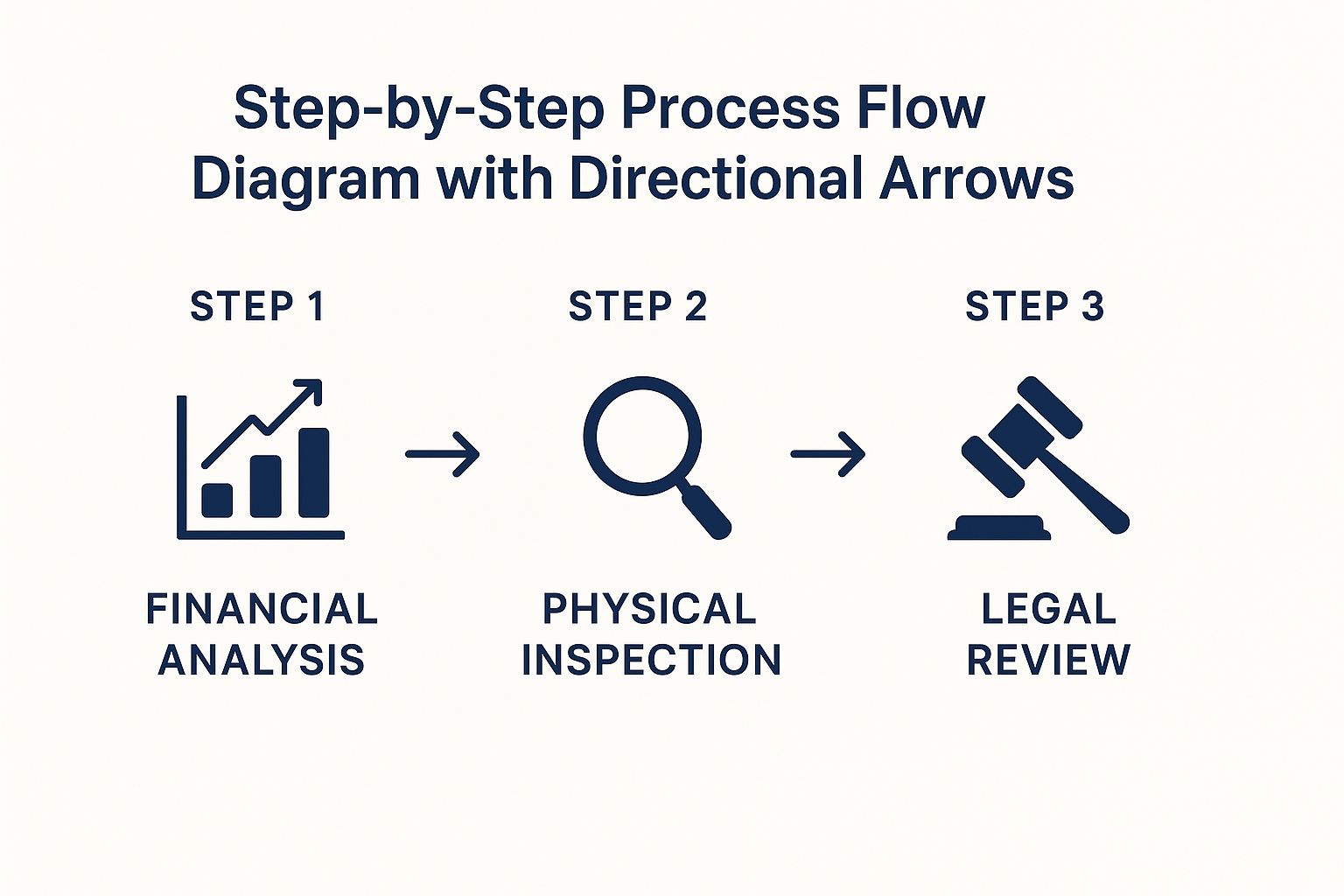
Think of it this way: your first look was a "back-of-the-napkin" sketch. Due diligence is where you create the high-resolution blueprint. A disciplined process here is your last, best chance to uncover hidden issues and protect your capital before the deal becomes final. The process boils down to three critical pillars: financial, physical, and legal.
Financial Diligence: Verifying the Numbers
Financial diligence is all about pressure-testing the property’s economic reality. The seller’s profit and loss (P&L) statement is just a starting point, not gospel. Your job is to audit it, line by line.
The most critical part of this is the lease audit. You must meticulously review every single lease agreement and cross-reference it with the rent roll.
Here’s what you’re looking for:
Do the tenant names, rent amounts, and lease expiration dates match the rent roll?
Are there hidden concessions or rent credits artificially inflating the income?
What are the security deposit amounts, and will they be properly transferred at closing?
Are utility reimbursements (like RUBS) being billed correctly and consistently?
Beyond income, you must validate every expense. Obtain actual utility bills, insurance policies, property tax statements, and maintenance invoices. Any mismatch between the seller’s T-12 and these source documents is a red flag that demands an explanation. For a deeper dive, our a guide to commercial real estate due diligence covers all your bases.
Physical Diligence: Kicking the Tires
While the numbers tell one story, the building itself tells another. Physical due diligence is your chance to uncover the property's true condition and identify any deferred maintenance that could destroy your budget. This is far more than a simple walkthrough.
You should always hire qualified, third-party professionals to conduct a thorough **Property Condition Assessment** (PCA). This provides an expert's take on the building's most critical—and expensive—components.
A comprehensive PCA must cover:
The Roof: Its age, current condition, and remaining useful life.
HVAC Systems: The age and functionality of all heating, ventilation, and air conditioning units.
Plumbing & Electrical: Any outdated or failing systems that could require a massive overhaul.
Foundation & Structure: Signs of settling, major cracks, or other structural integrity problems.
Deal Lens Example: The Roof Repair RenegotiationImagine you're buying a 100-unit building. Your initial underwriting assumed the roof had 10 years of life left. During inspection, your consultant finds major hail damage and estimates a full replacement is needed within two years at a cost of $150,000. This doesn't kill the deal; it becomes a powerful negotiation tool. Armed with the inspection report and a contractor's bid, you go back to the seller to request a $150,000 price reduction or a credit at closing. This is due diligence in action: turning a potential crisis into a negotiated solution that protects investor capital.
Legal Diligence: Confirming a Clear Title
Finally, legal diligence ensures you're acquiring a clean, unencumbered asset. This involves engaging a title company and a real estate attorney to investigate potential legal roadblocks.
The main event here is a title search. This process verifies the seller has the legal right to sell the property and uncovers any liens, easements, or judgments that could cloud the title. You'll also need to confirm that the property's current use complies with local zoning regulations. Discovering a zoning violation late in the game can be an absolute deal-killer, making this an essential checkpoint.
How to Structure the Deal and Secure Financing
You can find a great property, but if the financing and deal structure are wrong, the entire investment can fail. How you assemble the capital is just as critical as the building itself. The right mix of debt and equity—what we call the capital stack—can supercharge your returns. The wrong one can sink an otherwise solid deal.
This is where the rubber truly meets the road. A disciplined, multi-layered review ensures the deal structure is built on a solid foundation of real, verified information, not just rosy projections.
Navigating the Debt Landscape
Debt is almost always the largest piece of the capital stack. As an investor, you have several go-to options, each with its own pros and cons.
Agency Loans (Fannie Mae & Freddie Mac): These are the gold standard for stabilized apartment buildings. They offer long-term, fixed-rate financing at attractive rates and are typically non-recourse. This is a huge benefit, as it means the lender can only pursue the property itself, not your personal assets, in a default scenario. The trade-off? The underwriting is rigorous, and they come with prepayment penalties.
Bank Loans: Local and regional banks can be excellent partners, especially for value-add deals or if you have a strong local track record. They offer more flexibility and a faster, more personal approval process. The downside is these loans are often recourse and may have shorter terms or variable rates.
Bridge Debt: This is your short-term solution for a property requiring a major renovation. A bridge loan provides quick, flexible capital to execute your business plan and stabilize the building, positioning it to qualify for better long-term financing. They are more expensive but are the right tool for a heavy-lift project.
The right debt aligns with your business plan. A cash-flowing, stable asset is a perfect match for an agency loan. A major renovation project, however, calls for the flexibility of a bridge loan. For a deeper dive, see our [guide to commercial real estate financing options for investors](https://www.stiltsvillecapital.com/post/a-guide-to-commercial-real-estate-financing-options-for-investors).
Structuring the Equity Side
Equity is the cash that you and your partners bring to the deal. For most investors, this occurs through a real estate syndication, a structure that pools capital from multiple investors to acquire a property too large for any single individual to purchase alone.
Insight Edge: Alignment of Interests is EverythingA well-structured deal ensures everyone's interests are aligned. At Stiltsville Capital, we believe sponsors should only prosper when our investors do. This is achieved through carefully designed equity waterfalls that prioritize investor returns.
In a typical syndication, you’ll see two main roles:
General Partners (GPs): These are the operators, like us. We find the deal, structure it, and manage the property day-to-day. We invest our time, expertise, and a significant amount of our own capital.
Limited Partners (LPs): These are the passive investors who provide the bulk of the equity capital. In return, they receive ownership in the property and a share of the profits.
The entire relationship is governed by a partnership agreement that outlines how cash flow and profits are distributed. This is usually done with a "waterfall" structure that includes a preferred return. Think of it as a hurdle—a minimum annual return (often 7-8%) that LPs are paid before the GP receives any profit share. It's a powerful mechanism to ensure investors are paid first.
Executing the Business Plan and Managing the Asset

Reaching the closing table feels like a victory, but in reality, it’s just the starting line. The real work—and where true value is created—happens in the day-to-day execution that follows. This is where your meticulously crafted business plan meets the real world, and where proactive asset management transforms projections into actual returns for you and your investors.
This phase is all about execution. Whether you’re undertaking a major value-add renovation or stabilizing the operations of a newly acquired building, success demands constant attention and intelligent decisions.
Selecting Your Property Management Team
Unless you plan on fielding late-night plumbing calls yourself, your first and most critical decision is selecting a top-tier property management team. Do not take this lightly. Your property manager is your on-the-ground execution arm—the face of the property to tenants and the engine driving daily operations.
When vetting potential partners, look beyond the management fee. A truly great property management firm acts as a strategic ally, not a simple vendor.
Here’s what you should be looking for:
Deep Local Market Expertise: They need a strong portfolio of similar buildings in your specific submarket. This is non-negotiable. It means they understand local leasing trends, have established vendor relationships, and know the tenant base.
Sophisticated Technology Stack: A good firm uses modern software for everything from rent collection and maintenance requests to financial reporting. That data is invaluable for you as an asset manager.
Clear, Timely Reporting: You need financial reports that are accurate and delivered like clockwork. Vague or consistently late reports are a major red flag.
Insight Edge: Setting and Tracking KPIsNever just hire a property manager and hope for the best. From day one, establish clear Key Performance Indicators (KPIs) and review them weekly or bi-weekly. We're talking about metrics like economic vacancy, delinquency rates, days to turn a unit, and leasing traffic. Think of these KPIs as the real-time health dashboard for your asset.
Implementing Value-Add Strategies
For most apartment deals, the goal isn't just to collect existing rents. The real objective is to create new value. These value-add strategies are how you force appreciation and drive your Net Operating Income (NOI) higher.
A few common plays include:
Interior Unit Upgrades: A classic for a reason. A phased renovation plan—new flooring, modern countertops, stainless steel appliances, updated fixtures—can justify significant rent increases.
Amenity Enhancements: Adding or upgrading amenities like a fitness center, a dog park, or an outdoor grilling area can improve tenant retention and attract a higher-quality resident profile.
Operational Efficiencies: This goes straight to the bottom line. Implementing a Ratio Utility Billing System (RUBS) allows you to bill back a portion of utility costs to tenants, providing an immediate boost to your NOI.
Each initiative must be budgeted and scheduled with surgical precision to minimize disruption. A smart approach is to renovate units only as they naturally turn over, avoiding the cost and complexity of relocating current residents.
Managing Risks During Operations
Even the most well-conceived business plan will encounter turbulence. The mark of a successful asset manager is the ability to anticipate risks and have a plan in place before they escalate into crises.
Here’s a quick look at common operational challenges and how a prepared sponsor mitigates them.
Risk & Mitigation Table: Common Operational Hurdles
Risk: Construction Cost Overruns * Mitigation: Build a 10-15% contingency into the renovation budget; secure fixed-price bids from vetted contractors; phase renovations to manage cash outlay.
Risk: Leasing Below Pro-Forma Projections * Mitigation: Conduct rigorous, street-level rent comp analysis before acquisition; offer targeted leasing concessions; adjust marketing to attract the ideal tenant profile.
Risk: Unexpected Capital Needs (e.g., HVAC, boiler failure) * Mitigation: Commission a thorough Property Condition Assessment during due diligence; fund a replacement reserve account with each month's cash flow.
Risk: High Tenant Turnover * Mitigation: Focus on responsive property management and swift maintenance resolutions; build community with resident events; offer attractive renewal incentives.
By thinking through these scenarios ahead of time, you can protect your investment and keep the project on track. Proactive asset management is a continuous cycle: plan, execute, measure, and adjust. It’s this disciplined, hands-on expertise that transforms an ordinary apartment building into a high-performing investment.
Investor Checklist: Questions to Ask a Sponsor
Before investing in any syndication, performing your own diligence on the sponsor is non-negotiable. Here are key questions to ask:
Track Record: Can you share the performance of your past deals, including both successes and any that didn't meet projections?
Co-Investment: How much of your own capital are you (the GP) investing in this deal alongside the LPs?
Business Plan: What is your specific value-add strategy, and what are the key risks to executing it?
Assumptions: What are your primary underwriting assumptions for rent growth, exit cap rate, and operating expense inflation? How do these compare to the market?
Debt Structure: What are the terms of the loan (LTV, interest rate, recourse vs. non-recourse, prepayment penalties)?
Fees & Promote: Can you provide a clear breakdown of all fees and the full profit-sharing (waterfall) structure?
Communication: What is your communication protocol for investor updates (frequency, format, detail)?
Contingency: What is the contingency budget for unexpected capital expenses or operational shortfalls?
Exit Strategy: What are the primary and secondary exit strategies for this investment, and what is the target hold period?
Risk Mitigation: What do you see as the single biggest risk to this deal, and what is your plan to mitigate it?
Your Top Questions About Apartment Investing, Answered
Even with a detailed roadmap, questions are a natural part of the journey into apartment building investing. Here are straight answers to some of the most common ones we hear from both new and seasoned investors.
What is the typical minimum investment for an apartment syndication?
While this can vary by deal and sponsor, the minimum investment for a passive stake in a high-quality syndication typically ranges from $25,000 to $100,000. The sponsor (General Partner) sets this minimum for each specific deal, and it will be clearly stated in the official offering documents, known as the Private Placement Memorandum (PPM). This structure is what allows investors to pool their capital and acquire institutional-grade assets that would be out of reach individually.
How do sponsors (GPs) make money?
It is crucial to understand how the operators are compensated to ensure their incentives are aligned with yours. General Partners (GPs) are typically compensated through a combination of fees for their work and a share of the profits.
Investor Takeaway: A well-designed compensation structure is the hallmark of a good sponsor. The "promote" is key—it ensures the GP's largest payday occurs only after investors have received their preferred return and a full return of their initial capital. This creates a true partnership.
Here’s a typical compensation breakdown:
Acquisition Fee: A one-time fee, usually 1-2% of the purchase price, to cover the extensive upfront work of sourcing, underwriting, and closing the deal.
Asset Management Fee: An ongoing annual fee, typically 1-2% of the property’s gross revenue, which compensates the GP for overseeing the business plan and managing the property manager.
Profit Share (Promote): Also called "carried interest," this is the GP's share of the profits. Critically, it should only take effect after passive investors (LPs) have received their full "preferred return" and their original capital back.
What’s the Difference Between Class A, B, and C Apartments?
These terms are industry shorthand for a property's risk and return profile, based on its age, location, condition, and amenities.
Class A: Brand-new, luxury properties, typically less than 10 years old, in the most desirable neighborhoods with high-end amenities. They attract the highest-income tenants.
Class B: Solid, well-maintained properties, often 10 to 25 years old. They may lack the latest luxury finishes but appeal to a broad range of professional tenants.
Class C: Older properties (typically 25+ years) that offer more affordable rents. They are often located in working-class or up-and-coming neighborhoods and represent the classic "value-add" opportunity for investors to force appreciation through renovations.
Can I Use My IRA or 401(k) to Invest?
Yes, absolutely. Using retirement funds to invest in real estate syndications is a powerful strategy many sophisticated investors use to diversify their portfolios beyond traditional stocks and bonds.
To do this, you cannot use a standard IRA from a major brokerage. You need a self-directed IRA (SDIRA) or, if you're self-employed, a Solo 401(k). These accounts are designed to hold alternative investments like real estate. You will need to work with a specialized custodian that has experience handling real estate within a retirement account. The IRS has strict rules, so it is essential to consult with a qualified financial advisor and your custodian to ensure you are compliant and avoid any prohibited transactions.
At Stiltsville Capital, we believe that well-structured real estate assets can be a prudent, resilient component of a long-term wealth strategy. We provide accredited investors with access to exclusive, institutional-grade offerings, handling the entire process from sourcing to disposition with disciplined underwriting and proactive management. Acknowledging that all private investments involve risk, our model is built on conservative leverage, phased capital deployment, and deep market expertise to mitigate those risks.
Ready to explore how passive real estate can fit into your portfolio?
Information presented is for educational purposes only and does not constitute an offer to sell or a solicitation of an offer to buy securities. Any offering is made only through definitive offering documents (e.g., private placement memorandum, subscription agreement) and is available solely to investors who meet applicable suitability standards, including “Accredited Investor” status under Rule 501 of Regulation D. Investments in private real estate involve risk, including loss of capital, illiquidity, and no guarantee of distributions. Past performance is not indicative of future results.
Comments