


A Guide to Understanding and Managing Real Estate Investment Risks

Reading Time: 8 min | Good for: Novice Investors (A), Family Offices (B)
TL;DR: Key Takeaways on Real Estate Risk
Risk is unavoidable, but manageable. The goal isn't to find a risk-free deal, but to partner with sponsors who expertly underwrite, price, and mitigate risks.
Three core risk categories exist: Market/Economic (inflation, rates), Property/Operational (tenants, repairs), and Leverage/Structural (debt, legal terms).
The Sponsor is your biggest risk mitigator. The quality, alignment, and transparency of the General Partner (GP) are more critical than any single market trend.
The current market demands a focus on durable income. Resilient sectors like logistics, multifamily, and data centers offer more defensible cash flow in uncertain economic times.
Your next step: To build a resilient portfolio, you must learn to ask sponsors the tough questions about their operational playbook and risk management framework.
Getting Real About Real Estate Investment Risks

Let's be honest: everyone loves the idea of real estate returns, but the conversation about risk often gets pushed to the side. The secret to long-term success isn't finding a magical risk-free deal. It's about understanding the spectrum of real estate investment risks, pricing them into your strategy, and managing them head-on. For sophisticated investors, this means finding opportunities others have misjudged. For everyone, it means finding a partner with a proven track record of turning market chaos into tangible value.
To build a portfolio that lasts, you need a clear-eyed view of what can go wrong. Every asset, whether a new apartment complex or a sprawling data center, is subject to a web of variables. These risks aren’t just textbook terms—they’re real-world forces that can impact cash flow, asset value, and project timelines. This guide is built to help you move from a place of uncertainty to one of calculated confidence.
Why This Conversation Is More Important Than Ever
In today's economic climate, with fluctuating interest rates and shifting tenant demands, a disciplined approach to risk is paramount. The days of simply buying a property and letting a rising market do all the work are over. According to a UBS Global Family Office Report from 2023, 39% of family offices plan to increase their direct private equity real estate allocations, signaling a clear belief in the asset class but also demanding a higher level of diligence. Today's big wins will come from those who can skillfully navigate the specific challenges of niche markets and property types.
A Sneak Peek at the Risks We'll Unpack
This guide will break down the major risk categories every investor must understand:
Market & Economic Risks: How inflation, recessions, and local supply-and-demand dynamics can impact performance.
Property & Operational Risks: The hands-on challenges of managing tenants, unexpected maintenance, and day-to-day operations.
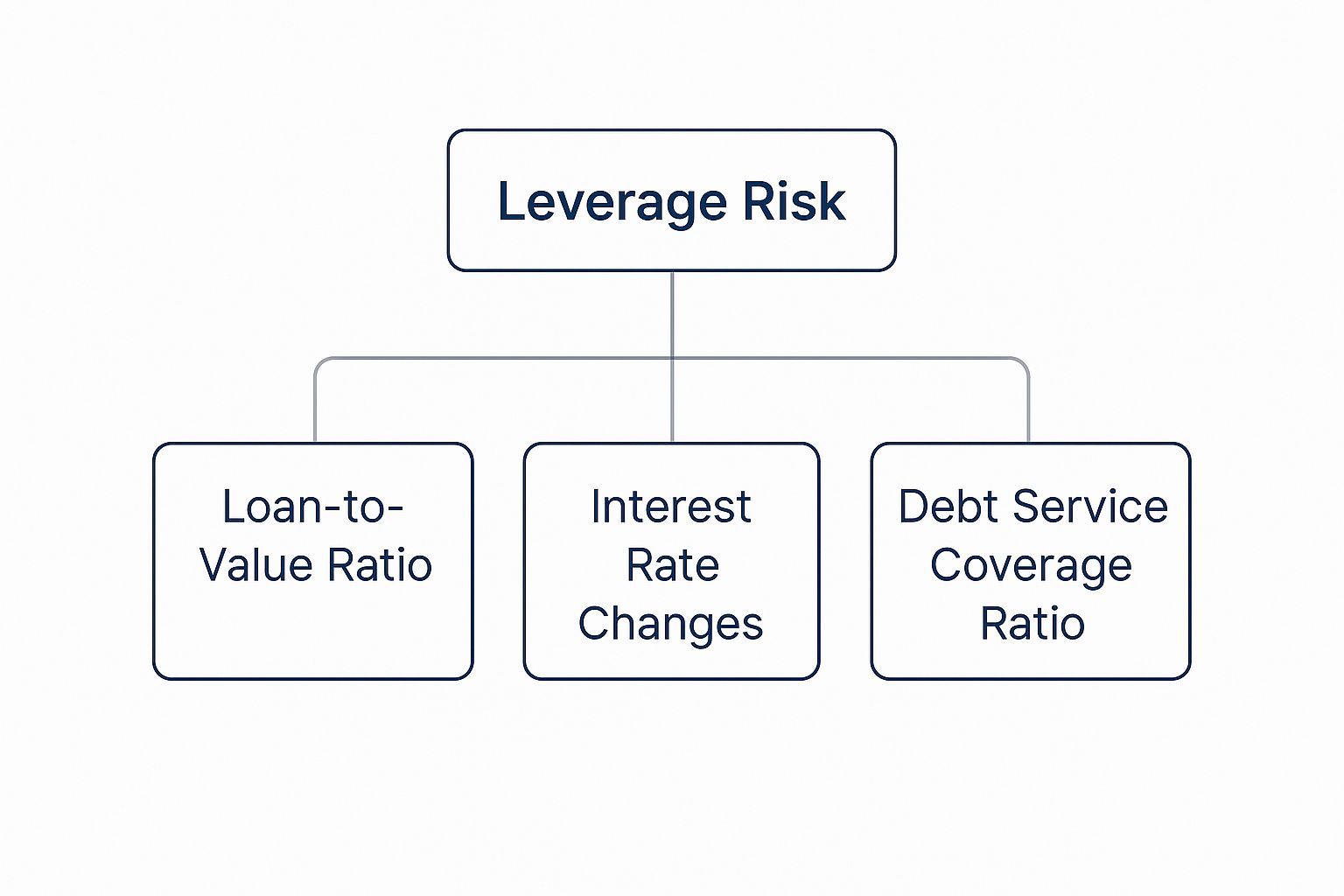
Leverage & Structural Risks: The complexities of financing, illiquidity, and the fine print in your partnership agreement.
Ignoring these factors can be devastating. Research from Alliance an indicates that many real estate ventures fail within five years due to poor market analysis and an inability to adapt to changing economic conditions. You can learn more about navigating these common hurdles at alliancecgc.com. By deconstructing each risk and its mitigants, you'll gain the confidence to identify strong opportunities and partner with sponsors who truly know how to manage them.
Decoding Market and Economic Headwinds
Real estate does not exist in a vacuum. No matter how perfectly a property is managed, it’s anchored to the larger economic currents that dictate its value and cash flow. These market and economic forces are among the most significant real estate investment risks because they are largely outside of an investor's direct control. Think of a well-run apartment building as a sturdy ship and the sponsor as its captain. The weather—the economic climate—can turn a smooth sail into a storm. Factors like recessions, inflation, and interest rate hikes are the powerful winds every captain must navigate.
The Macroeconomic Trio
Three major economic factors can profoundly impact a real estate deal. Understanding how they interact is essential, whether you're a new investor or a seasoned professional assessing a property's resilience.
Interest Rate Sensitivity: When the Federal Reserve raises interest rates to cool the economy, borrowing becomes more expensive. This directly impacts real estate by increasing mortgage payments on new acquisitions and making it harder to refinance existing debt, which can severely squeeze cash flow.
Inflation Dynamics: While real estate is often considered an effective hedge against inflation (as rents and property values tend to rise), runaway inflation drives up operating costs. Everything from property taxes and insurance to repair materials and utility bills becomes more expensive, eroding your net operating income (NOI).
Business Cycles and Recessions: Economic downturns lead to job losses and reduced consumer spending. This translates directly to weaker demand for real estate—companies lease less office space, families delay home purchases, and shoppers cut back, hurting retail tenants.
Navigating these currents requires foresight and a deep understanding of on-the-ground market dynamics. For a deeper dive into how these factors are shaping today's landscape, explore our analysis on the challenges confronting commercial real estate investors.
Local Market Forces: Supply and Demand
Beyond the national economy, what’s happening just outside a property’s front door is equally critical. The fundamental law of supply and demand is the ultimate arbiter of a property's success. If a city experiences a flood of new apartment construction but job growth remains flat, vacancies will rise and rents will fall—no matter how attractive your building is.
Key local drivers to monitor include:
Demographic Shifts: Is the population growing or shrinking? Are young professionals moving in, or is the area aging? These trends shape demand for different property types.
Job Growth and Industry Concentration: A market with diverse, expanding industries is far more resilient than a town dependent on a single employer that could relocate.
New Construction Pipeline: A prudent sponsor always monitors what’s being built. Being caught in a wave of new supply can suppress your property's performance.
Novice Lens: Why It MattersImagine opening a coffee shop. If you set up on a busy street with no other cafes (high demand, low supply), you’ll likely thrive. But if three more coffee shops open on your block next month (high supply), you'll have to compete for every customer, possibly by cutting prices. Real estate operates on the same principle.
Market Signal Box: Interpreting Capital Flows (as of Q4 2023)
Reading the market's mood is key. According to JLL's Global Real Estate Perspective (Q4 2023), global real estate investment volumes have moderated as investors adapt to higher financing costs and economic uncertainty. Transaction volumes dipped as buyers and sellers worked to bridge valuation gaps. The performance across sectors tells the real story: while logistics and necessity-based retail held up, office and discretionary retail saw significant declines. This highlights that risk and opportunity are now hyper-specific to property type and location.Investor Take: This data confirms that a "spray and pray" approach is obsolete. Success now requires a disciplined, sector-specific strategy focused on assets with strong, defensible demand drivers that can withstand economic ambiguity.
Managing Property and Operational Risks
Moving from the 30,000-foot view of market cycles, let's zoom in on the risks that exist within the property lines themselves. These are the tangible, day-to-day operational risks that determine whether a property generates consistent cash flow or becomes a constant drain on resources. Successfully navigating these ground-level challenges is what separates professional operators from amateurs.
The Ground-Level Challenges
Operational risk encompasses everything from keeping the lights on to keeping the building full. The most common hurdles are tenant issues, unexpected maintenance, and inefficient management.
Risk: Tenant and Vacancy * Impact: The lifeblood of any property is its rent roll. Tenants who don't pay and empty units that generate zero income directly reduce cash flow. High turnover also racks up costs for marketing, leasing commissions, and unit preparation. A seemingly small 5% increase in vacancy can derail a deal's financial projections. * Mitigation: Rigorous tenant screening (credit, income, background checks), clear lease enforcement policies, and proactive tenant retention programs.
Risk: Capital Expenditure (CapEx) Surprises * Impact: Every building eventually needs a new roof or HVAC system. If a sponsor hasn't properly budgeted for these big-ticket items, it can trigger a surprise capital call or force the property to take on more debt, eroding investor returns. * Mitigation: A detailed Physical Condition Report before acquisition, followed by a well-funded, consistently updated CapEx reserve budget.
Risk: Management Inefficiency * Impact: This is a fast track to failure. Poor management leads to slow leasing, uncontrolled expenses, and neglected maintenance that angers tenants and damages the property's reputation. * Mitigation: Partnering with in-house or third-party management with a proven track record, clear Key Performance Indicators (KPIs), and regular, transparent reporting.
This is where understanding lease structures is critical. A Triple Net (NNN) lease, common in commercial properties, shifts the burden of taxes, insurance, and maintenance to the tenant, insulating the owner from many operational cost surprises. Conversely, a Gross lease, typical in multifamily, leaves the owner responsible for all operating expenses, creating more potential for cash flow volatility.
What Are CapEx Reserves?Think of CapEx reserves as a dedicated savings account for a property's major repairs. Just as you'd set aside money for a new transmission in your car, a prudent sponsor allocates a portion of monthly income to cover future big-ticket items. A properly funded reserve ensures the property can handle major repairs without the sponsor unexpectedly asking investors for more money.
Investor Checklist: Questions to Ask a Sponsor
Evaluating a sponsor’s operational playbook is non-negotiable. Their answers reveal their competence. For a complete overview, see our guide to commercial real estate due diligence.To start, here are five essential questions to ask any sponsor:
Tenant Screening: "What is your exact process for qualifying new tenants? What are your minimum credit and income requirements?"
Preventative Maintenance: "Can you show me your schedule for preventative maintenance on major systems like HVAC, roof, and elevators?"
Capital Planning: "How do you determine your CapEx budget and ongoing reserves? Is it based on a professional physical condition report?"
Reporting: "What specific performance metrics do you track, and how often will I receive detailed performance reports?"
Contingency Plans: "What is your plan if a major tenant defaults or if vacancies spike higher than projected?"
Navigating Leverage and Structural Complexities
Beyond market trends and building operations, the financial and legal structure of a deal is where serious risks can hide. Concepts like leverage and illiquidity aren't just details; they are fundamental tools used to generate attractive returns. Understanding how they can both help and hurt you is crucial.
Many investors new to private real estate view illiquidity (the inability to sell an asset overnight) as a major negative. But for institutional investors, it's a feature, not a bug. This lack of daily pricing is the trade-off for earning a potential premium over public equities. A long-term hold gives a great sponsor the time needed to execute a business plan and create real value, insulated from the daily volatility of the stock market.
The Power and Peril of Leverage
Leverage is the rocket fuel of real estate. Using debt allows you to control a much larger asset than your cash alone could, amplifying potential returns. However, it's a double-edged sword. When a property's performance declines, that same leverage magnifies losses just as quickly.
This is where financing risk becomes a real threat. A deal that pencils out beautifully with a 3% interest rate can become a financial burden if it needs to be refinanced when rates are at 7%. Suddenly, the property’s income might not be enough to cover the new, higher mortgage payments, potentially triggering a cash flow crisis or even foreclosure. For a deeper dive into your options, check out our guide to commercial real estate financing options for investors.
Deal Lens Example: The Leverage Magnifier (Illustrative)Imagine a $10 million property purchase.* Scenario A (All Cash): You invest $10 million in equity. The property value increases by 10% to $11 million. You've made $1 million on your $10 million investment—a 10% cash-on-cash return.* Scenario B (With Leverage): You invest $3 million of equity and secure a $7 million loan. The property value still increases by 10% ($1 million profit). You've made that same $1 million profit but on only a $3 million investment. That’s a 33.3% return.That’s the magic of leverage. But now consider a 10% drop in value. In Scenario B, the $1 million loss erodes one-third of your $3 million equity base.
Understanding Structural and Legal Risks
The legal fine print is in the partnership agreement, which governs the relationship between you (the Limited Partner or LP) and the sponsor (the General Partner or GP). Skimming these documents is a rookie mistake.
Key structural risks to watch for in the operating agreement or private placement memorandum (PPM):
Capital Call Provisions: This clause gives the sponsor the right to demand more capital from you if the project encounters issues like budget overruns. If you are unable to contribute, you could face severe penalties, including dilution of your ownership stake.
Sponsor Fees and Promote Structure: The "promote" is the sponsor's share of the profits after investors receive their initial investment and a preferred return. An overly aggressive promote can incentivize the sponsor to take excessive risks to reach their payday, even if it's not in the investors' best interest.
Governance and Control: As a passive investor, you are ceding control to the sponsor. You must understand what major decisions, if any, require investor approval. A well-structured deal has clear guardrails to protect investors from unilateral decisions that could jeopardize the investment.
Building a Resilient Portfolio in Uncertain Times
Understanding the different types of real estate investment risks is step one. Step two is building a strategy that can not only weather market storms but potentially profit from them. A resilient portfolio isn’t about sidestepping risk entirely—that’s impossible. It's about making disciplined choices grounded in solid fundamentals.
The Shift to Durable Income Streams
In a world of geopolitical friction and unpredictable interest rates, stable cash flow is king. According to analysis from PIMCO, today's sharpest investors are shifting from broad market bets toward a focused hunt for assets with rock-solid, defensible income streams that perform even when the economy slows. The key is to find property types where demand is tied to fundamental needs, not economic whims. You can get more insights on this strategic pivot over at pimco.com.
Insight Edge: Pricing Risk, Not Fearing ItOur philosophy is simple: risk isn't something to avoid. It’s a characteristic of an asset that needs to be understood, underwritten, and priced into the deal. An experienced operator sees a property with fixable problems not as a lemon, but as an opportunity to acquire an asset below its potential value and create upside through strategic management.
Sectors Demonstrating Proven Resilience
While no asset class is bulletproof, some sectors have proven resilient because their demand drivers are non-negotiable.
Logistics and Industrial: As the engines of e-commerce, the demand for warehouses and distribution centers continues to grow with the need for efficient supply chains.
Multifamily Housing: Shelter is a basic need. Apartments, particularly those aimed at the workforce and middle-income renters, tend to maintain stable occupancy.
Digital Infrastructure: This is the physical backbone of our online world, including data centers and cell towers. The demand for data and connectivity is relentless and largely insulated from traditional economic cycles.
Necessity-Based Retail: Grocery-anchored shopping centers and pharmacies sell essential goods, ensuring consistent foot traffic and reliable rent payments.
The Central Role of a Quality Sponsor
After all the analysis, we land on the single most important factor in managing real estate investment risk: the sponsor. When you invest passively, you're not just buying a piece of a building; you are backing the expertise, integrity, and discipline of the team managing it. A top-tier sponsor is your partner, turning abstract risks into managed outcomes. Conversely, a weak or misaligned sponsor can run a great property into the ground.
An institutional-grade sponsor's interests are fundamentally aligned with yours. Look for sponsors who invest a significant amount of their own capital into the deal—this ensures they have real skin in the game alongside you.
Investor TakeawayThe quality of your sponsor is the ultimate risk shield. Their ability to underwrite conservatively, execute a business plan efficiently, and communicate with total transparency is what transforms a bundle of property-level risks into a resilient, professionally managed investment.
Choosing the right partner closes the gap between theory and reality. With a skilled and trustworthy team, a well-structured real estate deal can be a prudent and resilient cornerstone of a long-term wealth strategy.
Answering Your Top Questions About Real Estate Investment Risks
What Is the Single Biggest Risk for a Passive Real Estate Investor?
While market downturns grab headlines, the single biggest—and most controllable—risk for a passive investor is Sponsor Risk. Your investment's success is entirely in the hands of the sponsor. If you partner with a sponsor who has a weak track record, misaligned interests, or lacks transparency, you can lose capital even in a strong market. Your due diligence on the sponsor is as critical as your diligence on the property itself.
How Does Inflation Affect Real Estate Investments?
Inflation is a classic double-edged sword. On one hand, it drives up operating costs like utilities, insurance, and materials, which can erode net income. On the other hand, real estate is widely regarded as an effective inflation hedge. Rents, especially in sectors with shorter lease terms like multifamily, can be adjusted to keep pace with rising costs. Furthermore, as inflation increases the cost to build new properties, the value of existing assets often rises.
Is Diversification Enough to Mitigate All Real Estate Risks?
Diversification is a powerful and essential tool, but it is not a panacea. Spreading investments across different property types (e.g., industrial, multifamily), geographies, and strategies (e.g., core, value-add) is a cornerstone of smart portfolio construction. However, diversification cannot protect you from systemic risks that impact the entire market, like a deep recession or a global credit crisis. A robust risk strategy combines smart portfolio diversification with partnerships with top-tier sponsors who employ conservative underwriting and maintain strong operational controls.
At Stiltsville Capital, we pair disciplined underwriting with deep market expertise to manage risk and unlock value. To discuss how our institutional-grade strategies can fit within your portfolio, schedule a confidential call.
Information presented is for educational purposes only and does not constitute an offer to sell or a solicitation of an offer to buy securities. Any offering is made only through definitive offering documents (e.g., private placement memorandum, subscription agreement) and is available solely to investors who meet applicable suitability standards, including “Accredited Investor” status under Rule 501 of Regulation D. Investments in private real estate involve risk, including loss of capital, illiquidity, and no guarantee of distributions. Past performance is not indicative of future results.
Comments