


A Guide to Valuation Methods in Real Estate for the Modern Investor

Reading Time: 8 min | Good for: Novice Investors (A), Family Offices (B)
TL;DR: Your Quick Guide to Property Valuation
Valuation is Strategy: Accurately determining a property's worth isn't just an academic step; it's the foundation of every smart investment decision, influencing your offer, financing, and potential returns.
The Three Core Methods: Investors use a triangulated approach: the Sales Comparison Approach (what similar properties sold for), the Income Approach (how much cash it generates), and the Cost Approach (what it would cost to build from scratch).
Income is King for Commercial Assets: For income-producing properties like multifamily, data centers, or medical offices, the Income Approach—using tools like the Cap Rate and Discounted Cash Flow (DCF) analysis—is the most critical valuation lens.
Stress-Test Everything: A sophisticated investor's job is to challenge the assumptions behind any valuation. Ask tough questions about comps, cap rates, and growth projections to understand the true risk profile of a deal.
Why-Now: The Market Context for Savvy Investors
In today's dynamic market, a disciplined approach to valuation is more critical than ever. According to CBRE's 2024 U.S. Real Estate Market Outlook, while transaction volumes have moderated, well-capitalized investors are actively seeking opportunities where value is clear and defensible. This environment rewards investors who can look past market noise and identify assets priced below their intrinsic, income-generating potential. Furthermore, a recent survey by UBS Global Family Office Report noted that a significant portion of family offices plan to maintain or increase their real estate allocations, signaling continued confidence in the asset class for long-term wealth preservation.
Why Accurate Property Valuation Is Your North Star
Figuring out what a property is really worth is the foundation of any smart real estate investment. It's not about pulling a number out of thin air; it’s about using proven financial tools to understand an asset's true economic value. For serious investors, it all boils down to three core methods: the Sales Comparison Approach, the Income Approach, and the Cost Approach.
Getting these right isn't just a box-ticking exercise. It's the mechanism that informs your offer, helps you secure better financing, and provides a rock-solid position at the negotiating table. A valuation isn’t just a number; it’s the story of where an asset is today and where it could be tomorrow, all backed by objective, market-driven data.

The Three Lenses of Real Estate Valuation
To simplify these concepts, we see them as distinct, complementary lenses. Each gives a unique perspective, and when combined, they create a complete, defensible picture of an asset's true worth.
Valuation Method | Best For | Core Principle | Key Metric |
|---|---|---|---|
Sales Comparison | Single-family homes, owner-occupied assets, land | A property is worth what similar properties recently sold for. | Price per square foot, sale price of comps |
Income Approach | Commercial properties (multifamily, office, retail, industrial) | A property's value is tied directly to the income it can produce. | Net Operating Income (NOI), Capitalization Rate (Cap Rate) |
Cost Approach | New construction, unique/special-use properties (e.g., schools, churches) | A property's value should not exceed the cost to build an equivalent. | Replacement cost minus depreciation |
Let's break down what each of these "lenses" really tells you:
The Sales Comparison Approach: This is your reality check. It grounds your analysis in what real buyers have actually paid for similar assets in the current market.
The Income Approach: This is your financial engine. It zeroes in on the property's ability to generate cash flow, making it the most important method for any commercial asset.
The Cost Approach: This is your builder's quote. It determines value based on the cost to construct a replacement, which is crucial for new developments or special-use properties.
### Novice Lens: Why This Matters to YouA rock-solid valuation directly impacts your returns, your ability to get leverage, and your power in negotiations. If you overpay, you could cripple your Internal Rate of Return (IRR) from day one. If you underestimate the value, you might walk away from a fantastic opportunity. A data-backed valuation lets you negotiate from a position of strength.
We’re going to dive deep into each of these methods throughout this guide, showing you exactly how to apply them in the real world.
Using Market Data with the Sales Comparison Approach
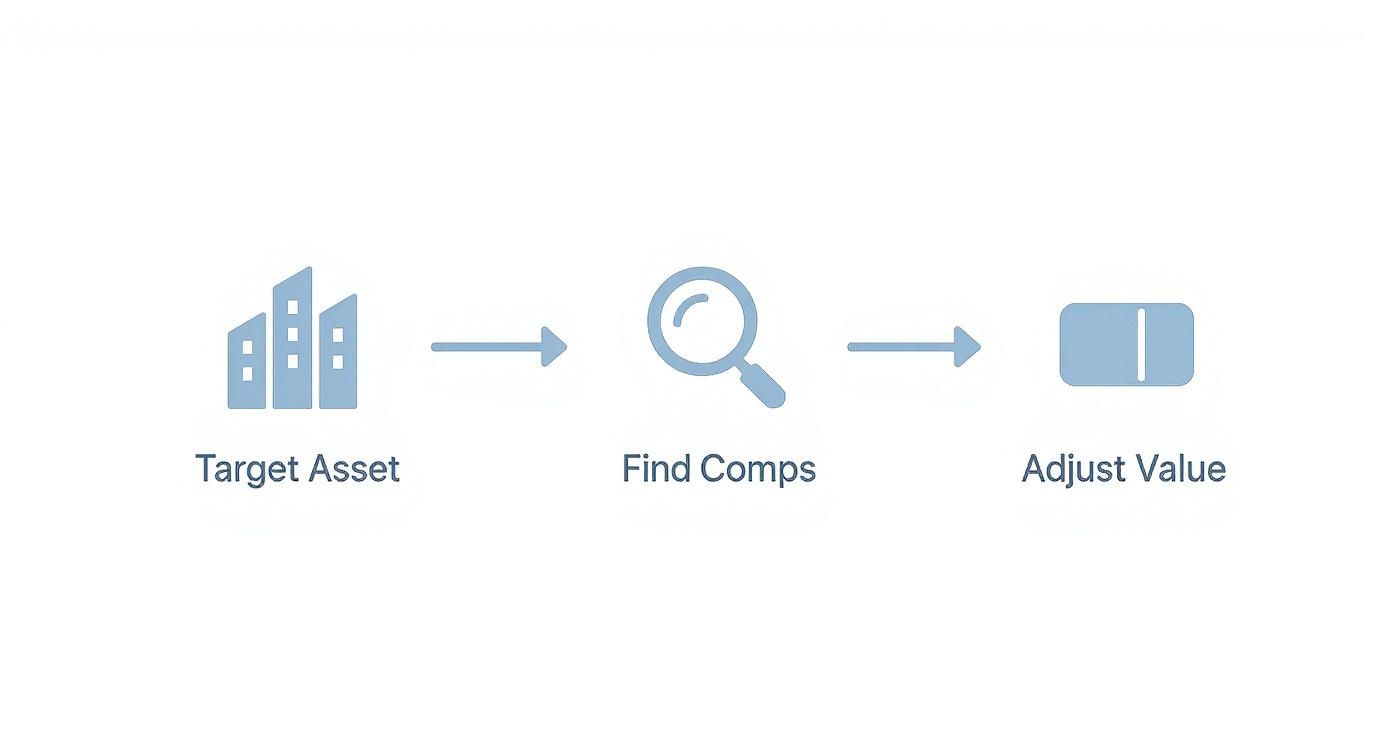
The Sales Comparison Approach, often just called the “comps” method, is the most intuitive way to value a piece of real estate. It’s built on a simple, powerful idea: a property is worth what someone else just paid for a similar one nearby.
While this is the same gut-check logic used to price a single-family home, applying it to commercial real estate involves higher stakes and requires a far more rigorous analysis. The real art isn't just finding recent sales; it's about meticulously quantifying the differences between properties.
Selecting Truly Comparable Properties
The first and most critical step is hunting down a set of recently sold properties that are as close a match as possible to your target asset (the "subject property"). A truly comparable property isn’t just in the same city; it has to share the fundamental DNA that drives its value.
Here's what to look for in a strong comp:
Property Type and Use: Compare an industrial warehouse to other warehouses, not to the retail strip mall down the street.
Location and Submarket: A property in a bustling downtown core is playing a different game than one in a quiet suburban office park.
Size and Unit Mix: Look for similar square footage. For a multifamily building, you need a similar mix of one-bedroom and two-bedroom units.
Age and Condition: A brand-new, Class A building can't be put side-by-side with a 30-year-old Class C asset without massive adjustments.
Sale Date: The more recent, the better. Ideally, comps should have closed in the last three to six months.
Finding good comps means digging into data from platforms like CoStar and CREXi, layered with local broker intelligence. This is where a deep understanding of how to find undervalued real estate markets for smart investing can give you a serious edge.
The Art of Making Defensible Adjustments
No two commercial properties are identical. The core of the Sales Comparison Approach is adjusting the sale prices of your comps to account for these differences, working toward a solid value for your subject property.
Investor Takeaway: Adjustments are where deals can get fuzzy and disciplined underwriting shines. Every adjustment must be backed by a clear, data-supported reason. If a comp has better amenities, you need to prove how much those amenities are worth in your market—not just guess.
Common adjustments are made for factors like location, physical features (e.g., a modern fitness center), economic characteristics (e.g., a long-term, credit-worthy tenant), and conditions of sale (e.g., an "arm's-length" deal vs. a distressed sale).
Mastering Income Valuation with Cap Rate and DCF Analysis
When you're dealing with commercial real estate, the property's income stream is its beating heart. Assets like apartment buildings, data centers, and medical offices are valued almost entirely on their ability to generate cash flow.
This is where the Income Approach to valuation shines. The two workhorses of this approach are Direct Capitalization (using the Cap Rate) and Discounted Cash Flow (DCF) analysis.
The Direct Capitalization Method: A Market Snapshot
Direct Capitalization is a quick way to translate a property’s annual income into its current market value. It's the go-to method for an immediate snapshot of how the market is pricing assets based on what they earn right now.
The formula boils down to two key inputs:
Net Operating Income (NOI): The property's total income after all operating expenses, but before debt service and income taxes.
Capitalization Rate (Cap Rate): The expected rate of return on a property based on its income. It’s a market sentiment gauge; a low cap rate means buyers are willing to pay more for each dollar of income.
The formula is beautifully simple:
Property Value = Net Operating Income (NOI) / Capitalization Rate (Cap Rate)
If your asset generates $500,000 in NOI and similar buildings are trading at a 5% cap rate, your property is worth about $10 million ($500,000 / 0.05). But if the market gets nervous and the cap rate rises to 6%, that same property is suddenly valued closer to $8.33 million.
The Discounted Cash Flow Method: The Forward-Looking View
The cap rate gives you a picture of today, but what about tomorrow? Sophisticated investors need a tool that looks down the road. That’s where Discounted Cash Flow (DCF) analysis comes in. DCF projects a property’s cash flows over a longer holding period—usually 5-10 years—and then discounts them back to what they’re worth in today's dollars.
This method is more involved, but it gives you a much richer picture of a property's long-term potential. It’s essential for value-add or development projects where income is expected to change dramatically.
A solid DCF analysis has a few key ingredients:
Projecting Future Cash Flows: Forecasting NOI for each year of the hold period, making assumptions about rent growth, vacancy, and expenses.
Choosing a Discount Rate: This rate reflects the deal's risk and the time value of money.
Calculating a Terminal Value: Estimating the sale price at the end of the hold period, typically using a future "exit cap rate."
Summing It All Up: Each year's projected cash flow and the final sale proceeds are discounted back to their present value and added together.
Because it relies heavily on assumptions, DCF is both an art and a science. The cap rate approach is fantastic for stable properties, while DCF is powerful but data-intensive. For more on these valuation dynamics from NYU Stern, their breakdown is excellent.
If you want to go deeper, check out our guide on how to calculate a discounted cash flow for real estate success.
### Advanced Lens: The Power of Sensitivity AnalysisFor institutional investors and family offices, a single DCF number isn't enough. The real insight comes from sensitivity analysis. This involves creating a table that shows how the property's value changes as you tweak key assumptions, like rent growth and the exit cap rate. By modeling a "Base Case," "Downside Case," and "Upside Case," you can stress-test the deal's resilience and quantify its true risk-reward profile. It elevates the conversation from "What's it worth?" to "What could it be worth, and what has to go right (or wrong) to get there?"
Understanding When to Use the Cost Approach
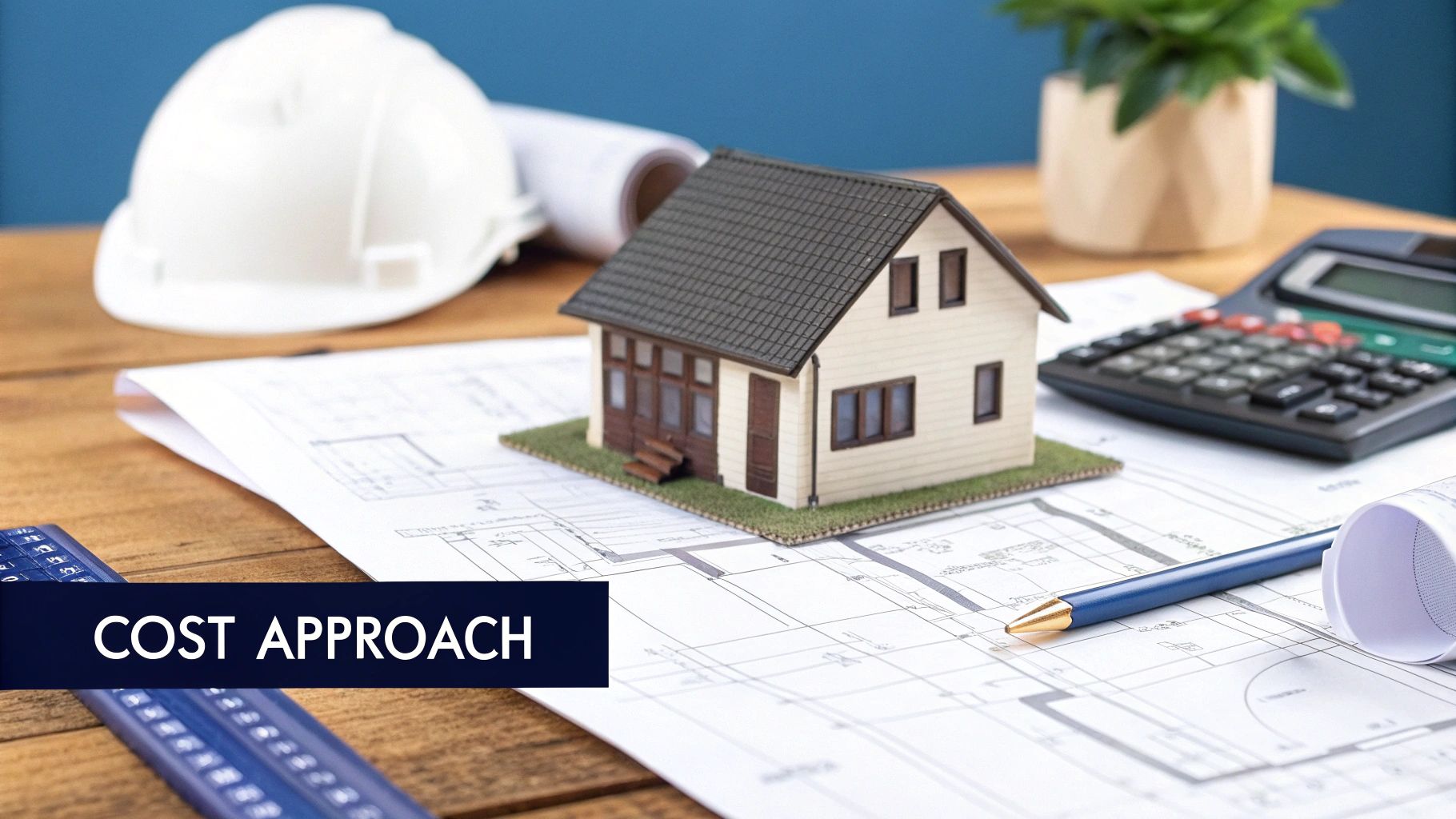
Of all the valuation methods, the Cost Approach is the most specialized. It is based on a single, fundamental idea:
A smart buyer will never pay more for a property than it would cost to build an equivalent one from the ground up.
This isn't your go-to method for a typical apartment complex. Instead, it's a critical tool for specific situations where comps and income numbers don't exist or don't make sense. It effectively puts a logical ceiling on a property's value.
Core Components of the Cost Approach
The formula is straightforward:
Property Value = Land Value + (Replacement Cost – Accumulated Depreciation)
Let's break down each ingredient:
Land Value: What the land would be worth if vacant, typically found by looking at recent sales of similar lots.
Replacement Cost: The estimated cost to construct a building with the same function using current materials and standards.
Accumulated Depreciation: The total loss in value from all causes, which is the trickiest part to determine.
Depreciation isn't just about wear and tear. It comes in three flavors:
Physical Deterioration: Tangible breakdown, like a leaky roof or an old HVAC system.
Functional Obsolescence: Outdated design, like an office with a maze of tiny rooms instead of an open layout.
External Obsolescence: Loss in value from factors outside the property lines, like a new noisy highway or a major local employer shutting down.
The Cost Approach shines for unique properties like schools or churches and is a must-do for any developer's feasibility analysis. If the cost to build is higher than the market value of the finished product, the project is a non-starter.
An Investor Checklist for Stress-Testing Valuations
Knowing the different valuation methods real estate pros use is one thing. Knowing how to poke holes in a sponsor’s pro forma is another. As an investor, your job is to shift from a passive audience to an active partner.
This checklist provides a framework for that critical due diligence, ensuring the sponsor’s discipline is as sharp as your own.

Questions to Ask a Sponsor About Their Valuation
A great sponsor will welcome these questions and have data-backed answers ready.
How were the sales comps selected? Ask to see the full list and question why certain recent, nearby sales might have been excluded.
What specific adjustments were made to the comps? Dig into the logic behind a +15% adjustment for location or a -10% for age. The reasoning must be clear.
How did you land on the proposed cap rate? The sponsor must justify their chosen rate with recent, comparable sales data from the submarket.
What are the key assumptions driving the DCF model? Zero in on projected annual rent growth rates. How do they stack up against historical trends and third-party forecasts?
What is the exit cap rate assumption, and why? A common mistake is assuming the exit cap rate will be the same or lower than the entry rate. A more prudent approach often assumes a slightly higher cap rate at sale to build in a margin of safety.
How were operating expense projections created? Are they based on the seller’s historicals or completely re-underwritten? For more, see our guide on how to find Net Operating Income for real estate investors.
Does the valuation line up with the business plan? If it’s a value-add deal, does the "as-stabilized" valuation realistically reflect the planned improvements and expected rent bumps?
Building Your Portfolio on a Foundation of Smart Valuation
Ultimately, figuring out what a property is really worth is part science, part art. The most successful investors, from family offices to large institutions, know that no single number tells the whole story. They pull insights from every angle to build a complete, multi-dimensional view of an asset’s value.
This disciplined, triangulated approach is the absolute bedrock of any resilient real estate portfolio. It’s what gives you the confidence to preserve wealth, generate consistent cash flow, or build a strong hedge against inflation. A solid grasp of these valuation methods is your best defense against risk.
From Theory to Action
No investment is a sure thing. But a robust valuation process ensures you're making decisions based on diligent analysis, not market hype. It turns you from a passive price-taker into an informed investor who can spot real value and negotiate from a position of strength.
The Investor Takeaway: Mastering these valuation principles is key to unlocking better, risk-adjusted returns. It gives you the power to see past the glossy pro forma and truly understand what makes a deal tick, ensuring your capital is put to work intelligently for the long haul.
At the end of the day, building a lasting portfolio comes down to making one smart decision after another. That journey always starts with a clear, honest, and comprehensive answer to a simple question: What is it really worth?
An Investor's FAQ on Real Estate Valuation
How Do You Choose the Right Valuation Method?
It's rarely about picking just one. The best approach is tied to the property type and available data.
Sales Comparison Approach: Best for properties with plenty of recent, similar sales (e.g., standard warehouses, condos).
Income Approach: Essential for any asset that generates rent (e.g., apartment buildings, data centers).
Cost Approach: Reserved for unique assets where good sales or income data is unavailable (e.g., a new build, a church).
What Is the Difference Between As-Is and As-Stabilized Value?
This distinction is critical for value-add and opportunistic real estate.
'As-Is' Value is what a property is worth today, in its current condition. It’s your starting line.'As-Stabilized' Value is the projected value after the business plan is executed—renovations are complete, and occupancy has reached a normal market level. It's the finish line.
Why Do Different Appraisers Arrive at Different Values?
Valuation is a blend of science and art, so professional judgment always comes into play. Even with the same data, two qualified appraisers can arrive at different numbers because they might:
Select a different set of comparable properties.
Apply different values to adjustments for location, age, or amenities.
Use slightly different assumptions for rent growth or exit cap rates in a DCF model.
This is why sophisticated investors look at multiple valuation methods real estate pros use and often get a second opinion to establish a credible value range, not just a single number.
Take the Next Step
At Stiltsville Capital, we believe a disciplined, multi-faceted valuation process is the cornerstone of successful investing. If you're ready to explore how our institutional-grade underwriting can help you achieve your portfolio goals, we invite you to connect with our team.
Information presented is for educational purposes only and does not constitute an offer to sell or a solicitation of an offer to buy securities. Any offering is made only through definitive offering documents (e.g., private placement memorandum, subscription agreement) and is available solely to investors who meet applicable suitability standards, including “Accredited Investor” status under Rule 501 of Regulation D. Investments in private real estate involve risk, including loss of capital, illiquidity, and no guarantee of distributions. Past performance is not indicative of future results.
I remember panicking when I had an SPSS deadline approaching and still wasn’t confident about interpreting the output. There were so many tables and values that I wasn’t sure which ones were important enough to include. Someone mentioned SPSS Assignment Help Online during our course discussion, but what helped most was focusing on the results that directly answered the research question rather than trying to explain everything.