


Finding Undervalued Real Estate Markets for Smart Investing

Reading Time 6 min | Good for: A, B
TL;DR
The Opportunity: Undervalued markets offer higher appreciation potential and better yields because property prices haven't caught up to strong economic fundamentals and growth catalysts.
Who Should Care: Sophisticated investors, family offices, and wealth advisors seeking to diversify portfolios and generate alpha through disciplined, data-driven real estate strategies.
The Path Forward: The key is a repeatable framework combining quantitative metrics (cap rates, replacement cost) with qualitative, "boots-on-the-ground" intelligence to avoid value traps and unlock hidden potential.
Spotting an undervalued real estate market feels like finding a hidden gem. It’s a location where property prices haven't quite caught up to the area's real economic muscle and its trajectory for growth. This isn't just about finding something "cheap"; it's about seeing a disconnect between how the market views a place today and where the data says it’s heading tomorrow. For investors, this gap is the entry point.
Beyond Headlines: Uncovering Opportunity in Overlooked Markets
For savvy investors and family offices, the real wins often come from looking past the crowded, headline-grabbing markets. The goal is to find those overlooked areas where disciplined, data-first analysis uncovers a growth story the rest of the market hasn't priced in yet.
Think of it like being a scout who drafts a future all-star in the early rounds. The player's current stats might not be flashy, but all the fundamentals point to a breakout performance down the line. It’s about investing in that future potential, not just reacting to today’s trends.
Why This Matters for Your Portfolio
Pinpointing these markets is a cornerstone of any smart real assets strategy. It unlocks several key advantages:
Higher Potential for Appreciation: When you buy below what a property is truly worth, you create a much wider runway for capital growth as the market eventually catches on.
Enhanced Yields: Since the initial buy-in is lower, you can often secure far more attractive cash-on-cash returns and cap rates compared to overheated primary markets.
Favorable Cost Basis: Getting into a market before it’s on everyone’s radar helps protect your portfolio from the intense pricing pressure that comes with a flood of institutional capital.
This disciplined approach means tuning out the noise and focusing on the real signals—both quantitative and qualitative—that drive long-term value. As we dig into in our guide to the best markets for real estate investment, a winning strategy is always built on rigorous, forward-looking analysis.
To help you start spotting these signals, here’s a quick-reference table outlining the key indicators we watch for.
Table: Key Indicators of an Undervalued Market
This table summarizes the primary signals that suggest a real estate market may be undervalued relative to its future potential.
Indicator Type | Metric to Watch | Why It Matters for Investors |
|---|---|---|
Economic Growth | Job Growth Rate (especially in high-wage sectors) & GDP Growth | A growing economy means more people with more money, fueling demand for all types of real estate. |
Demographics | Population Growth & Net Migration | More people moving in than out is a direct signal of rising housing and commercial space demand. |
Affordability | Rent-to-Income Ratio & Price-to-Income Ratio | Markets where costs are still reasonable for residents have room for rents and values to grow sustainably. |
Development Pipeline | Low Levels of New Construction vs. Demand | When supply isn't keeping up with population and job growth, existing properties become more valuable. |
Market Perception | Lack of National Headlines or "Hype" | "Boring" markets often hide the best opportunities before institutional capital drives up prices. |
Watching these metrics together gives you a much clearer picture of a market’s trajectory than just looking at property prices alone.
The Current Market Window: A Why-Now Moment
The recent shake-up in the economy has opened a unique window for sharp investors. While financing uncertainty has kept transaction volumes low, it has also pushed down prices in markets that are otherwise fundamentally strong.
A recent MetLife Real Estate Outlook (as of Q2 2024) noted that property values appear to have bottomed out. The report pointed out that key cities like San Francisco and San Jose were showing higher cap rates, a classic sign of potential undervaluation compared to their long-term norms. This environment is perfect for investors who know how to underwrite a deal based on solid, durable demand—not cheap debt or market hype.
Building Your Framework for Identifying Market Value
Spotting a genuinely undervalued market isn’t about stumbling upon a cheap listing. It’s about building a repeatable, institutional-grade framework that blends hard numbers with what’s happening on the ground. This disciplined approach is what separates a speculative gamble from a strategic, forward-looking acquisition.
The whole process kicks off with quantitative analysis. We have to start with the objective, measurable data to get a clear baseline of a market’s health and current pricing. It’s all about letting the numbers tell the first chapter of the story.
Mastering the Quantitative Metrics
These are the key financial vitals we check to find gaps between a property's asking price and what it’s fundamentally worth.
Cap Rate Spreads: The capitalization rate—a property's net operating income (NOI) divided by its price—is a classic. But we look at the "spread," or the difference, between today's cap rates in a target market and their historical averages. A spread that’s wider than usual can be a flashing sign that assets are trading at a discount to their real earning power.
Replacement Cost Analysis: This one is huge. We calculate what it would cost to build a similar property from scratch today—land, labor, materials, everything. If you can buy an existing building for far less than its replacement cost, you've got a powerful built-in margin of safety. It's a foundational value proposition.
Price-to-Rent Ratios: While often used in residential, the concept is just as relevant for commercial assets. It compares median property prices to median annual rents. A lower ratio, especially when stacked against other markets or its own history, suggests it’s more attractive to buy than rent, hinting at future upward pressure on property values.
Sourcing Credible Data
A solid framework is only as good as the data you feed it. For the kind of analysis we do, we stick to a handful of trusted, institutional-quality sources:
CoStar: The industry standard for comprehensive data on commercial real estate deals, listings, and deep market analytics.
CBRE and JLL: These global powerhouses publish incredible market reports and research, giving us the macroeconomic context and forecasts we need.
U.S. Census Bureau: This is the ultimate source for the demographic data—population growth, income levels, migration patterns—that fuels long-term demand.
Getting a handle on these metrics is fundamental to any serious analysis. For a deeper dive, check out our guide to real estate property valuation methods for investors, which breaks these concepts down even further.
This simple flowchart shows how we distill this data into a clear, three-step process to find and act on value.
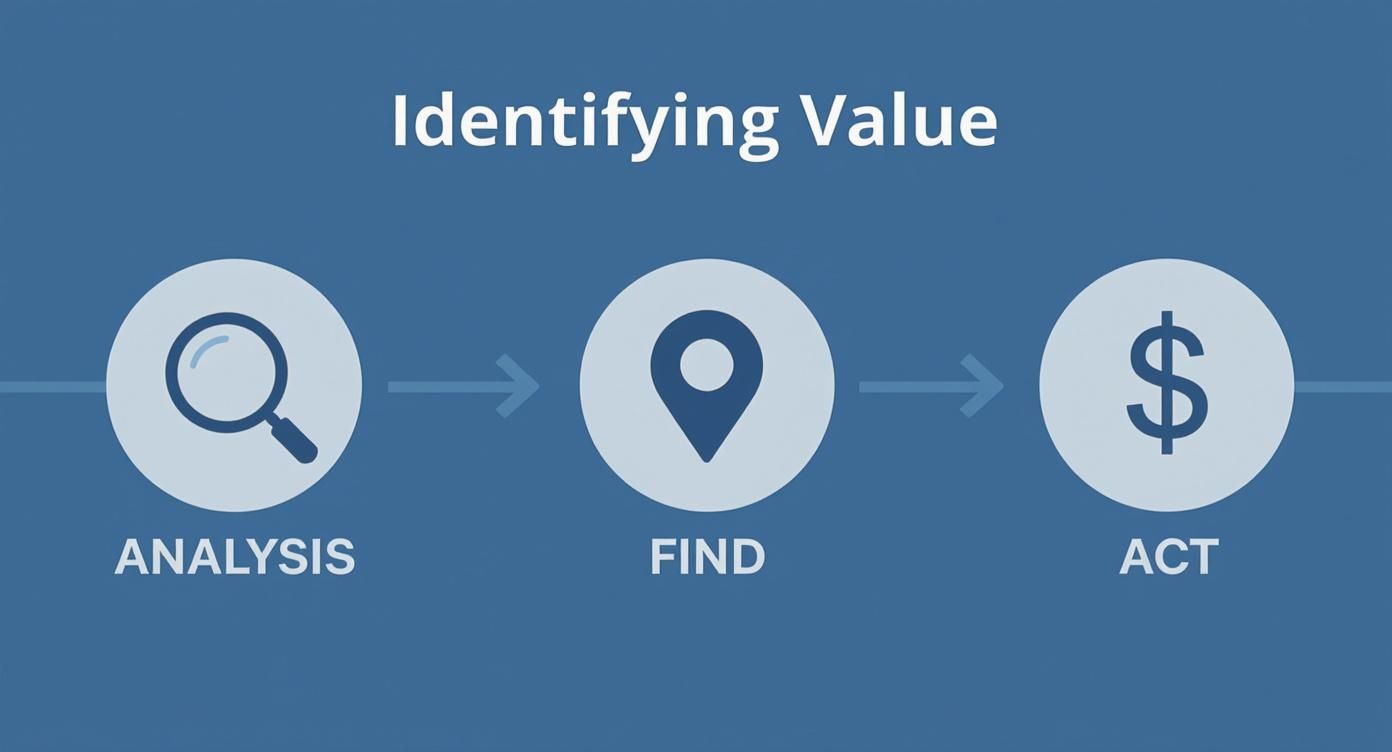
It’s a simple workflow that keeps our strategy focused: Analyze the data, Find the opportunity, and Act with precision.
The Art of Qualitative Analysis
But numbers alone never paint the full picture. The second, equally critical, piece of the puzzle is qualitative analysis—the kind of "boots-on-the-ground" intelligence that spreadsheets will never capture. These are the real, forward-looking signals of growth and change.
This is where we hunt for the catalysts that will unlock a market's future value. We're looking for things like:
New Infrastructure Projects: Is a new light rail line being built? A major highway expansion? An airport renovation? These projects are game-changers for connectivity and can light a fire under commercial and residential demand.
Major Corporate Relocations or Expansions: When a giant like Apple or Amazon announces a new campus, it’s not just one building. It’s thousands of high-paying jobs that create a massive ripple effect across the entire local real estate ecosystem.
Favorable Zoning Changes: We keep a close eye on municipalities that are rezoning old industrial areas for mixed-use development or increasing density allowances in growing corridors. Getting in before these changes are common knowledge is a classic value-add play.
To really nail down your framework and get an essential third-party perspective, exploring options for professional property valuation services can make all the difference.
Insight Edge: Weighing Leading vs. Lagging IndicatorsA common mistake is relying too heavily on lagging indicators, like recent comparable sales. That data only tells you where the market has been. A sophisticated investment thesis is built on leading indicators. For example, a spike in building permits (a leading indicator) is a much stronger signal of future growth than last quarter's median sales price (a lagging indicator). By focusing on catalysts like job announcements, permit velocity, and infrastructure spending, we build our thesis around where a market is headed, not where it's been.
Finding Global Opportunities in Real Estate
While we're laser-focused on high-growth U.S. markets, any serious investor knows that you can't operate in a vacuum. Looking beyond our borders isn't about distraction; it's about context. The hunt for undervalued real estate is a global game, shaped by big-picture forces like shifting interest rates and changing growth expectations.
Keeping an eye on these international trends helps validate our domestic strategies. It confirms that the principles of disciplined investing hold true everywhere. When we see similar patterns playing out in the Sunbelt and across the globe, it strengthens our conviction that we're on the right track.
A Look Across the Atlantic
Right now, Europe is telling a compelling story. After a period of fast and furious price corrections, many top-tier markets are now trading for less than their long-term intrinsic value. For investors with capital ready to go, this has created a pretty unique entry point.
The logistics sector is a perfect example. E-commerce isn't slowing down, and supply chains are constantly being reconfigured—these are durable, long-term drivers of demand. Yet, in several key European hubs, asset prices haven't quite caught up to this reality. This disconnect is exactly where savvy investors can acquire critical infrastructure at a favorable cost.
Market Signal Box: Widespread Opportunity in EuropeA recent Cushman & Wakefield European Investment Atlas dropped a bombshell: a staggering 82% of the 119 prime office, retail, and logistics markets they track are currently undervalued (as of Q1 2024). This isn't a niche opportunity; it's a widespread dislocation between current pricing and fundamental strength, signaling a great climate for smart capital.Investor Take: This confirms that pricing disconnects are a global phenomenon. The same analytical rigor used to identify value in European logistics can be applied to U.S. multifamily or industrial assets showing similar fundamentals.
Data-Driven Insights from Europe
The numbers paint a clear picture. According to that same report, the Fair Value Index for these European markets was at 91 in Q1, which basically screams "underpriced." While there are always local variations, the overall trend points to significant buying opportunities for those who know where to look.
Take Germany, for instance. Its real estate sectors went through a major repricing, and now all of its tracked markets fall into the "underpriced" category. It's a powerful reminder of how macroeconomic pressures can create value, even in one of Europe's most historically stable economies. You can dive deeper into these findings in Cushman & Wakefield's comprehensive analysis.
Applying Global Lessons to U.S. Markets
So, what does all this mean for an investor focused on the U.S.? It hammers home one of our core beliefs: value is found through disciplined analysis, not by chasing headlines.
The very same dynamics creating opportunity in European logistics—strong underlying demand and a temporary pricing disconnect—are mirrored in pockets all across the U.S., especially in sectors like multifamily and industrial.
By staying aware of the global picture, we can spot parallels and double down on our conviction in our chosen markets. The U.S. real estate market still offers unparalleled stability, scale, and liquidity, making it the premier place to apply these globally-validated principles. The key is to look past the obvious and follow the data, whether it leads to a distribution hub in Rotterdam or a multifamily development in a booming Sunbelt city.
Deal Lens Example: Unlocking Value in a Multifamily Asset
Theory and data are great, but the real magic happens when you see an investment thesis come to life. Let's step away from the spreadsheets for a moment and walk through a real-world example of a value-add multifamily deal in an undervalued real estate market—think a secondary Sunbelt city that’s humming with job and population growth.

This kind of case study shows how a disciplined team can spot an underperforming asset and create serious value through smart improvements, regardless of what the broader market is doing. It’s all about manufacturing equity at the property level.
The Opportunity: A Diamond in the Rough
Let’s call our target property "Sunbelt Commons," a 100-unit apartment complex built in the 1980s. Our analysis uncovered a classic mismatch: the neighborhood's rental demand was booming thanks to a new corporate campus, yet Sunbelt Commons' rents lagged a full 15% below market rate.
It didn't take a detective to figure out why. The units were tired, the ownership was absentee, and deferred maintenance was everywhere. This resulted in low morale among tenants and a revolving door of turnover. This is exactly the kind of operational mess we love to find—a problem that capital and hands-on management can solve.
The Value-Add Business Plan
We bought the property with a clear, three-year game plan to turn it around. The strategy wasn't overly complicated, but it demanded flawless execution.
Acquisition: We purchased the property at a price that reflected its current poor performance, giving us a favorable cost basis from day one.
Capital Improvements (CapEx): We planned a systematic renovation of unit interiors—new flooring, modern kitchens, updated bathrooms—as tenants moved out. We also budgeted for a major curb appeal boost and new community perks like a dog park and an outdoor grilling station.
Operational Overhaul: We brought in professional property management focused on keeping tenants happy and reining in costs. This also meant installing water-saving fixtures and LED lighting to trim down utility expenses.
Rent Optimization: As the newly renovated units came online, we adjusted rents to match the market rate, capturing the upside we created.
This methodical approach is what separates institutional-grade investing from guesswork. We actually break down many of these techniques in our guide covering proven strategies to add value to real estate investments.
Novice Lens: What is 'Value-Add'?Think of it like buying a classic car that runs but looks rough. The engine (the property's location and structure) is solid, but the paint is faded and the interior is shot. A value-add investor restores it—new paint job, modern interior—and sells it for a much higher price. The profit is the value they created. We do the same thing, just with buildings.Why it Matters: This strategy allows investors to "force appreciation" through operational improvements, rather than just hoping the overall market goes up. It's an active way to create equity.
The Numbers Made Simple
So, how does this strategy actually translate to the bottom line? The table below shows a simplified projection for our hypothetical 100-unit project, illustrating how targeted investments can directly boost value.
Illustrative Value-Add Multifamily Project
This simplified financial projection for a hypothetical 100-unit multifamily property in an undervalued Sunbelt market shows the impact of strategic capital improvements.
Metric | At Acquisition (Year 0) | Post-Stabilization (Year 3) | Value Creation Driver |
|---|---|---|---|
Purchase Price | $10,000,000 | N/A | Favorable entry point |
Capital Improvements | $500,000 ($5k/unit) | N/A | Modernization & amenities |
Average Monthly Rent | $1,000/unit | $1,250/unit | Renovations & market alignment |
Annual Gross Income | $1,200,000 | $1,500,000 | Rent growth |
Net Operating Income (NOI) | $600,000 | $825,000 | Income growth & expense control |
Exit Cap Rate | 6.0% (Purchase) | 5.5% (Projected Exit) | Improved asset quality |
Estimated Property Value | $10,000,000 | $15,000,000 | Forced appreciation |
As you can see, a strategic $500,000 investment led to a $225,000 increase in annual Net Operating Income (NOI). That operational improvement, combined with a slightly lower exit cap rate—which reflects the property’s now-superior condition—resulted in a $5 million jump in property value.
This is exactly how value is manufactured in undervalued assets, creating returns that aren't just dependent on good market timing.
Navigating Risks in Undervalued Markets
The thrill of the hunt is a huge part of investing, but a disciplined strategy means taking a hard look at the potential pitfalls. Let’s be clear: not every "cheap" market is a hidden gem. Some are undervalued for very good, and very persistent, reasons. Knowing the difference is what separates a smart investment from a costly mistake.
Risk & Mitigation Framework
Here’s how we think about the primary risks and the concrete steps we take to mitigate them.
RISK: The Value Trap * An asset looks cheap but has no real catalyst for growth (e.g., shrinking population, weak economy). Your capital gets stuck with no appreciation.
MITIGATION: Focus on Leading Indicators * We mitigate this through rigorous due diligence on forward-looking data: job creation trends, net migration patterns, and specific public/private investments (new transit, corporate campus) that will drive future demand.
RISK: Execution & Liquidity Hurdles * The business plan fails due to poor management (execution risk), or it becomes difficult to sell the asset at the target price in a smaller market (liquidity risk).
MITIGATION: Partner with Proven Local Operators * We tackle execution risk by partnering only with seasoned local operators with a proven track record in that specific submarket. For liquidity, we underwrite conservative exit plans and build a broad network of potential buyers long before we plan to sell.
Global transaction data from MSCI shows that real estate investment volumes fell by 2% year-over-year in the first quarter of 2024, driven partly by investor caution. You can learn more about how global trends influence real estate valuations on UBS.com. This just goes to show how critical it is to create value at the asset level instead of just hoping the market will lift all boats.
Questions to Ask a Sponsor: Your Due Diligence Checklist
Pinpointing a promising deal in an undervalued market is one thing. But the real work—the part that separates a good thesis from a great investment—starts with due diligence. This is where a compelling story either holds up to scrutiny or falls apart.
Think of this checklist as your framework for that critical phase. Use these questions when you’re talking with a sponsor to cut through the fluff and get right to the heart of the deal's real-world potential.

Questions About the Market and Thesis
First things first, you have to pressure-test the big picture. Does the sponsor’s vision for the market actually line up with the data?
What's the single biggest driver that will unlock this market’s value? Is it a major new employer, a game-changing infrastructure project, or a recent zoning change?
When is this catalyst actually supposed to happen? What are the key milestones we can track to see if it’s on schedule?
What's the strongest argument against this market? How have you specifically planned for the chance that this growth story stalls out or even goes backward?
Who are the other big players investing here? What makes your strategy smarter or different from theirs?
Questions About the Asset and Business Plan
Next, it's time to zoom in on the property itself and the sponsor’s plan to make it profitable. This is where execution risk lives and breathes. Before you even think about committing to an investment, a deep dive is non-negotiable. This means going through a comprehensive commercial property due diligence checklist that covers everything from the physical building to the financials and legal paperwork.
Is your renovation budget based on actual bids from contractors, or is it just an estimate? What kind of contingency do you have baked in for surprises?
What happens to the deal if rents don't grow, or if operating costs jump by 10%? At what point does the investment stop making sense?
Who is your most likely buyer once this property is stabilized? And what’s your Plan B if that buyer isn't there in 3-5 years?
Questions About the Sponsor and Alignment
This last part is arguably the most important: vetting the team you're trusting with your money. Their track record and how the deal is structured will tell you everything you need to know about how well your interests are aligned.
A great asset in a great market can still become a poor investment if managed by the wrong team. Verifying a sponsor's specific, relevant track record is non-negotiable.
What's your exact track record in this specific neighborhood and with this type of asset? I want to hear about deals you’ve bought, managed, and sold right here.
How much of your own money is in this deal, and are you getting the same terms as me?
What’s your exact plan for keeping investors in the loop? How often will we hear from you, and what will those updates look like?
When you arm yourself with these questions, you’re moving past the glossy pitch deck. You’re engaging on a professional level, making sure that the deal in front of you is a genuinely solid asset—a smart, resilient piece of your long-term wealth strategy.
Common Questions, Answered
When you're exploring undervalued real estate, a few key questions always come up. Let's tackle them head-on to give you a clearer picture of the landscape.
What's the Difference Between a Cheap and an Undervalued Market?
This is a critical distinction. A "cheap" market is usually cheap for a reason—think declining population, a stalled economy, or a major employer leaving town. Buying here is often a classic value trap where low prices stay low, or even fall further.
An "undervalued" market, on the other hand, has all the right ingredients for growth but hasn't hit the mainstream radar yet. You’ll see strong fundamentals like solid job creation and more people moving in than out. The secret sauce is spotting a near-term catalyst that’s ready to unlock the market’s hidden potential, pushing asset prices toward their true worth.
How Long Does It Take for an Undervalued Market to Hit Fair Value?
While there’s no universal timeline, a typical hold period for a value-add play in these markets is three to seven years.
That window usually gives you enough time to execute the business plan—completing renovations, stabilizing operations with new tenants, and letting the market's growth story play out. This patience ensures the value you've created is fully recognized when it's time to sell.
What Are the Biggest Risks in Secondary or Tertiary Markets?
Moving outside the major gateway cities comes with its own set of challenges. The two biggest are:
Lower Liquidity: The pool of potential buyers is smaller than in a place like New York or Los Angeles. This can make it a bit tougher to sell an asset quickly at your target price.
Economic Concentration: Some of these markets rely heavily on just one or two industries. If that sector hits a rough patch, the local economy can feel it more acutely.
The best way to sidestep these risks? Meticulous due diligence and, most importantly, partnering with a sponsor who has deep, boots-on-the-ground operational expertise in that specific market.
How Do Rising Interest Rates Affect the Thesis?
It’s no secret that rising rates make borrowing more expensive, which can put downward pressure on property values. However, a well-built investment thesis in a truly undervalued market is designed to weather these storms.
The strategy hinges on creating value at the property level, not just riding a wave of cheap debt. By focusing on smart operational improvements, the goal is to grow the Net Operating Income (NOI) faster than interest rates rise. This makes the investment's success dependent on skillful execution, not just favorable market-wide financing.
Ready to see how a disciplined, data-driven approach to finding undervalued real estate can fit into your portfolio? The team at Stiltsville Capital has deep expertise in identifying and executing on these opportunities.
Information presented is for educational purposes only and does not constitute an offer to sell or a solicitation of an offer to buy securities. Any offering is made only through definitive offering documents (e.g., private placement memorandum, subscription agreement) and is available solely to investors who meet applicable suitability standards, including “Accredited Investor” status under Rule 501 of Regulation D. Investments in private real estate involve risk, including loss of capital, illiquidity, and no guarantee of distributions. Past performance is not indicative of future results. Verification of accredited status is required for participation in Rule 506(c) offerings.
Comments