


How to Invest in Commercial Property: A Guide for Sophisticated Investors

Reading Time: 9 min | Good for: Novice (A), Informed (B), Sophisticated (C)
Jumping into commercial real estate isn't like buying stocks with a few clicks. It's a hands-on, strategic game. Before you even think about touring a property or looking at a single listing, you need a solid game plan—a disciplined approach that aligns with your portfolio goals.
Your success hinges on getting this first part right—figuring out exactly what you want to achieve, how you'll get there, and how much risk you're willing to take on.
TL;DR: The Bottom Line Up Front
Define Your "Why": Your investment goals—whether income, growth, tax benefits, or diversification—dictate every decision, from property type to risk level (Core, Value-Add, Opportunistic).
Choose Your Path: Direct ownership offers control but requires significant capital and expertise. Passive investing through syndications or private funds provides access to larger, professionally managed deals without the day-to-day operational burden.
Diligence is Non-Negotiable: The most successful investments hinge on rigorous underwriting and due diligence to uncover hidden risks and confirm the business plan's viability before capital is committed.
Value is Actively Created: Returns are driven by a sponsor's ability to execute a business plan—increasing income, controlling costs, and timing the exit (sale or refinance) to maximize profit.
Charting Your Course in Commercial Real Estate
So, you're looking at commercial real estate. Smart move. For anyone serious about building long-term wealth, from savvy individuals to established family offices, CRE offers a powerful mix of steady income, appreciation, and significant tax advantages. It serves as a potent hedge against inflation and a source of diversification away from public markets.
Unlike a typical rental house, commercial properties often come with longer leases, which means more predictable cash flow and less turnover. But that stability doesn't just happen by chance. It starts with being crystal clear about your goals. This single step will shape every decision you make down the line.
What’s Your “Why?”: Nailing Down Your Investment Goals
Everyone comes to the table with a different end game. Are you hunting for a hands-on project to transform, or would you rather partner with an expert operator and collect distributions? The answer fundamentally changes your investment approach.
Think about what matters most to you:
Consistent Income: This is all about securing reliable cash flow. You’d be looking for stabilized properties with creditworthy tenants locked into long-term leases—think a busy medical office or a grocery-anchored retail strip.
Long-Term Growth: Here, the focus is on appreciation. You might target a property in an up-and-coming neighborhood or find a building that requires strategic improvements to boost its value for a future sale.
Tax Benefits: CRE is famous for its tax perks, especially depreciation, which can help shelter your income. Some investors focus almost exclusively on properties that maximize these kinds of deductions.
Portfolio Balance: Real estate often zigs when the stock market zags, making it a great way to diversify. Adding a CRE asset can help smooth out your overall portfolio's ride, a strategy many family offices use to preserve wealth.
Picking Your Investment Lane
Once you know your "why," it’s time to choose how you'll invest. There’s no single right answer here. The best path depends on how much capital you have, how involved you want to be, and your own level of expertise.
Investor Takeaway: For many high-net-worth individuals and family offices, the time and headache of directly owning and managing a property just aren't worth it. Investing passively in a syndication or a private fund provides access to top-tier deals without having to handle the day-to-day grind.
This is a huge decision point. A family office principal might prefer a co-investment with a trusted sponsor to maintain strategic input. On the other hand, a newcomer might feel more comfortable starting with a publicly traded Real Estate Investment Trust (REIT) for its simplicity and low barrier to entry.
To make it clearer, here’s a quick breakdown of the main ways you can jump into commercial real estate.
Commercial Real Estate Investment Pathways
Investment Method | Typical Investor | Level of Control | Key Benefit |
|---|---|---|---|
Direct Ownership | Experienced operators, large family offices | High | Complete control over all decisions |
Syndication (Passive) | Accredited investors, professionals | Low | Access to larger deals with professional management |
Private Real Estate Fund | Institutional investors, UHNWIs | Low | Instant diversification across multiple properties |
Public REITs | Retail and institutional investors | None | High liquidity and low entry barrier |
Choosing the right pathway sets the stage for everything that follows. It's about matching your personal resources and goals with the right vehicle to get you where you want to go.
Matching Your Strategy to Your Risk Appetite
Finally, let's talk risk. In CRE, deals are typically sorted into three main buckets based on their risk-and-return profile. Knowing where you stand helps you avoid sleepless nights and ensures the deals you’re looking at actually fit your financial plan.
Core: This is the safest bet. Think of a fully leased, Class A office building in a prime downtown location. These are low-risk, stabilized assets that produce predictable cash flow. Target returns are solid but not spectacular, usually in the 7-10% IRR range.
Value-Add: This is where things get interesting. You’re buying a property with a fixable problem—maybe the rents are way too low, the lobby is dated, or it's just being managed poorly. You go in, fix the issue, and create new value. The risk is moderate, but you're targeting higher returns, often between 12-18% IRR.
Opportunistic: This is the high-risk, high-reward territory. We're talking about building from the ground up (development), turning a failed hotel into apartments, or betting on an emerging market before anyone else. These deals demand serious expertise and carry real risk, but they also aim for returns of 20% IRR or more.
Market Signal Box (As of Q2 2024)The Data: Despite recent market choppiness, sentiment is improving. Over 68% of industry leaders are optimistic about market fundamentals in 2024—a huge jump from just 27% in 2023. Even better, 69% expect capital availability to improve, which is great news for financing new deals.Source: Deloitte’s 2024 CRE outlook.Investor Take: Improving sentiment and capital access suggest a favorable window for discerning investors. As competition heats up, working with a sponsor who has strong lender relationships is a key advantage.
How to Find and Analyze Potential Deals
Once your investment path is clear, it's time to roll up your sleeves and transition from strategy to execution. This is where the real work begins—sourcing opportunities and meticulously vetting them to see if they actually hold up to scrutiny. I've learned over the years that the best deals aren't always the most obvious ones. Knowing where and how to look is a critical skill for any serious investor.

This process is what separates seasoned pros from novices. It's about looking beyond the glossy marketing brochure and getting to the real numbers that drive returns.
Sourcing Deals: On-Market vs. Off-Market
Potential investments typically come from two channels: on-market and off-market.
On-market deals are the ones you see publicly listed, often on platforms like CoStar or LoopNet, and marketed by commercial real estate brokers. This approach gives you wide visibility into what's available, but it also means you're competing against a huge pool of other buyers, which can easily drive up prices.
Off-market deals, on the other hand, are not publicly advertised. These are the hidden gems. You typically find them through a sponsor's network of relationships with owners, attorneys, and other industry insiders. The main advantage here is simple: less competition. That often leads to better pricing and more favorable terms.
Investor Takeaway: While on-market listings provide a good sense of market pricing, the most compelling opportunities are often found off-market. A sponsor with deep local roots and a strong network is invaluable for uncovering these deals.
Underwriting: The Numbers Behind the Deal
Finding a property is just the first step. The make-or-break phase is underwriting. This is the rigorous financial analysis we use to project an investment's performance and figure out what it's truly worth. It involves dissecting every single line item of a property's financials to build a realistic pro forma.
Novice Lens: Key Terms Defined* Net Operating Income (NOI): The property's total income minus all operating expenses (but before debt payments). It's the purest measure of a property's profitability.* Capitalization Rate (Cap Rate): The NOI divided by the property's purchase price. Think of it as the unleveraged rate of return. A lower cap rate often means lower risk and a higher price.* Cash-on-Cash Return: The annual pre-tax cash flow you receive divided by the total cash you invested. It measures the direct return on your deployed capital.
Experienced sponsors never just take the seller's numbers at face value. We stress-test everything. We run downside scenarios—what if vacancy rises, or rent growth stalls? This conservative approach is what ensures a deal can withstand market bumps and bruises.
Deal Lens Example: A Value-Add Multifamily Asset
Let's put this into practice with a simplified, illustrative case. Imagine a sponsor finds a 100-unit apartment building for sale for $10,000,000. The property is dated, and its rents are a good 20% below the market average.
The Opportunity: The underwriting quickly identifies a clear value-add play. By investing $1,500,000 in unit renovations and amenity upgrades, the sponsor projects they can push rents to market levels over two years.
The Numbers: Initially, the property's NOI is $500,000, giving it a 5.0% cap rate on the purchase price. After the renovation and stabilization, the projected NOI climbs to $750,000.
The Exit: The plan is to sell three years later. If the market cap rate for stabilized properties of this quality is 5.5%, the projected sale price would be around $13,600,000 ($750,000 NOI / 0.055). This creates a significant capital gain on top of the cash flow generated during the hold period.
This is the kind of disciplined analysis that quantifies an opportunity and gives you the foundation to make a confident investment decision.
Even in a shifting market, a disciplined approach helps identify resilient assets. For instance, recent analysis shows that while U.S. commercial real estate transaction volume fell to $69.3 billion in a recent quarter, nearly 33,200 parcels still traded hands. This signals that discerning investors are still out there finding and closing deals. To get a better feel for the current climate, you can explore more about U.S. CRE transaction trends from Altus Group.
Structuring the Deal and Securing Financing
Finding a promising deal is a huge win, but what comes next is just as important: putting the deal together and locking in the right financing. For investors just learning the ropes of commercial property, this is where a good investment is separated from a risky gamble. The financial blueprint for any deal is what we call the capital stack.
Think of the capital stack as the different layers of funding that come together to buy a property. It's a mix of debt and equity. The layers at the bottom are the safest—they get paid first. The layers at the top carry more risk, but they also have the highest potential for reward.
Getting this structure right is everything. A well-built deal balances risk and return, making sure the property isn't drowning in debt while still using leverage smartly to boost returns for investors like you.
Breaking Down the Capital Stack
Most commercial deals boil down to two main ingredients in the capital stack:
Debt: This is your standard mortgage from a bank or lender. It’s the most secure part of the stack and usually the largest, often covering 60-75% of the total project cost. Lenders always get paid first from the property's income or sale.
Equity: This is the cash put up by the sponsor (the deal operator) and passive investors. It fills the gap between the loan and the total price tag. Equity investors get paid after the debt is handled, which is why they take on more risk for a shot at much higher returns.
A sponsor's "skin in the game" is a powerful sign that your interests are aligned. When a sponsor puts a good chunk of their own money into the equity portion, their financial success is directly tied to yours. Always ask how much the sponsor is personally investing.
Common Financing Sources
Getting the right loan is critical. The financing landscape can be complex, and sponsors have to weigh a lot of variables to find terms that fit the property's business plan. Key factors include interest rates, how much the bank will lend (loan-to-value), and the length of the loan term.
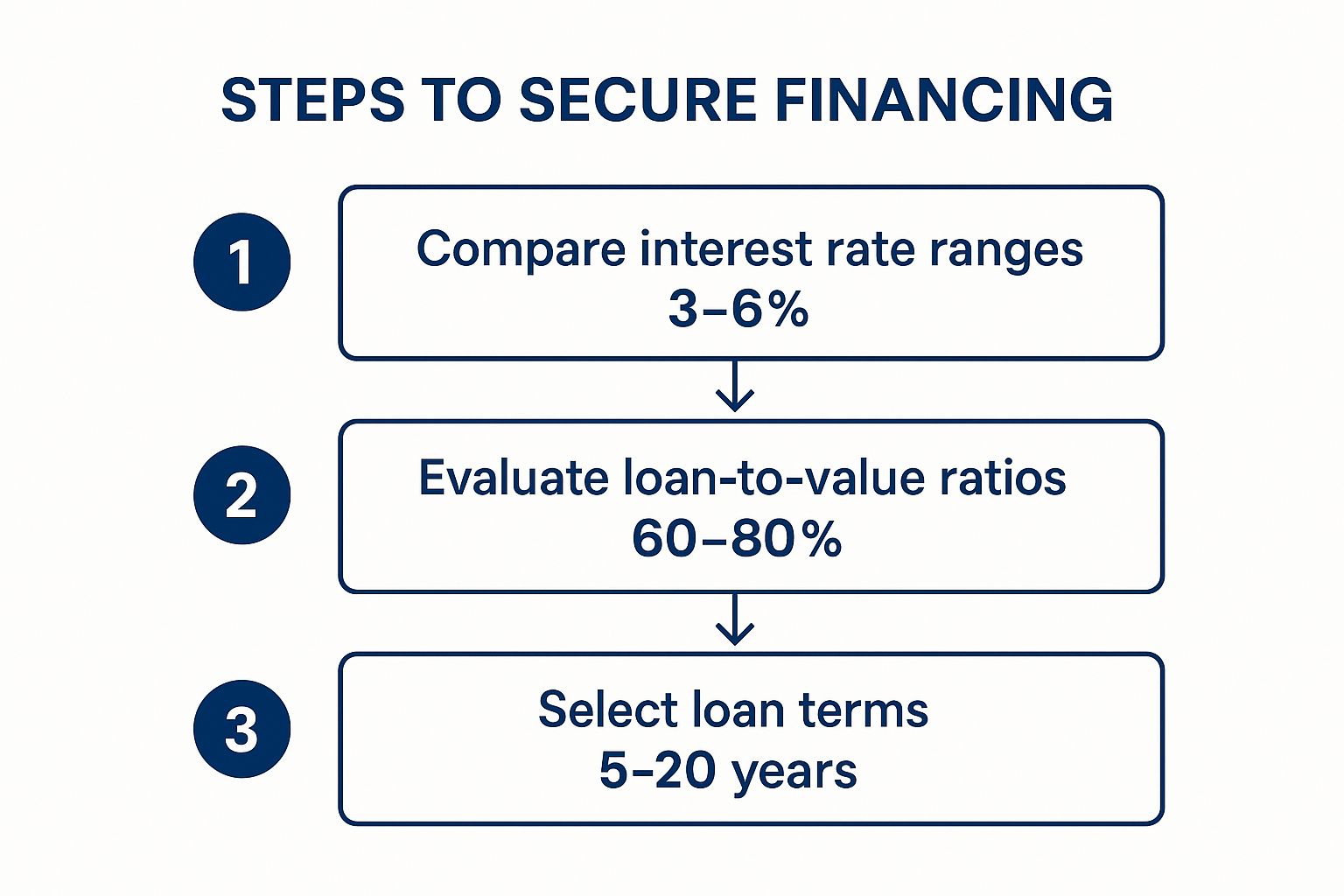
The flowchart above gives you a peek into how a sponsor thinks through these decisions. For a deeper dive, check out our guide to commercial real estate financing options for investors.
Investor Checklist: Vetting the Capital Stack
When you're looking at a deal, you’re really just pressure-testing its financial structure. Here are the must-ask questions for any sponsor:
What’s the total loan-to-cost (LTC) ratio for this project?
Is the main loan fixed-rate or floating-rate? If it’s floating, is there an interest rate cap in place to protect against rising rates?
Is the loan recourse or non-recourse? (Non-recourse is key—it protects your personal assets).
How much is the sponsor co-investing, and where does their money sit in the capital stack?
Are there other layers of debt, like a mezzanine loan or preferred equity?
What are the loan’s pre-payment penalties? This impacts the flexibility to sell the property early.
What debt coverage ratio (DCR) does the bank require, and how much of a safety cushion is built into the financial projections?
Navigating Due Diligence and Closing the Deal
So, you’ve pinpointed a promising property and have your financing lined up. Now comes the most critical part of the entire process: due diligence. This is the intensive, make-or-break investigation that starts once a letter of intent (LOI) is signed. It's your last real chance to uncover any skeletons in the closet before your capital is committed for good.
This phase isn't just about double-checking the numbers on a spreadsheet. It’s a full-on forensic deep dive into the property's physical, financial, and legal health. A properly executed due diligence process is what separates a great investment from a catastrophic one, ensuring the deal is exactly what the seller presented it to be.
Core Pillars of Due Diligence
Effective due diligence is absolutely a team sport. A good sponsor will assemble and coordinate a small army of professionals to comb through every single detail of the investment.
You can’t afford to cut corners here. We focus on three main pillars:
Financial Audit: This goes way beyond the seller’s optimistic pro forma. We conduct a line-by-line audit of past operating statements, scrutinize the rent roll, and verify every single lease. We’re looking for discrepancies, questioning every assumption, and rebuilding the financial model from scratch.
Physical Inspection: We bring in engineers and contractors to inspect the property from the foundation to the rooftop. They assess the structural integrity, HVAC systems, plumbing, electrical—everything. The goal is to sniff out any deferred maintenance or major capital needs that weren't disclosed.
Legal and Title Review: Our attorneys get to work examining the property's title for any liens, claims, or encumbrances. They also review zoning laws, permits, and surveys to confirm the property is fully compliant and can legally operate the way our business plan requires.
Myth vs. Reality: What Due Diligence Uncovers
A lot of new investors think this phase is just a formality. It’s not. It's less about confirming what you were told and more about discovering what you weren't.
Myth: Due diligence is just about making sure the seller’s numbers are correct.Reality: Due diligence is about finding the risks the seller didn’t tell you about. It’s about uncovering hidden operational flaws, surprise repair costs, or problematic lease clauses that could derail the business plan.
An experienced sponsor knows that the issues you uncover here are a powerful negotiating tool. If we find something significant, we can go back to the seller and renegotiate the price, demand credits at closing, or—if the problems are bad enough—walk away from the deal entirely.
For anyone who wants to go deeper on this topic, our team has put together a comprehensive playbook. You can find a more granular breakdown in our article, A Guide to Commercial Real Estate Due Diligence: The Investor's Playbook.
Risk and Mitigation in Commercial Real Estate
Every investment comes with risk, but in commercial real estate, the game is about identifying those risks early and having a solid plan to manage them. Surprises are expensive. Here's a look at how we approach some common challenges.
Risk: Market downturn affecting rents and property value. Mitigation: We underwrite deals with conservative rent growth and below-market leverage. We also target resilient property types in markets with diverse economic drivers.
Risk: A major tenant defaults or vacates. Mitigation: We build a diversified rent roll with multiple tenants across various industries. We also maintain strong tenant relationships to encourage renewals and proactively address issues.
Risk: Unexpected capital expenditures (e.g., roof failure). Mitigation: We commission a thorough Property Condition Assessment (PCA) during due diligence and establish a well-funded capital reserve account from day one to handle surprises.
Risk: Rising interest rates on a floating-rate loan. Mitigation: We purchase an interest rate cap or swap to hedge against rate volatility. When possible, we structure financing with long-term, fixed-rate debt to lock in costs.
Ultimately, a diligent and exhaustive process is your best defense against post-closing headaches. The disciplined work done during due diligence is what truly lays the foundation for a successful, profitable investment.
Executing the Business Plan and Creating Value
Once the contracts are signed and the deal is officially closed, the real work begins. This is the asset management phase—the critical period where a sponsor's carefully crafted business plan moves from paper projections to tangible results. Successful passive investing really hinges on a sponsor's skill in actively managing the property and creating value where others couldn't.
For a value-add property, this means a period of intense activity. You’ll see physical renovations getting underway, inefficient operations being streamlined, and aggressive marketing campaigns kicking off to boost occupancy and rental income. This hands-on management is the engine that drives returns, transforming an underperforming asset into a stabilized, cash-flowing investment.
The Return Driver Stack
To really get how value is created, it helps to think in terms of the 'Return Driver Stack.' This is just a framework that breaks down the different levers a sponsor can pull to generate profit. Every component contributes to the overall return, and a seasoned operator knows exactly which ones to prioritize for any given property.
The primary levers include:
Rent Growth: This can happen organically as market demand rises, or it can be forced through strategic renovations that justify higher rents.
Expense Control: This is all about operational efficiencies. Think ESG-focused energy-saving upgrades or renegotiating vendor contracts—every dollar saved drops straight to the bottom line.
Occupancy Improvement: An effective leasing strategy paired with strong tenant relations is key to reducing vacancy and maximizing the property's income potential.
Favorable Exit: Timing is everything. Selling or refinancing at the right moment—to capitalize on a strong market and a lower exit cap rate—can seriously amplify your final returns.
Ultimately, effective management is about pulling these levers in concert to steadily increase the Net Operating Income (NOI) over the hold period. For a deeper look into how NOI influences an asset’s worth, explore our guide on the [top commercial real estate valuation methods for investors](https://www.stiltsvillecapital.com/post/top-8-commercial-real-estate-valuation-methods-for-investors).
Advanced Lens: PropTech in Action
Today’s top-tier sponsors are moving beyond old-school property management by integrating property technology (PropTech). These tools give them a powerful edge in optimizing efficiency and enhancing the tenant experience—two things that are absolutely crucial for staying competitive.
Investor Takeaway: PropTech isn't about flashy gadgets; it's about data-driven decision-making. Smart building systems can slash utility costs by 15-20%, while tenant experience apps can improve retention by making communication and service requests seamless. These efficiencies translate directly to a healthier bottom line and a more valuable asset.
This tech-forward approach allows for proactive, not just reactive, management. It reinforces a key principle for passive investors: your success is directly tied to the active, forward-thinking management provided by your sponsor.
This active management must also adapt to broader economic trends. Commercial real estate is constantly shaped by shifting market demands. Right now, industrial properties are leading the charge thanks to e-commerce and logistics. For instance, U.S. industrial rents recently hit an average of $10.13 per square foot, a massive 61% jump from five years ago, even as vacancy rates saw a small uptick.
Meanwhile, the office sector is pivoting toward high-quality, sustainable buildings to attract tenants in our new hybrid work world. There's cautious optimism for a soft landing, with moderated interest rates and improved economic momentum pointing toward better leasing and income potential ahead. Discover more insights about these commercial real estate trends from J.P. Morgan.
Planning Your Exit and Realizing Your Returns

A successful commercial real estate deal isn’t really finished until the capital and profits are sitting back in your account. The truth is, the exit strategy is baked into the plan from day one—it's the grand finale where the entire business plan comes together. This is the stage that ultimately proves a sponsor's foresight and execution.
Every single decision made along the way, from the initial underwriting to the final coat of paint on a renovation, is designed to maximize the property's value at this critical moment. For you, the passive investor, this is where potential returns transform into tangible wealth.
Primary Exit Scenarios
An exit isn't just about putting a "For Sale" sign out front. Experienced sponsors are constantly reading the market to figure out the smartest path forward. It usually boils down to one of two main strategies.
Strategic Sale: This is the classic endgame. After the sponsor has executed the business plan—stabilizing the property, bumping up rents, and maximizing the Net Operating Income (NOI)—they sell the asset to a new buyer. This sale is what crystallizes all the value created during the holding period.
Refinance and Hold: Sometimes, a property is performing so well and the market still has room to run that selling feels premature. In this case, a sponsor might choose to refinance the asset. This means securing a new, larger loan based on the property’s now-higher value, which allows them to return a huge chunk (or even all) of the initial investor capital while everyone continues to own the asset.
Investor Takeaway: A refinance can be a fantastic "best of both worlds" scenario. You get to de-risk your investment by taking your original cash off the table, but you still get to participate in the property’s ongoing cash flow and future appreciation.
Calculating Your Total Return
When an exit finally happens, those key performance metrics from the initial pitch deck come full circle. This is when the Internal Rate of Return (IRR) and the Equity Multiple get their final calculation, giving you the complete picture of the investment’s success.
The equity multiple is pretty straightforward. If you invested $100,000 and received a total of $220,000 back over the life of the investment, your equity multiple is a solid 2.2x.
The IRR is a bit more sophisticated because it factors in the time value of money. It’s not just about how much profit you made, but also how quickly you made it. A higher IRR means your capital was put to work more efficiently and profitably.
Understanding the Sponsor’s Promote
Here’s where things get interesting. After all investors have received their initial capital back plus a pre-agreed preferred return (think of it as a minimum annual return, often around 8%), the remaining profits are split. This split is between the investors and the sponsor, and the sponsor’s share is called the “promote” or “carried interest.”
This structure is a powerful alignment tool. It gives the sponsor a massive incentive to not just hit the projections but blow past them. Why? Because their biggest payday only comes after the investors have already achieved strong results.
Ultimately, a clearly defined exit strategy is the hallmark of a disciplined investment. It’s the final confirmation that a well-structured commercial real estate deal, managed by experts with a clear plan, is a resilient and highly rewarding part of any long-term wealth strategy.
Your CRE Investing Questions, Answered
Even with the best game plan, questions always pop up. It’s just part of the process when you're diving into commercial property investing.
Let's clear up some of the most common things we hear from new and seasoned investors alike. This is all about the practical side of building your portfolio.
What’s the Real Minimum to Get Started in Commercial Real Estate?
This is a big one, and the answer really depends on how you want to play the game. The entry point can vary wildly.
If you’re thinking about buying a property directly, you’re often looking at needing millions of dollars in upfront capital. It's a high bar.
But there’s another way in. Passive investing through a syndication dramatically lowers that barrier. For accredited investors, typical minimums land somewhere in the $50,000 to $100,000 range. For the absolute lowest cost of entry, you could look at publicly traded Real Estate Investment Trusts (REITs), where you can buy shares for a small amount, but you sacrifice direct control and a more hands-on feel for the asset.
How Do I Actually Get Paid from a Commercial Property?
When it comes to returns, your money comes from two different places. Getting a handle on both is crucial for sizing up any potential deal.
Ongoing Cash Flow: This is your slice of the property's net income—basically, the rent collected after all the bills are paid. These profits are typically sent out to investors on a regular schedule, usually quarterly. It’s the steady pulse of the investment.
Appreciation Profits: This is the big payday. It’s the capital gain you get when the property is sold or refinanced for more than we paid for it. In a syndication deal, these profits are distributed to investors based on a "waterfall" structure, which is all spelled out in the legal documents you sign.
What Are the Main Risks I Should Know About?
Every investment has its risks, and knowing them upfront is the first step to managing them. In commercial real estate, the main ones to watch are market risk (like an economic downturn hitting property values), execution risk (the sponsor doesn’t pull off the business plan as promised), and illiquidity risk (your cash is tied up for the long haul, often 3-10 years).
The best way to sidestep these risks? Partner with an experienced sponsor. A team that does its homework, uses smart and conservative financing, and has a proven track record is your single best defense against things going sideways.
Ready to Build Your Real Estate Portfolio?
Well-structured private real estate can be a prudent, resilient component of a long-term wealth strategy. While all investments carry risk, a disciplined approach focused on strong fundamentals and experienced management can unlock significant opportunities for income and growth.
If you're an accredited investor interested in learning more about institutional-quality commercial real estate, we invite you to connect with us.
Schedule a confidential call with Stiltsville Capital to discuss your investment goals.
Information presented is for educational purposes only and does not constitute an offer to sell or a solicitation of an offer to buy securities. Any offering is made only through definitive offering documents (e.g., private placement memorandum, subscription agreement) and is available solely to investors who meet applicable suitability standards, including “Accredited Investor” status under Rule 501 of Regulation D. Investments in private real estate involve risk, including loss of capital, illiquidity, and no guarantee of distributions. Past performance is not indicative of future results. Verification of accredited status is required for participation in Rule 506(c) offerings.
Comments