


How to Invest in Commercial Real Estate: A 2025 Guide

Reading Time 8 min | Good for: Novice Investors, Family Offices, UHNWI
TL;DR: Your Path to CRE Investing
Why Now: Cautious optimism is returning to commercial real estate (CRE). While overall transaction volume is down, high-quality assets in resilient sectors are holding their value, creating opportunities for disciplined investors.
Three Main Paths: You can invest directly (full control, full-time job), buy REITs (liquid like stocks, no control), or invest passively with a sponsor (access to institutional-grade deals with expert management). For most busy investors, the passive route offers the best blend of access and efficiency.
Your Blueprint is Key: Before investing a dollar, define your goals. Decide on your role (active vs. passive), choose property types (e.g., multifamily, industrial), and match your risk tolerance to a strategy (Core, Value-Add, or Opportunistic).
Vet the Sponsor: In passive investing, your success is tied to the sponsor's expertise. Diligently review their track record, sourcing network, underwriting discipline, and how they align their interests with yours (e.g., preferred returns, sponsor promote).
Next Step: To explore how expertly managed, private real estate can fit into your long-term wealth strategy, schedule a confidential call with Stiltsville Capital.
Navigating the Current CRE Landscape: The Market "Why Now"
The commercial real estate market is in a fascinating phase of cautious optimism. After a period of high inflation and economic jitters, we’re seeing signs of renewed energy in leasing and occupancy in select sectors. This shift creates both unique challenges and compelling opportunities for investors who know where to look. According to Altus Group data (Q1 2024), while overall US CRE transaction volume fell 22.3% from the prior quarter, average prices per square foot held firm, signaling resilience in high-quality assets.
You can dig deeper into these trends in the full 2024 CRE outlook.
Market Signal Box (Q2 2024) * The Data: US CRE transaction volume was down 22.3% in Q1 2024 vs. Q4 2023. (Source: Altus Group, Q1 2024) * Interpretation: The market is bifurcated. While overall deal flow is slower due to interest rate uncertainty, capital is chasing quality. Full-service hotels saw +7.1% price growth, while industrial prices dipped -4.6%. * Investor Take: A disciplined investment strategy is paramount. Success means focusing on resilient property types and markets that can ride the wave of economic momentum while sidestepping risks like interest rate swings.
The Three Core Pathways to Invest in Commercial Real Estate
Before you can invest, you must understand your options. Each path into commercial real estate comes with a different level of control, capital, and risk.
Direct Ownership: This is the most hands-on route. You find and buy a property yourself, making you responsible for everything—from securing the loan and managing tenants to fixing the roof and eventually selling. It offers total control but also demands the most capital, time, and expertise.
Real Estate Investment Trusts (REITs): Think of REITs like stocks for real estate. These are publicly-traded companies that own or finance large portfolios of income-producing properties. Buying shares is easy, liquid, and has a low barrier to entry. The trade-off? You have zero say in which specific buildings are bought or sold.
Private Equity Syndications (Passive Investing): This is where you team up with a professional sponsor (like us at Stiltsville Capital) who handles the entire process. You pool your capital with other accredited investors to buy a high-quality asset that would be nearly impossible to acquire alone. It gives you access to institutional-grade deals and expert management, all while being a passive partner. Your success is directly tied to the sponsor's.
Building Your Personal CRE Investment Blueprint

A successful commercial real estate portfolio doesn't happen by accident. It's built with a clear, disciplined strategy—your personal investment blueprint. This foundational document guides every decision you make, ensuring every investment aligns with your long-term vision for income generation, inflation hedging, and wealth preservation.
Defining Your Investor Role: Active vs. Passive
First things first: how involved do you want to be? This is a crucial fork in the road.
Active Direct Ownership: The hands-on approach. You buy the property, you operate it, you call the shots. It offers maximum control but demands significant time, deep expertise, and a willingness to manage everything from leaky faucets to tenant negotiations.
Passive Investing with a Sponsor: This is where you partner with a specialized firm that handles the entire investment lifecycle. It’s a common structure in private equity, giving you access to larger, institutional-quality deals and professional management without the day-to-day headaches. For many high-net-worth individuals and family offices we work with, the passive route is simply more efficient.
Selecting Your Property Type
Next, pick the property sectors that fit your market outlook. Every asset class has its own unique drivers and cycles.
Multifamily: Taps into the fundamental, evergreen need for housing.
Industrial & Logistics: Fueled by the unstoppable growth of e-commerce and modern supply chains.
Medical Office: Benefits from powerful demographic trends and the non-discretionary nature of healthcare.
Retail: Focuses on necessity-based or experience-driven tenants that are resilient to online competition.
Data Centers: Capitalizes on the explosion in cloud computing, data storage, and AI.
Choosing a sector isn’t just picking a building type; it's making a calculated bet on the economic trends you believe will drive long-term growth.
Matching Risk with Strategy
Finally, you must be honest about your risk appetite. In commercial real estate, this typically falls into three core strategies, each with a different risk-return profile.
Comparing Commercial Real Estate Investment Strategies
This table outlines the typical risk, return, leverage, and investor involvement associated with the three primary CRE investment strategies, helping you align an approach with your specific financial goals and risk tolerance.
Strategy | Risk Profile | Target IRR | Typical Leverage | Investor Involvement |
|---|---|---|---|---|
Core | Low | 7-10% | < 60% | Low (Stable Income) |
Value-Add | Medium | 11-16% | 60-75% | Medium (Oversee Plan) |
Opportunistic | High | 17%+ | > 70% | High (Complex Execution) |
A Core strategy is about stability—think high-quality, fully leased properties generating predictable cash flow. A Value-Add approach involves buying properties with fixable problems to force appreciation. An Opportunistic strategy takes on the most risk, like ground-up development, but offers the highest potential returns.
Deal Lens Example: Value-Add vs. Opportunistic Let's say you have capital to deploy. A Value-Add deal could be a $20M acquisition of a 1990s apartment complex. The game plan? Inject $3M in renovations over 24 months to boost rents by 25% and sell in year five. In contrast, an Opportunistic play might be buying land for $15M to build a data center. This requires a much larger $50M development budget over three years. It's a higher-risk venture, but you're aiming for a significantly larger profit multiple when you sell the stabilized asset to an institutional buyer. Your blueprint will tell you which is right for you.
How to Source and Analyze Winning CRE Deals
Once your investment blueprint is set, the real hunt begins. Finding a great deal is where strategy meets action. This is where a sponsor's deep network and boots-on-the-ground intelligence become invaluable. High-quality opportunities rarely appear on public listings; the best deals are almost always found off-market through long-standing relationships with brokers, lenders, and property owners.
The Initial Screen: Avoiding Fatal Flaws
When an opportunity surfaces, a seasoned professional does a quick but disciplined initial screening. This "back-of-the-napkin" analysis checks for fatal flaws to see if the deal warrants a closer look. We’re asking a few simple questions:
Does the property type and location fit our thesis?
Are there obvious physical or legal red flags?
Do the initial numbers hint at a path to our target returns?
If a deal passes this gut check, the real work of hard-number analysis begins.
Understanding the Core Metrics of a Deal
To analyze a deal like a pro, you need to speak the language. While financial models get complex, the foundational concepts are straightforward.
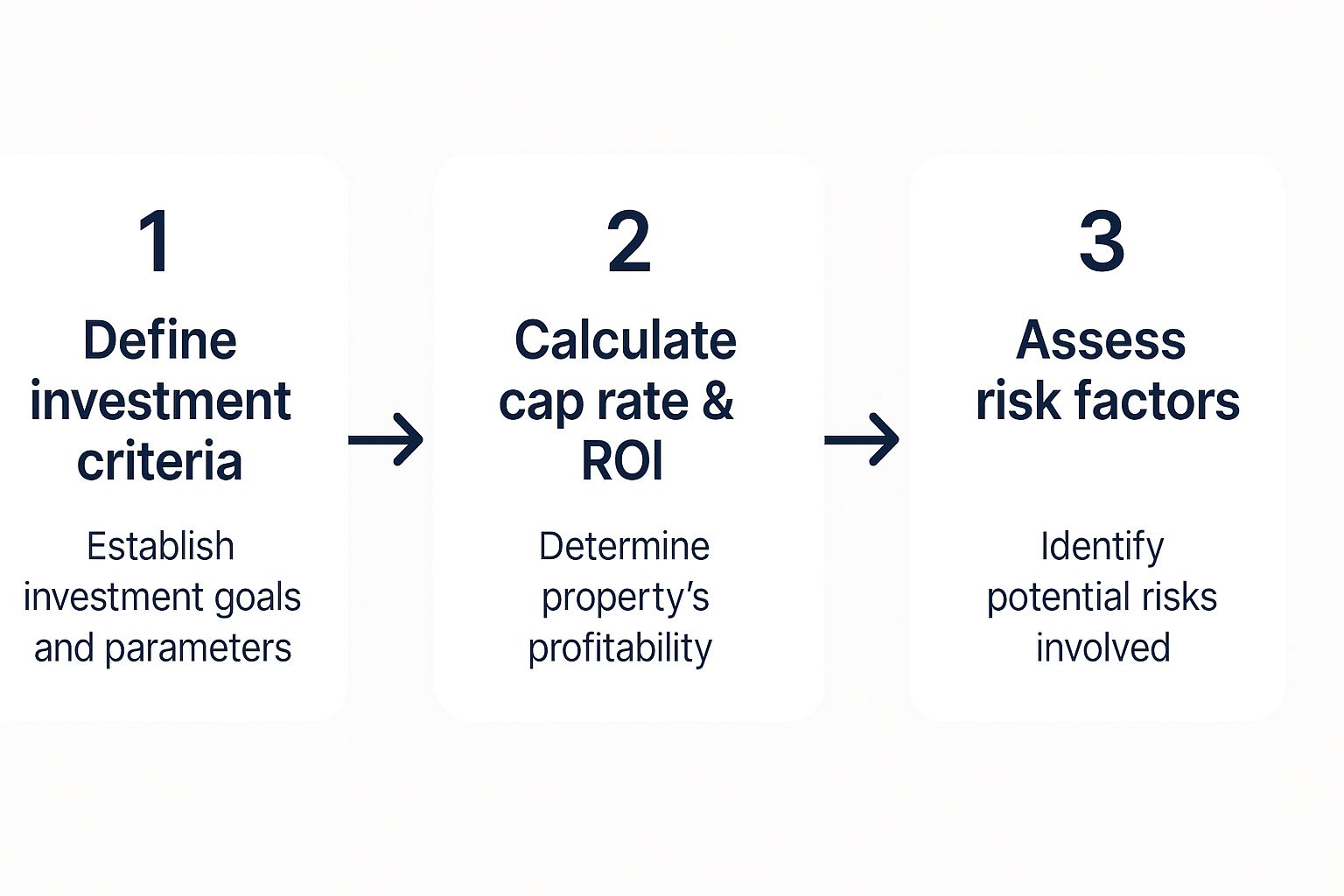
Novice Lens: Key Metrics Defined * Net Operating Income (NOI): The property's annual income after all operating expenses but before mortgage or income taxes. Think of it as the property's pure, unlevered profit. * Capitalization (Cap) Rate: Connects a property's NOI to its market value (NOI / Property Price). A higher cap rate generally suggests higher potential return, but often with more perceived risk. * Internal Rate of Return (IRR): The ultimate performance metric. It calculates the total annualized return on an investment, accounting for all cash flows over the entire life of the project, including the final sale.
These metrics provide a standardized way to compare different opportunities. A sponsor’s ability to accurately project these numbers—and then execute a plan to hit them—is what separates a successful investment from a flop.
Sourcing in a Shifting Market
Today's market makes a sponsor's sourcing ability more critical than ever. As noted, US CRE transaction volume dropped significantly in early 2024. And yet, despite the slowdown, average prices per square foot ticked up slightly. This tells us there's a real resilience in high-quality assets and highlights the importance of sector and location selection. Some subsectors like full-service hotels (+7.1% price growth) are thriving, while others like industrial (-4.6%) have seen prices dip. You can explore more on these transaction trends at Altus Group.
This complex environment creates real opportunities for well-capitalized investors who can find value where others can't. While the market presents many hurdles, a disciplined approach can uncover strong deals. For a deeper look, you can explore our analysis on the challenges confronting commercial real estate investors.
Navigating Due Diligence and the Closing Process

The time between signing a letter of intent and wiring final funds is where a deal is truly made or broken. This is due diligence, an intense investigation where a sponsor must validate every assumption made in the initial underwriting. It is a methodical sprint to de-risk the investment and protect investor capital by verifying the property's physical, financial, and legal health.
Understanding the Financial Architecture
Before stepping on the property, you must understand how the deal is structured. A core concept here is the capital stack, which is all the different layers of money used to buy the property, including senior debt (the bank loan) and various types of equity—including your investment as a limited partner (LP).
Novice Lens: Preferred Returns and Sponsor Promote * Preferred Return (the "Pref"): This is a key threshold. It’s the annual return that LPs receive before the sponsor shares in the profits. A common pref is 7-8%, meaning investors get the first cut of cash flow up to that amount. * Sponsor Promote (Carried Interest): Once the "pref" is paid to investors, the sponsor earns a larger, disproportionate share of the remaining profits. This "promote" is their main incentive to execute the business plan and directly aligns their success with yours.
Checklist: Questions to Ask Your Sponsor During Diligence
A great sponsor will be an open book. As an investor, your job is to ask the right questions to ensure they are turning over every stone.
Physical & Environmental: Have third-party experts completed a Property Condition Assessment (PCA) and a Phase I Environmental Site Assessment (ESA)? What are the estimated costs for any immediate repairs?
Lease & Tenant Audit: Have you performed a detailed audit of every lease against the seller’s rent roll? Are there any unusual clauses, near-term expirations, or delinquent tenants we should know about?
Financial Verification: Have you audited the seller’s historical financials (last 3 years of T-12s, or trailing 12-month statements)? Do the numbers align with the offering memorandum?
Legal & Title Review: Has the title report been scoured for liens or easements that could impede our business plan? Are all permits and zoning designations compliant?
Market Assumptions: How have you re-verified your initial projections on market rent growth, vacancy, and exit cap rates? What are local brokers telling you right now?
A sponsor's ability to give detailed, confident answers to these questions speaks volumes about their professionalism.
Deal Lens Example: Navigating a Due Diligence Surprise Imagine we're under contract to buy a value-add apartment complex. Our engineer finds that the HVAC systems in one building are failing—a surprise $250,000 expense. An inexperienced operator might panic. A skilled sponsor negotiates. We immediately go back to the seller with the third-party report and either: 1. Negotiate a price reduction to cover the cost. 2. Secure a seller credit at closing for that amount. 3. If the seller won’t budge, we re-run our model. If the deal no longer hits target returns, we walk away, protecting our investors' capital. This is a perfect example of how diligence isn’t just a checklist. It's an active process that creates and protects value.
Financing Your CRE Investment and Using Leverage Wisely
Leverage—using borrowed capital to buy an asset—is the jet fuel of commercial real estate. When used correctly, it can amplify returns. Mismanaged, it can turn a great deal into a disaster. Understanding how to finance a commercial property is non-negotiable. Lenders are laser-focused on one thing: the property's ability to generate enough income to comfortably cover its debt payments.
The Lender's Litmus Test: LTV and DSCR
When a lender evaluates a commercial loan, they live by two ratios. A professional sponsor must ensure any deal clears these hurdles from day one.
Loan-to-Value (LTV): The loan amount as a percentage of the property's appraised value. For a $10 million property with a $7 million loan, the LTV is 70%. A lower LTV means less risk for the lender.
Debt Service Coverage Ratio (DSCR): Measures the property's ability to pay its mortgage, calculated by dividing the Net Operating Income (NOI) by the total annual debt payments. A DSCR of 1.25x is a common minimum, meaning the property generates 25% more cash than needed to cover the mortgage.
Investor Take: A sponsor who insists on conservative leverage (lower LTV, higher DSCR) is demonstrating their commitment to protecting your capital. Aggressive leverage might project higher returns, but it leaves zero room for error if the market softens.
Risk and Mitigation in CRE Financing
Every financing decision is a trade-off. A good sponsor proactively identifies risks and builds in protections to safeguard investor capital.
Risk: Rising Interest Rates * Mitigation: We aim to lock in fixed-rate debt when possible. If using floating-rate loans, we buy an interest rate cap to put a ceiling on our exposure. Periods of lower interest rates can act as a catalyst for commercial real estate, creating unique buying opportunities.
Risk: Refinancing Risk * Mitigation: We avoid short-term balloon loans on long-term holds. It’s critical to structure loan terms that extend beyond the business plan's timeline or to negotiate extension options upfront.
Risk: Covenant Default * Mitigation: We underwrite deals with conservative DSCR and LTV ratios. This maintains a significant buffer above lender requirements, preventing a technical default if the market hiccups.
Risk: Sponsor Recourse * Mitigation: We prioritize non-recourse debt. This loan type limits the lender’s claim to the property itself, protecting the sponsor and our investors from personal liability (except for standard "bad-boy" carve-outs).
Proactive Asset Management and Exit Planning

Successfully closing on a property isn't the finish line; it’s the starting gun. The real work—and the bulk of value creation—happens during the holding period through disciplined, hands-on asset management. This is where a sponsor’s expertise transforms a static property into a dynamic engine for wealth generation.
Executing the Business Plan
The asset manager’s primary job is to turn pro-forma projections into reality. This is an active, hands-on process. Depending on the property, this could involve:
Property Renovations: Overseeing upgrades to units, common areas, or building systems to attract higher-quality tenants and justify rent increases.
Strategic Leasing: Actively managing the tenant roster, negotiating favorable lease terms, and working relentlessly to minimize vacancy.
Operational Efficiency: Scrutinizing every expense, renegotiating vendor contracts, and implementing new tech to boost Net Operating Income (NOI).
Planning Your Exit From Day One
A crucial part of any institutional-grade investment strategy is knowing how you’ll eventually realize gains. A great sponsor has a clear exit strategy in mind before a deal even closes. While the strategy can adapt to market conditions, the goal is always to maximize investor returns. You can see how this fits into the bigger picture in our **guide to commercial real estate private equity**.
Investor Takeaway: The exit isn't a single event but a strategic decision. A skilled sponsor continuously reads the market to pinpoint the optimal time and method to sell or recapitalize. It’s a balancing act—weighing the desire for maximum profit against the need to protect investor capital from changing market dynamics. The ultimate goal is to crystallize the value we've built together and return capital to our partners.
FAQ: Common Questions from CRE Investors
What’s the real minimum to get into a private deal?
The entry point can vary significantly depending on the deal sponsor. For most private syndications aimed at accredited investors, you'll typically see a minimum investment between $50,000 and $100,000. This amount is substantial enough for meaningful participation but also allows you to diversify your capital across multiple assets.
How exactly do I get paid in a syndication?
Investor returns generally come in two forms. First are regular cash flow distributions, usually paid quarterly from the property's net operating income. The second—and often larger—payout comes from a capital event, like a sale or refinance. When that occurs, you receive your proportional share of the profits.
Why It Matters: Every deal has a "waterfall" structure spelled out in the offering documents. This is crucial because it dictates the order of payouts, including any preferred return ("pref") that investors earn before the sponsor takes their share of the profits.
What are the main risks I should know about?
When investing passively in CRE, the risks boil down to three things: market, execution, and illiquidity.
Market Risk: You can't control the economy. A downturn can impact rents, occupancy, and property values.
Execution Risk: This is sponsor-specific. It's the risk that the sponsor cannot successfully execute the business plan.
Illiquidity Risk: Commercial real estate is not a liquid asset like stocks. Your capital is typically locked in for the life of the deal, usually 3-7 years.
The single best way to mitigate these risks is to partner with a seasoned sponsor with a proven track record of navigating multiple market cycles—not just the good times.
Ready to explore how institutional-grade real estate can fit into your portfolio? The team at Stiltsville Capital is here to provide clarity and access to exclusive opportunities. Schedule a confidential call with us today.
Information presented is for educational purposes only and does not constitute an offer to sell or a solicitation of an offer to buy securities. Any offering is made only through definitive offering documents (e.g., private placement memorandum, subscription agreement) and is available solely to investors who meet applicable suitability standards, including “Accredited Investor” status under Rule 501 of Regulation D. Investments in private real estate involve risk, including loss of capital, illiquidity, and no guarantee of distributions. Past performance is not indicative of future results.
Comments