


The Institutional Investor's Guide to Real Estate Due Diligence

Reading Time 7 min | Good for: A, B
When you're dealing with institutional-quality real estate, fortunes aren't made on gut feelings. They’re built on the solid foundation of meticulous, data-driven verification. Real estate investment due diligence is far more than a pre-closing checklist—it's the strategic discipline that separates savvy investors from speculators. It’s about converting a compelling story into a verified financial asset, ensuring your capital is both protected and positioned for growth.
TL;DR: Your Due Diligence Edge
Defense & Offense: Due diligence shields your capital from hidden risks (title defects, deferred maintenance) and uncovers opportunities others might miss (untapped upside, operational efficiencies).
Systematic Approach: A rigorous process systematically vets four key areas—Financial, Physical, Legal, and Market—to ensure no stone is left unturned before committing capital.
Beyond the Numbers: Modern diligence integrates Environmental, Social, and Governance (ESG) criteria and technology (like AI and drones) to assess long-term resilience and gain a competitive edge.
Why Due Diligence Is Your Most Critical Investment
For family offices and sophisticated investors, the due diligence process serves two essential purposes.
First, it’s a defensive shield. It’s your best tool for uncovering hidden risks that could erode your capital—things like undisclosed deferred maintenance, defects in the title, or a sponsor's overly optimistic income projections.
Second, it's an offensive tool. This is where you can find the real value others might have overlooked, confirm the sponsor's business plan holds water, or even spot new upside potential that wasn't part of the original pitch.
The Modern Diligence Mandate
Market Signal BoxThe global real estate market was valued at an estimated $4.2 trillion in 2023 and is projected to grow at a compound annual growth rate (CAGR) of 5.8% through 2030, according to reports from Grand View Research. In a market this massive and competitive, due diligence has become the strategic backbone of any serious investment decision.Investor Take: With more capital chasing fewer deals, the margin for error is shrinking. A disciplined, institutional-grade diligence process is no longer optional—it's the primary way to secure a durable competitive advantage.
It’s no longer just a compliance exercise. The modern approach weaves together rigorous financial validation, up-to-date valuation standards, and forward-looking environmental checks, including new frameworks for climate resilience. You can learn more about the strategic evolution of due diligence in real estate investing.
The Four Pillars of the Process
Any institutional-grade analysis boils down to four distinct but deeply interconnected pillars. Each step builds on the last, creating a logical funnel for vetting opportunities without wasting time or money on a deal that was flawed from the start.
This infographic lays out the core flow beautifully, showing how a deal must first pass financial muster before you ever spend a dime on physical inspections or legal deep dives.
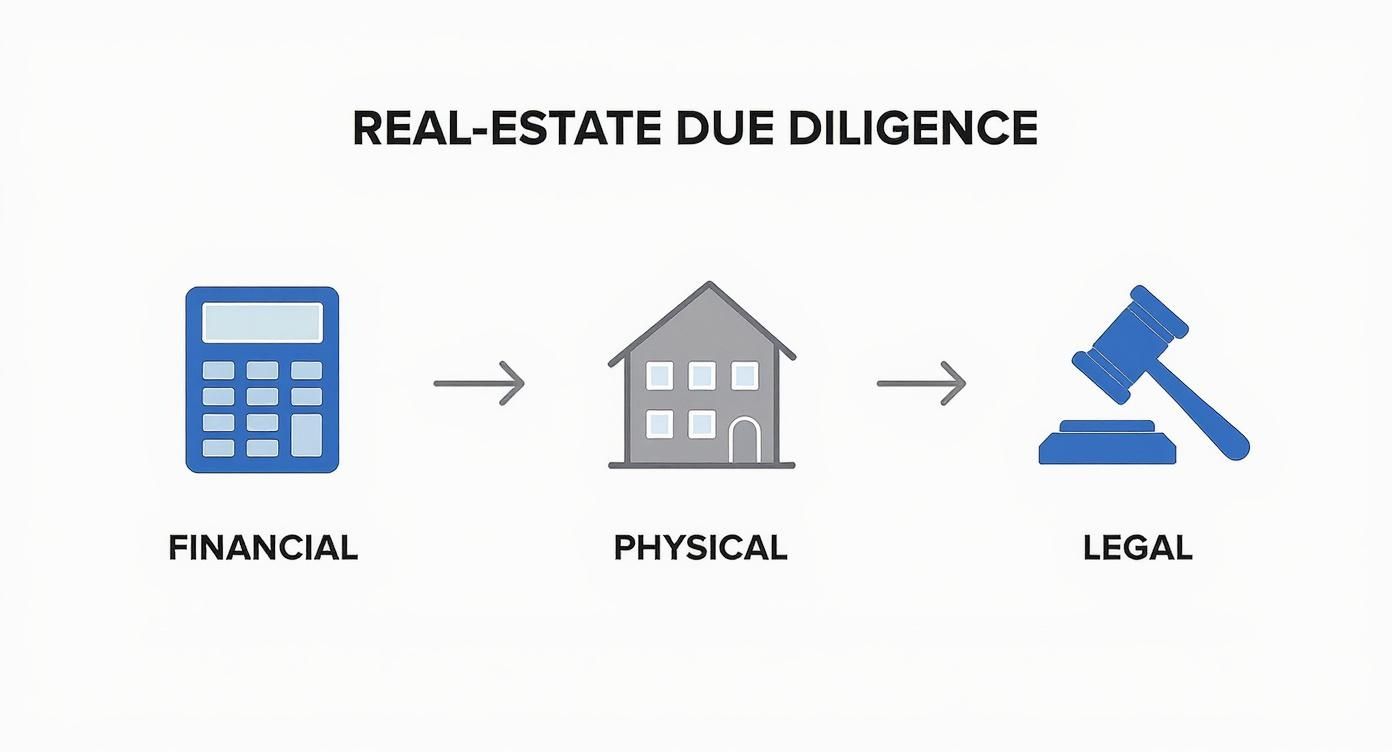
This process is designed to be a cost-effective filter. Why pay for an expensive property condition report if the numbers don't even work?
Let's break down these pillars into a more structured view.
The Four Pillars of Real Estate Due Diligence
A comprehensive due diligence process covers four core components. Here are the goals and key documents for each area.
Pillar 1: Financial * Goal: Verify the property's economic performance and validate the investment thesis. * Documents: Rent rolls, P&L statements, lease abstracts, bank statements, utility bills, CAM reconciliations.
Pillar 2: Physical * Goal: Assess the building’s condition, identify immediate repairs, and forecast future capital expenditures. * Documents: Property condition report (PCR), environmental site assessment (ESA), zoning report, surveys, appraisals.
Pillar 3: Legal * Goal: Confirm clear ownership, uncover liabilities, and ensure compliance with all regulations. * Documents: Title report, ALTA survey, service contracts, permits, corporate documents, loan agreements.
Pillar 4: Market * Goal: Analyze market trends, competition, and demographic shifts to confirm demand and growth potential. * Documents: Market studies, competitor analysis (comps), demographic reports, submarket vacancy/rent data.
An investment without rigorous due diligence is not an investment at all; it’s a gamble. The goal is to leave no stone unturned, transforming assumptions into certainties and ensuring every risk is identified, quantified, and mitigated.
A successful outcome isn't just about closing the deal. It's about closing the right deal on the right terms, with total clarity on the asset you're acquiring. This guide is your roadmap to executing that process with institutional precision.
Deconstructing the Deal’s Financials and Market Fit

A deal’s narrative might be compelling, but the numbers tell the real story. This is where we move past the sales pitch and into the rigorous financial and market analysis that either proves an investment thesis or exposes its fatal flaws. An institutional-grade due diligence process is forensic, detailed, and frankly, skeptical by nature.
The first document to tear apart is the rent roll. Don't just see it as a list of tenants and their rents; it’s the absolute lifeblood of the property's income. Your job is to audit it for inconsistencies, cross-reference the data with actual lease agreements, and get a true feel for the quality and stability of that income stream.
Auditing the Rent Roll: Looking Beyond the Surface
A quick glance at the rent roll just won't cut it. A seasoned investor knows to hunt for the subtle clues and potential red flags that could derail future cash flow.
Here’s what to focus on:
Lease Expiration Schedule: Do you see a huge chunk of leases expiring in the same year? That’s a massive rollover risk waiting to happen. What you want to see is a staggered schedule, which creates a much more predictable and stable income.
Tenant Concentrations: Is one big tenant responsible for a disproportionate amount of the income? If that anchor tenant leaves, it could be catastrophic for your returns.
Rent Concessions and Abatements: Does the rent roll truly reflect periods of free rent or other perks given to tenants? The gross rent figures can look fantastic until you realize significant abatements are hiding in the fine print.
Security Deposits: This is a small but telling detail. Are security deposits collected consistently and recorded properly? It’s often a good indicator of the sponsor's overall management discipline.
Scrutinizing Expenses and Leases
Once you have a solid handle on the income, it’s time to challenge every single expense line item. The operating statements provided by the seller are just a starting point—never the final word. You have to verify these numbers against actual utility bills, tax statements, and service contracts.
Novice Lens: Why This MattersThe most dangerous assumption in real estate is that the past equals the future. Your job during due diligence is to verify past performance while building a forward-looking model based on realistic, market-supported assumptions—not the seller's pro-forma.
The lease agreements themselves are a goldmine of information and potential risks. You need to read them carefully, looking for clauses that could dramatically alter the property's financial outlook. Think early termination options, co-tenancy requirements (where one tenant can break their lease if a key neighbor leaves), or caps on how much of the expenses you can pass through to tenants. I’ve seen a retail center’s value plummet after an anchor grocery store left and triggered a cascade of co-tenancy clauses for the smaller tenants.
Stress-Testing the Sponsor’s Pro-Forma
For the sophisticated investor, the real work begins when you start stress-testing the sponsor’s financial model, often called the pro-forma. This is where you push back on their core assumptions to see how the deal holds up when things don't go perfectly.
Key Levers to Test:
Rent Growth: Is their projected rent growth of 5% a year actually supported by historical data and third-party market reports for that specific submarket? Or is it an overly optimistic hockey-stick projection?
Vacancy Rates: Does the model assume a constant 5% vacancy when the submarket average is closer to 8%? A seemingly small tweak here can have a major impact on the Net Operating Income (NOI).
Exit Capitalization (Cap) Rate: A sponsor might project a sale at a 5.0% cap rate in five years. What happens to your Internal Rate of Return (IRR) if rising interest rates push exit cap rates to 6.0%? This single assumption is one of the most powerful drivers of a deal’s projected success.
By running these downside scenarios, you begin to understand the deal's true risk profile. This process is fundamental to building a robust discounted cash flow (DCF) model. If you want to dive deeper, we have a detailed guide on how to calculate a discounted cash flow for real estate success.
A thorough financial and market analysis isn't about finding reasons to say "no." It's about gaining the clarity and confidence to say "yes" to the right deals, armed with a complete picture of the risks and a verified understanding of the potential rewards.
Uncovering a Property's Physical Story
Every property has a story that spreadsheets and financial models just can't tell. This is where the real work begins—moving from the theoretical to the tactile to uncover the building’s true history and, more importantly, its future needs.
The physical condition of an asset is where so many hidden risks and costs lie dormant. For any serious investor, bringing in third-party experts isn't just a good idea; it's non-negotiable. This is a forensic investigation into the building's core systems and structural integrity, giving you an unbiased, professional opinion on what you're really buying.
Commissioning Key Third-Party Reports
Two reports are foundational to any physical due diligence process: the Property Condition Assessment (PCA) and the Phase I Environmental Site Assessment (ESA). Think of them as a comprehensive health check-up for the property.
Property Condition Assessment (PCA): Conducted by a specialized engineering firm, this report digs into the building's major systems—roof, foundation, HVAC, electrical, and plumbing. A solid PCA gives you a detailed list of immediate repair needs and, crucially, a forecast of future capital expenditures (CapEx).
Phase I Environmental Site Assessment (ESA): This is all about investigating the property's current and past uses to flag any potential environmental contamination. You absolutely want to avoid acquiring a property with a costly cleanup liability. A clean Phase I is essential for securing financing and dodging a massive long-term risk.
These reports aren't just about finding problems; they're about putting a price tag on them. A leaky roof on that industrial warehouse isn't just a maintenance task; it's a potential $250,000 capital expense that has to go directly into your financial model, impacting everything from cash flow to your final returns.
Translating Physical Risks into Financial Impacts
A cracked parking lot or an aging HVAC unit—every physical defect has a specific cost. The real skill here is translating these findings into hard numbers for your underwriting.
An experienced sponsor will take the PCA and immediately use it to refine their CapEx budget. If the report says the roof only has three years of life left, the model needs to show a full replacement in year three, not year ten. This kind of discipline prevents those nasty surprises that can completely derail an investment.
The most expensive mistake in real estate is underestimating future capital expenditures. A thorough PCA isn't an expense; it's an investment in certainty that pays for itself by preventing unforeseen cash calls and protecting your IRR.
This process also gives you powerful negotiating leverage. If your diligence uncovers $500,000 in immediate, critical repairs the seller never mentioned, that becomes a very clear point of discussion to adjust the purchase price.
Investor Checklist: Questions to Ask Your Inspector
Just getting a 200-page report isn't enough. You have to engage with your inspectors to truly understand the asset. For a more exhaustive list, check out our ultimate commercial property inspection checklist.
Beyond immediate needs, what are the top three "ticking time bombs" in this building that will require attention in the next 5-7 years?
Based on similar properties, are the utility systems adequate for modern tenant demands?
Is there any evidence of major structural issues, like significant foundation settling or water intrusion?
How do your repair cost estimates compare to local labor and material costs? Are these conservative?
Are there any compliance issues with current building codes, ADA standards, or fire safety regulations?
Ultimately, physical due diligence is about building a complete picture. It's about understanding the asset's past, assessing its present, and accurately forecasting the capital needed to secure its future. It’s how you make sure the story the numbers tell aligns perfectly with the reality of the brick and mortar.
Diving Into the Legal and Regulatory Weeds
Once you've stress-tested the financial model and kicked the tires on the physical building, it's time for the legal and regulatory deep dive. This is where deals can truly fall apart. A clean title and the right zoning aren't just checkboxes; they are the absolute foundation of a solid investment.
If you cut corners, you could inherit problems that are expensive, time-consuming, or impossible to fix after closing. This stage is about getting comfortable with dense legal documents, ideally with an experienced attorney by your side, to uncover any hidden claims, restrictions, or obligations that could derail your plan for the property.
Uncovering Title and Survey Surprises
First, you need a meticulous review of the title report and the ALTA survey. These two documents provide a complete picture of the property's legal boundaries and any baggage that comes with it.
The title report answers, "Who really owns this, and who has a claim on it?" You’re looking for a "clean" title, but it’s common to find issues like a mechanic's lien from an unpaid contractor or an old mortgage that wasn’t properly removed. These usually just need to be cleared up before closing.
The ALTA survey is the detailed map. It shows you things the paper trail can't, like:
Easements: Does the utility company have the right to dig up your parking lot? Is there a shared driveway agreement with the neighboring property?
Encroachments: Is the neighbor's fence a foot over your property line? Does that new awning extend over the public sidewalk?
These might sound like small details, but they can grow into massive headaches. An unknown easement could kill your plans for future expansion.
Making Sure Your Plan Fits the Zoning Rules
Just because the building is a thriving medical office today doesn't automatically mean you can keep it that way—or execute your value-add plan. Every city has its own rulebook, and zoning dictates exactly how a property can be used. Confirming zoning compliance is a non-negotiable part of any serious real estate investment due diligence.
Your legal team needs to get a zoning report or talk directly with the local planning department. You need straight answers. Can you add that second story you were planning? Is the property "under-parked" according to current code? The answers directly impact the property's value.
Insight Edge: The Entitlement TrapA classic mistake investors make on value-add deals is assuming special permits or zoning variances—"entitlements"—automatically transfer to the new owner. Bad assumption. A previous owner might have gotten a permit for a specific project that has since expired or was tied only to them. You have to verify that any special permissions critical to your business plan are still valid and fully transferable.
Digging Into Existing Contracts and Agreements
Finally, your due diligence must cover every single contract that comes with the building: service agreements, vendor contracts, property management agreements, etc. You need to know precisely what you’re inheriting.
Go through every contract and look for red flags. Are you about to be stuck in a long-term, overpriced contract with a lazy landscaping company? Is there an automatic renewal clause in the property management agreement that’s almost impossible to break? A bad contract can directly chip away at your Net Operating Income (NOI).
The goal is to spot these potential landmines early and make their termination a condition of the sale. A little proactive legal work now can save you from inheriting someone else's expensive mistakes later.
Blending ESG and Tech Into Modern Due Diligence
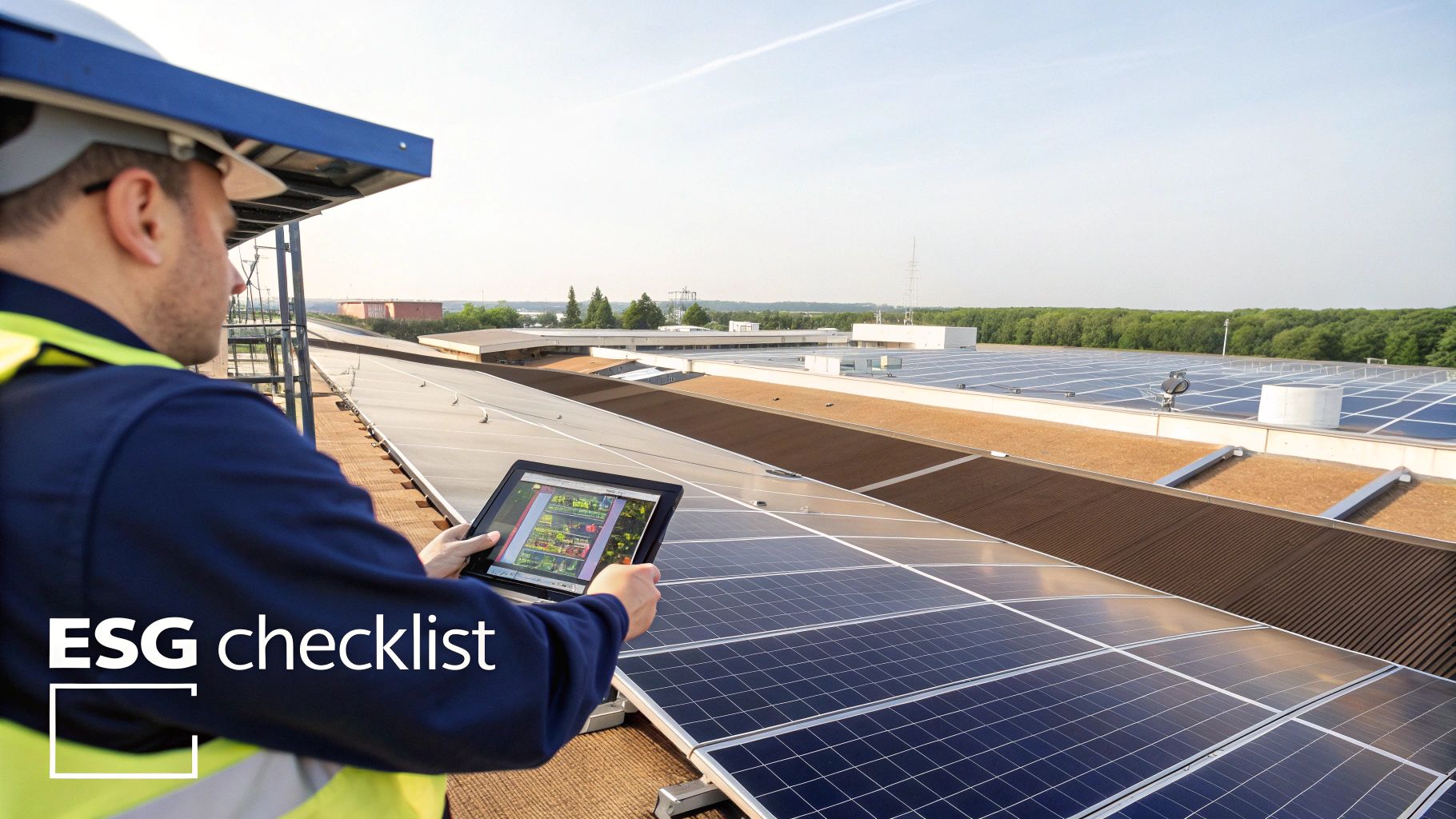
The future of real estate investment due diligence is already here, and it's smarter, faster, and more conscious than ever. While the fundamentals haven't changed, the sharpest sponsors are weaving two powerful forces into their process: Environmental, Social, and Governance (ESG) criteria and cutting-edge tech.
This isn't just a passing trend. It’s a genuine shift in how we measure and protect long-term value. For any serious investor, understanding this evolution is crucial for ensuring your portfolio is built to withstand risks that don't show up on a typical P&L.
Why ESG Diligence Matters More Than Ever
ESG has moved from the "nice-to-have" column to a non-negotiable part of institutional underwriting. Think of it as a practical framework for spotting hidden risks and opportunities tied to a property’s environmental footprint, its role in the community, and how it’s managed.
This shift is grounded in real-world financial consequences. According to a PwC and Urban Land Institute report, by 2025, climate and ESG factors are expected to have a significant impact on real estate investment decisions, with a growing risk of certain properties becoming "stranded assets"—impossible to sell without major green upgrades.
Investor TakeawayA building with sky-high energy bills, a location prone to flooding, or a sour relationship with the local community carries very real financial liabilities. On the flip side, a property with LEED certification, high-efficiency systems, and a positive community presence can command premium rents and attract the best tenants, significantly boosting its long-term value.
Understanding how a sponsor bakes these factors into their analysis is critical. For a closer look, check out our guide on sustainable real estate development and building future-proof portfolios.
Tech: The Diligence Accelerator
If ESG provides a new lens for seeing risk, technology gives us the tools to do it faster and with more precision. The days of sifting through bankers' boxes of paperwork are gone. Today's best sponsors lean on a tech stack that gives them a clear competitive edge.
A dedicated data room for due diligence is the foundation for this efficiency. It’s a secure, central hub where legal teams, inspectors, and partners can all work from the same up-to-the-minute information, drastically cutting down on errors and delays.
But it goes way beyond just managing files. Sponsors now deploy advanced tools like:
AI-Powered Lease Abstraction: Instead of a junior analyst spending days reading hundreds of pages of legalese, AI can scan lease documents in minutes to pull out critical dates, financial terms, and non-standard clauses.
Drone-Based Site Inspections: For a sprawling industrial park, drones can capture high-res images and create 3D models of roofs, facades, and land contours, spotting problems you’d miss from the ground.
Geospatial Data Analysis: Imagine overlaying demographic shifts, traffic patterns, and climate risk maps onto a single property. Sophisticated mapping tools do just that, giving a much richer picture of a property's market position.
When vetting a sponsor, ask them about their tech stack. A team that invests in modern tools is usually more disciplined, efficient, and better equipped to find the subtle insights that separate a good deal from a great one.
Your Top Real Estate Due Diligence Questions Answered
When you’re deep in the weeds of a potential deal, a lot of practical questions pop up. Here are some straight answers to the questions we hear most often from investors.
How Long Should Due Diligence Take for a Commercial Property?
You should plan for a due diligence period of 30 to 90 days. The exact timeline hinges on the complexity of the property and the deal. A straightforward, single-tenant building with a clean history might wrap up on the shorter end. But for a large multifamily complex, a value-add project that needs a zoning change, or a portfolio of properties, you’ll easily need the full 90 days—and maybe an extension.
What’s the Biggest Mistake Investors Make in Due Diligence?
The single costliest mistake is blindly trusting the seller's numbers and documents without independent verification. It’s tempting to accept the pro-forma at face value or rely on reports neatly packaged in the deal room, but you simply can’t.
Always operate with a healthy dose of professional skepticism. You must stress-test the numbers, question every assumption, and bring in your own independent experts to get a true picture of the property's physical, financial, and legal condition.
How Much Should I Budget for Due Diligence?
As a general rule of thumb, set aside 0.5% to 2% of the purchase price for your due diligence costs. This will cover essentials like legal fees, the appraisal, and crucial third-party engineering and environmental reports. On a multi-million dollar property, these costs can quickly climb into the tens of thousands. Think of this as an investment in protecting your capital. A great way to organize the process is by referencing some good due diligence checklist templates to guide your review.
What’s a "Fatal Flaw" That Means I Should Walk Away?
A "fatal flaw" is a deal-breaker—an issue you can’t fix that completely torpedoes your original investment plan. Think of things like incurable title defects, significant environmental contamination where the cleanup costs more than the property is worth, or zoning that flat-out prohibits what you want to do with the site. Finding a fatal flaw is a successful outcome of due diligence. It just saved you from a disastrous investment.
Take the Next Step
A disciplined due diligence process is the bedrock of any successful real estate investment. It transforms uncertainty into calculated risk and ensures that every decision is backed by data, not just a good story. Well-structured real assets can be a prudent, resilient component of a long-term wealth strategy, and it all starts with getting the diligence right.
If you are an accredited investor interested in learning more about institutional-grade real estate opportunities, we invite you to schedule a confidential call with Stiltsville Capital.
Information presented is for educational purposes only and does not constitute an offer to sell or a solicitation of an offer to buy securities. Any offering is made only through definitive offering documents (e.g., private placement memorandum, subscription agreement) and is available solely to investors who meet applicable suitability standards, including “Accredited Investor” status under Rule 501 of Regulation D. Investments in private real estate involve risk, including loss of capital, illiquidity, and no guarantee of distributions. Past performance is not indicative of future results. Verification of accredited status is required for participation in Rule 506(c) offerings.
Comments