


Your Ultimate Commercial Property Due Diligence Checklist for 2025

Reading Time: 8 min | Good for: Novice Investors (A), Informed Principals (B)
TL;DR: Your Diligence Blueprint
Diligence is Value Creation: Rigorous due diligence isn't just about avoiding risk; it's where sophisticated investors create value by uncovering facts others miss, allowing for better pricing and strategic planning.
It’s a Team Sport: No single person can master all facets. Effective diligence requires a coordinated team of legal, environmental, engineering, and market experts. Your sponsor's ability to manage this process is a key indicator of their expertise.
Beyond the Checklist: The goal isn't just to check boxes but to build a comprehensive, data-driven story of the asset—validating its past performance, its current condition, and its future potential within the market.
Next Step: Use this guide to stress-test any deal presented to you. Ask a sponsor how they approach these eight critical areas to gauge their discipline and transparency.
In the world of institutional-grade real estate, the most critical value is created long before any deal closes. It's forged in the exhaustive, disciplined process of due diligence. For sophisticated investors, family offices, and those new to passive commercial real estate (CRE) investing, mastering this process is non-negotiable. It's your primary firewall against unforeseen liabilities and the bedrock for predictable, risk-adjusted returns. While a glossy offering memorandum presents the potential, a rigorous commercial property due diligence checklist uncovers the reality.
This comprehensive guide moves beyond surface-level checks. It provides a structured, actionable framework for evaluating any commercial property investment, ensuring you and your partners ask the right questions to protect and grow capital. The process is about transforming assumptions into verified facts, identifying risks that can be mitigated or repriced, and confirming the value-creation thesis. An oversight here can turn a promising acquisition into a long-term financial drain, impacting everything from cash flow to the final exit valuation.
We will break down the eight mission-critical domains that top-tier sponsors scrutinize to separate premier opportunities from well-marketed pitfalls. From forensic financial analysis to environmental assessments, this checklist details the essential steps for uncovering a property's true operational and financial health. Following this structured approach ensures that every potential investment is viewed through a lens of disciplined underwriting and strategic foresight, laying the groundwork for superior performance.
1. Title and Legal Documentation Review
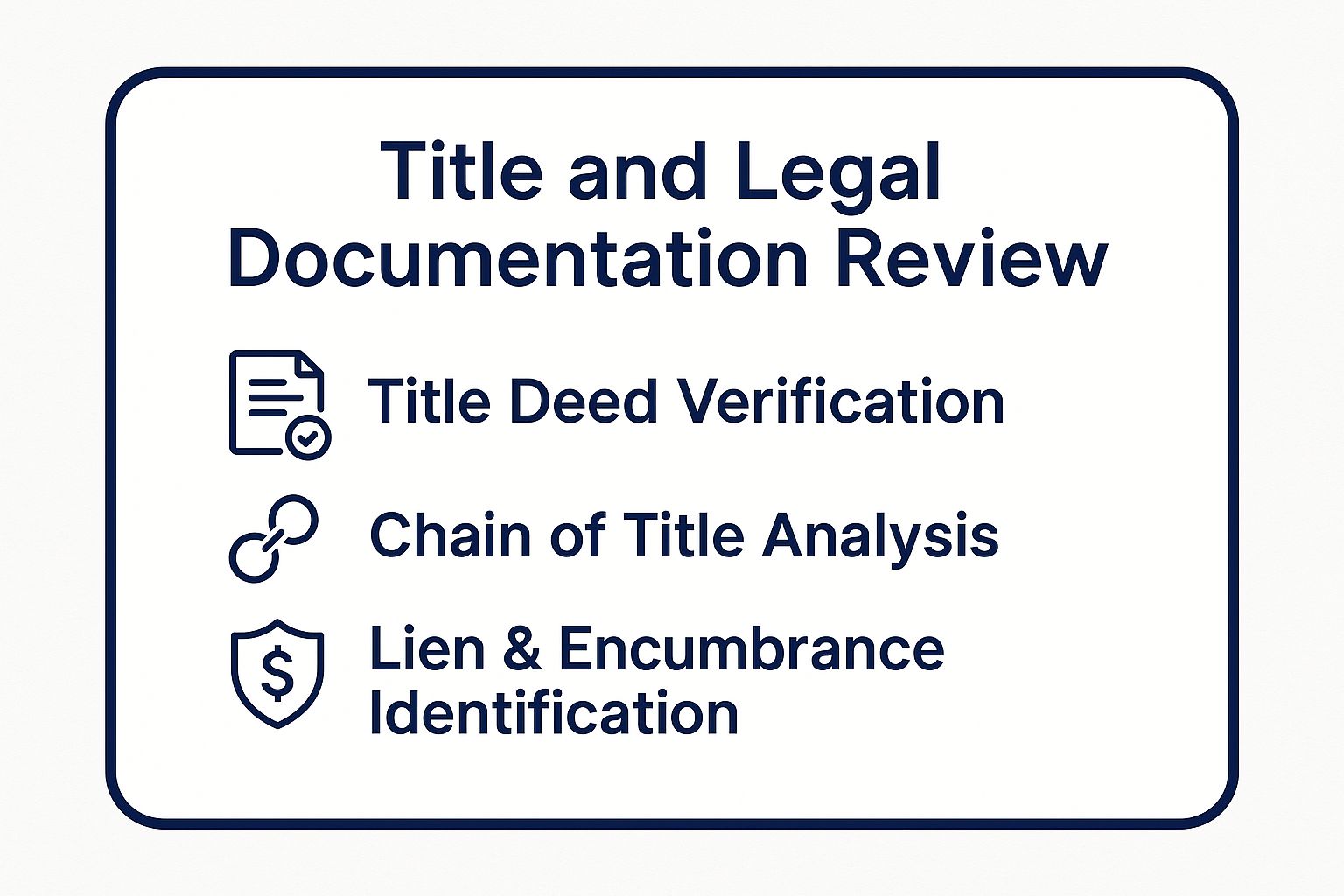
The first step in any sound commercial property due diligence checklist is a meticulous review of the property's title and legal documentation. This foundational analysis confirms that the seller possesses the legal right to sell the property—a concept known as "clear and marketable title." It's like verifying the authenticity and provenance of a masterpiece before an auction; without it, the entire transaction rests on a faulty premise.
This process involves a deep dive into public records to trace the property's ownership history (the "chain of title"), ensuring there are no gaps or fraudulent transfers. It also uncovers any legal claims, restrictions, or obligations tied to the property, known as liens and encumbrances. These could range from mortgages and unpaid tax bills to easements granting a neighbor access across your land.
For sophisticated investors, this isn't just a box to check. It's a critical risk mitigation step that prevents future legal challenges and financial liabilities that could jeopardize the investment. Major acquisitions, like Blackstone Group's portfolio purchases, always involve stringent title insurance requirements to protect against these unforeseen historical issues.
Why it matters (Novice Lens): Ignoring a thorough title review is one of the fastest ways to inherit someone else's problems. Imagine discovering after closing that a previous owner's unpaid contractor has placed a lien on the property, or that a utility company has an easement that prevents your planned expansion. These issues are costly and time-consuming to resolve.
Actionable Tips for a Comprehensive Review
Engage a Qualified Real Estate Attorney Early: Do not wait. An experienced attorney can identify subtle red flags in legal descriptions and recorded documents that a layperson might miss.
Insist on an ALTA/NSPS Land Title Survey: This detailed survey goes beyond simple boundary lines, mapping out easements, encroachments, and other physical encumbrances crucial for development or value-add strategies.
Obtain an Extended Title Insurance Policy: For commercial properties, a standard policy is often insufficient. An extended or "ALTA" policy provides broader coverage, protecting against unrecorded liens, survey errors, and other off-record matters.
Scrutinize All Recorded Documents: Look beyond the deed. Review every document referenced in the title report, including Covenants, Conditions, and Restrictions (CC&Rs), easements, and development agreements that could limit your use of the property.
2. Financial Performance Analysis
Following the legal review, the next critical phase in any commercial property due diligence checklist is a rigorous financial performance analysis. This step moves from verifying ownership to validating the asset's economic viability. It involves a forensic examination of the property’s income statements, rent rolls, and operating expenses to confirm its profitability and cash flow stability. This is the equivalent of a corporate auditor verifying a company's earnings before a major acquisition; it ensures the numbers presented by the seller are not just projections, but are rooted in historical reality.
This process scrutinizes the property's entire financial ecosystem. You will analyze the quality of the income stream, the reasonableness of operating costs, and the property's Net Operating Income (NOI)—the lifeblood of any CRE investment. A detailed financial review uncovers potential risks like over-reliance on a single tenant, unsustainable expense levels, or deferred maintenance costs that could drain future cash flow.
Why it matters (Novice Lens): Skipping the financial analysis is like buying a business based solely on the owner's verbal promises of high profits. You might discover after closing that reported income was inflated, or that utility costs were drastically understated. These hidden liabilities can immediately erode your expected returns. A thorough financial review protects your capital by stress-testing the asset's ability to perform under your ownership. A complete understanding of this process is essential; you can learn more about commercial real estate underwriting on stiltsvillecapital.com.
Actionable Tips for a Comprehensive Review
Request at Least 3 Years of Actuals: Insist on receiving a minimum of three years of audited or certified financial statements and tax returns, not just a seller-prepared summary. This provides a clearer picture of performance trends.
Verify the Rent Roll with Lease Agreements: Cross-reference every detail on the rent roll (tenant name, lease term, rent amount, escalations, expense reimbursements) with the actual, signed lease documents.
Benchmark Operating Expenses: Compare the property's historical expenses (property taxes, insurance, utilities, management fees) against industry benchmarks for similar properties in the same market to spot any anomalies or understatements.
Analyze Tenant Payment History: Scrutinize tenant ledgers and accounts receivable aging reports to identify patterns of late payments or delinquencies, which could indicate tenant financial distress.
Factor in Immediate Capital Needs: Identify any necessary capital improvements and ensure these costs are factored into your underwriting model, as they will directly impact your initial cash flow.
3. Physical Property Inspection and Engineering Assessment
Beyond the legal and financial paperwork, the physical asset itself is the core of your investment. A physical property inspection and engineering assessment is a comprehensive, hands-on evaluation of the building's condition, from its foundation to its roof and all the critical systems in between. It's the equivalent of a full medical workup for the property, identifying existing conditions, diagnosing potential failures, and forecasting future needs.
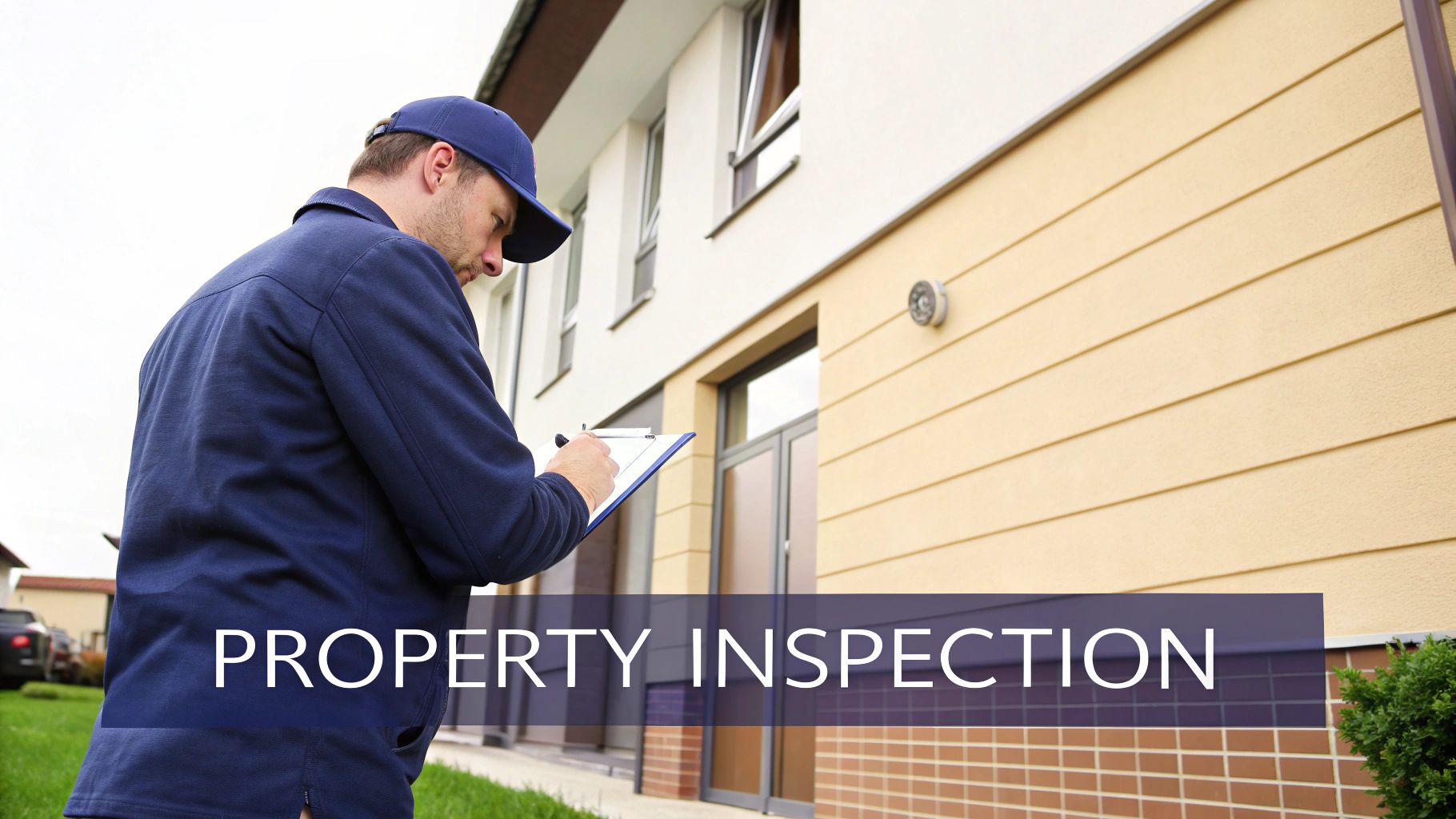
This process, guided by standards from organizations like ASTM International, involves qualified engineers and specialists examining structural integrity, HVAC, electrical, plumbing, and life-safety systems. The goal is to uncover deficiencies, estimate the remaining useful life of major components, and project future capital expenditure (CapEx) requirements. For instance, Prologis never acquires a warehouse without specialized industrial facility inspections that assess everything from slab tolerances to sprinkler system adequacy for modern logistics.
For sophisticated investors, this isn't just about avoiding lemons; it's about quantifying future costs. The findings from this assessment directly inform the underwriting model, ensuring that the pro forma accounts for necessary repairs and replacements. A surprise roof replacement or HVAC overhaul can cripple returns if not budgeted for at acquisition.
Why it matters (Novice Lens): Ignoring a thorough physical inspection is speculating, not investing. Hidden defects represent massive, unbudgeted liabilities that can surface immediately after closing. Imagine discovering that a multifamily property's plumbing system is suffering from systemic corrosion or that an office building's facade requires a million-dollar resealing project. These findings drastically alter the investment's financial viability.
Actionable Tips for a Comprehensive Review
Hire Licensed Professionals with Niche Experience: Use an engineering firm that specializes in your specific commercial property type. A hotel has different systems and wear patterns than a data center.
Request and Scrutinize All Maintenance Records: Compare the inspector's findings against the seller's maintenance logs and capital improvement history. Discrepancies can be a major red flag.
Focus on Big-Ticket Items: Pay special attention to the roof, HVAC systems, elevators, and building envelope (windows and facade). These are the most expensive components to replace and have the largest impact on your CapEx budget.
Factor Findings into Negotiations: Use the Property Condition Report (PCR) as a negotiation tool. The estimated cost for immediate and short-term repairs should be grounds for a price reduction or seller credit.
Video Source: GRS Group. A detailed inspection provides the hard data needed to validate your investment thesis and protect your capital from unforeseen physical risks.
4. Environmental Site Assessment (Phase I ESA)
A critical component of any comprehensive commercial property due diligence checklist is the Environmental Site Assessment (ESA). Specifically, a Phase I ESA is a systematic evaluation designed to identify potential or existing environmental contamination liabilities. This non-intrusive investigation follows strict EPA standards and is the real estate equivalent of a full-body health scan for a property; it seeks to uncover hidden, below-the-surface issues that could lead to catastrophic financial and legal consequences.
The process involves a rigorous review of historical records, aerial photographs, government databases, and site reconnaissance to determine if the property's past usage—such as a gas station, dry cleaner, or manufacturing plant—could have resulted in soil or groundwater contamination. A clean Phase I ESA is almost always a prerequisite for securing financing from institutional lenders and is essential for qualifying for certain liability protections under federal environmental laws.
Why it matters (Novice Lens): Failing to conduct a Phase I ESA means you are effectively acquiring a property blind to its environmental history. Discovering contamination after closing can trigger massive cleanup obligations, often costing millions of dollars. This liability can attach to you as the new owner, regardless of who caused the pollution. Imagine purchasing a prime retail corner only to find leaking underground storage tanks from a long-gone gas station, rendering your development plans unfeasible and your investment toxic.
Actionable Tips for a Comprehensive Review
Engage an EPA-Qualified Environmental Consultant: Do not compromise on expertise. A certified and insured environmental professional understands the specific standards (ASTM E1527-21) and has the experience to identify subtle indicators of contamination.
Review All Available Historical Records: Dig deep into city directories, Sanborn fire insurance maps, and historical aerial photos to build a complete picture of every business that has ever operated on or near the site.
Budget for a Potential Phase II Assessment: If the Phase I report identifies Recognized Environmental Conditions (RECs), you will likely need a Phase II assessment, which involves physical soil and groundwater sampling. Proactively budget for this possibility to avoid project delays.
Negotiate Environmental Indemnification Clauses: In the purchase agreement, seek to include clauses where the seller retains liability for any pre-existing contamination they caused. While not a substitute for your own due diligence, this adds a layer of contractual protection.
5. Lease Agreement and Tenant Analysis
For any income-producing asset, the value is inextricably linked to the strength and stability of its cash flow. This makes a forensic analysis of all lease agreements and tenants a non-negotiable part of any commercial property due diligence checklist. This stage moves beyond the physical asset to scrutinize the contractual relationships that generate revenue. It is the financial equivalent of stress-testing the engine of a high-performance vehicle; the property may look impressive, but its performance depends entirely on the quality of its income stream.
This process involves more than just reading the leases. It's about deconstructing each agreement to understand tenant obligations, landlord responsibilities, renewal options, and potential revenue pitfalls. It requires a deep dive into the creditworthiness and business health of each tenant to forecast the likelihood of continued, uninterrupted rent payments. For institutional investors, this analysis is paramount. Vornado Realty Trust, for instance, predicates major acquisitions on a granular tenant credit analysis, ensuring the durability of its rental income against economic headwinds.
Why it matters (Novice Lens): A property is only as valuable as the income it produces. Failing to properly analyze lease agreements means you are essentially buying an asset blind. You might inherit tenants on the brink of bankruptcy, leases with unfavorable terms that cap rent growth, or a dangerously high concentration of lease expirations in a single year. These hidden liabilities can cripple an investment's projected returns.
Actionable Tips for a Comprehensive Review
Create Detailed Lease Abstracts: For every significant tenant, create a summary document or "abstract" that outlines key terms: rent amount and escalations, lease start/end dates, renewal options, expense responsibilities (NNN, Gross), and any special clauses.
Verify Tenant Financial Health: Request and analyze tenant financial statements, especially for larger, non-public tenants. For publicly traded companies, review their credit ratings from agencies like Moody's or S&P to gauge their ability to meet long-term obligations.
Analyze Lease Expiration Concentration: Map out the lease expiration schedule for the entire property. A high percentage of leases expiring in the same year exposes the investment to significant vacancy and re-leasing risk, particularly in a down market.
Review Tenant Estoppel Certificates Carefully: An estoppel certificate is a signed statement from a tenant verifying their lease terms. Scrutinize these documents for any discrepancies with the lease agreement itself, as they can reveal side deals or disputes.
Assess Tenant Mix and Diversification: Evaluate the compatibility of tenants within the property. A well-diversified tenant base across different industries can provide a buffer against sector-specific economic downturns. This is a core component of effective asset management, which you can explore further by learning about the best practices for superior returns in real estate asset management.
6. Zoning and Land Use Compliance Verification
Just because a building is physically present and operating doesn't mean it’s legally compliant. Verifying zoning and land use regulations is a critical component of any commercial property due diligence checklist. This step ensures that the property's current use is permitted by local ordinances and that your future plans for the asset—whether it's a simple renovation or a full-scale redevelopment—are legally feasible. It is the architectural blueprint for what you are allowed to do, not just what is physically possible.
This process involves a detailed examination of municipal zoning maps, codes, and ordinances to confirm the property’s official designation (e.g., C-2 Commercial, I-1 Industrial). It uncovers specific rules governing setbacks, building height, parking requirements, and permitted uses. A property might be operating as a retail center, but if it's in a zone that was recently changed to residential-only, its "legal non-conforming" status could severely restrict any future expansion or rebuilding efforts.
Why it matters (Novice Lens): Ignoring zoning is like navigating without a map; you might end up in a place you can't develop or operate as planned. Discovering post-acquisition that your plan to add a second story violates height restrictions, or that the property lacks the required number of parking spaces for its current tenancy, can trigger costly fines, legal battles, or force a complete pivot in your investment strategy.
Actionable Tips for a Comprehensive Review
Obtain a Formal Zoning Verification Letter: Go beyond online maps. Request an official letter or report from the local planning and zoning department that confirms the property's current zoning classification and its compliance status.
Verify the Certificate of Occupancy (CO): Ensure the existing CO matches the property's actual use. A discrepancy can create significant legal and financing hurdles, signaling an illegal conversion or unpermitted use.
Review Local Planning Commission Minutes: Look for discussions about proposed zoning changes in the area. Upcoming "downzoning" could devalue your property, while "upzoning" could present a future value-add opportunity.
Engage a Local Land Use Attorney or Consultant: For properties with development potential or complex histories, an expert is invaluable. They understand the nuances of local politics and regulations and can effectively navigate the variance or rezoning process if needed.
7. Market Analysis and Comparable Sales Research
Beyond the physical asset and its financial statements, a commercial property’s value is fundamentally tied to its location and the economic forces at play within its market. A thorough market analysis and comparable sales research phase is where you validate the investment’s core assumptions. This process is akin to a strategic commander studying the terrain before committing troops; it determines whether you are buying at the top of the market or securing an asset with a clear path to appreciation.
This step involves a rigorous evaluation of local economic drivers, supply and demand dynamics, and rental and sales trends. By analyzing "comps" or comparable sales, you establish a fact-based valuation for the property, moving beyond the seller’s asking price to understand its true market worth. This isn’t just about finding similar buildings; it’s about finding properties with similar characteristics that have recently transacted under comparable market conditions.
Why it matters (Novice Lens): Failing to conduct a deep market analysis can lead to overpaying for an asset or misjudging its future performance. Imagine acquiring a retail center just as a major local employer announces its departure, or buying an office building in a market saturated with new supply. These external market factors, which have nothing to do with the property itself, can devastate returns.
Actionable Tips for a Comprehensive Review
Use Multiple Data Sources: Do not rely on a single report. Cross-reference data from sources like CoStar, CBRE, JLL, and local economic development agencies to get a complete picture.
Focus on Truly Comparable Properties: Look beyond square footage. Compare properties based on age, class (A, B, C), location, tenant quality, lease terms, and recent capital improvements for a true "apples-to-apples" comparison.
Analyze Future Supply and Demand: It’s not enough to know the current market. Investigate the development pipeline to understand how much new competing supply is coming online and analyze absorption rates to gauge demand.
Evaluate Key Economic Drivers: Scrutinize local employment trends, population growth, and the health of key industries. A diverse and growing economic base is a strong indicator of a resilient real estate market.
Engage Local Market Experts: Leverage the on-the-ground knowledge of commercial real estate brokers and appraisers who live and breathe the local market. Their qualitative insights can be invaluable.
8. Insurance and Risk Assessment Review
An often-underestimated component of a commercial property due diligence checklist is a rigorous review of the asset's insurance and overall risk profile. This step moves beyond merely confirming coverage exists; it involves a strategic assessment of potential liabilities, the adequacy of current policies, and the future cost of comprehensive protection. Think of it as stress-testing the property's financial resilience against unforeseen events, from natural disasters to tenant lawsuits.
This process requires a deep dive into the property's claims history, an analysis of existing policies for gaps or exclusions, and securing forward-looking quotes for the coverage you will need post-acquisition. For sophisticated investors, this is not a clerical task delegated at the last minute. It's a core underwriting variable that directly impacts net operating income and, consequently, the property's valuation. Firms like Brookfield Property Partners integrate comprehensive risk assessment into their acquisition models, ensuring potential insurance costs and liabilities are priced into the deal from the outset.
Why it matters (Novice Lens): Failing to properly assess insurance and risk can lead to devastating financial surprises. Discovering post-closing that the property is in a newly designated high-risk flood zone or has a history of liability claims can cause insurance premiums to skyrocket, torpedoing your pro forma projections. In regions like California or Florida, specialized coverage for earthquakes or hurricanes is a critical budget line item.
Actionable Tips for a Comprehensive Review
Engage an Insurance Broker Early: A commercial real estate insurance specialist can quickly identify risks specific to the property type and location, and begin sourcing competitive quotes from multiple carriers.
Review the Property's Loss History Report: Request a 3-5 year "loss run" report from the seller's current insurer. This document details past claims and can reveal recurring issues, such as water damage or security problems, that may not be obvious during a physical inspection.
Scrutinize Lender Insurance Requirements: Lenders have specific, non-negotiable insurance requirements. Confirm your quoted policies will meet these covenants for coverage types and amounts to avoid last-minute financing hurdles.
Evaluate Business Interruption Coverage: For income-producing properties, assess the need for business interruption insurance. This coverage replaces lost rental income if the property becomes uninhabitable due to a covered event, protecting your cash flow during reconstruction.
From Checklist to Confidence: Partnering for Success
Navigating the extensive landscape of a commercial property due diligence checklist is a formidable task, but it represents the foundational work that separates speculative bets from sound, strategic investments. This is not simply about paperwork; it's about piecing together a mosaic of legal, financial, physical, and market-based details to reveal the true story of an asset. From scrutinizing title reports and lease abstracts to conducting Phase I Environmental Site Assessments and validating zoning compliance, each step is a critical data point that informs the final investment decision.
Mastering this process transforms abstract risk into a quantifiable and manageable variable. It provides the clarity needed to underwrite an acquisition with discipline, model future performance with greater accuracy, and structure a deal that protects investor capital. For high-net-worth individuals, family offices, and institutional investors, the quality of a sponsor's due diligence is a direct reflection of their operational excellence and fiduciary commitment. A truly comprehensive commercial property due diligence checklist isn't a barrier to closing a deal; it's the very blueprint for its long-term success.
Key Takeaways and Strategic Imperatives
Financial and Legal Verification is Non-Negotiable: The numbers and the legal framework must be ironclad. Discrepancies in historical financials or unresolved title encumbrances are significant red flags that demand immediate resolution or a decision to walk away.
The Physical Asset Tells a Story: A building's condition, from its structural integrity to its HVAC systems, directly impacts future capital expenditure requirements. A thorough physical and environmental assessment prevents unexpected, costly surprises that can erode returns.
Market Context is King: An otherwise perfect asset in a declining market or with insurmountable zoning restrictions is a flawed investment. Your due diligence must confirm that the property is well-positioned within its competitive landscape and compliant with all local regulations for its intended use.
Actionable Next Steps for the Prudent Investor
Moving from theory to practice is the final, crucial step. Before committing capital to any commercial real estate opportunity, whether directly or through a sponsor, use this checklist as your guide. Engage qualified professionals, including legal counsel, environmental consultants, and property condition assessors.
Most importantly, for passive investors, the ultimate due diligence is on the sponsor themselves. You must rigorously question their process.
Questions to Ask a Sponsor (Investor Checklist)1. Can you walk me through your due diligence process on a recently closed deal?2. What was the biggest unforeseen challenge you uncovered during diligence, and how did you mitigate it?3. Which third-party experts (legal, engineering, environmental) do you use, and why?4. How do you verify a seller's pro forma financials and operating expenses?5. What are your key assumptions about the market (rent growth, exit cap rate), and what data supports them?
Ultimately, this exhaustive process is about building a foundation of confidence. It’s about knowing you’ve turned over every stone, analyzed every document, and stress-tested every assumption. This is the discipline that underpins resilient, long-term wealth creation in commercial real estate. When executed correctly, the commercial property due diligence checklist becomes your most powerful tool for converting opportunity into performance.
Ready to invest with confidence?
At Stiltsville Capital, this level of institutional-grade scrutiny is not just a process; it is the core of our investment philosophy. We empower our partners by conducting exhaustive due diligence, ensuring every asset is vetted to mitigate risk and unlock value. If our disciplined, transparent approach to real estate investment aligns with your goals, we invite you to schedule a confidential call to discuss your investment objectives.
[Schedule a Confidential Call with Stiltsville Capital]
Information presented is for educational purposes only and does not constitute an offer to sell or a solicitation of an offer to buy securities. Any offering is made only through definitive offering documents (e.g., private placement memorandum, subscription agreement) and is available solely to investors who meet applicable suitability standards, including “Accredited Investor” status under Rule 501 of Regulation D. Investments in private real estate involve risk, including loss of capital, illiquidity, and no guarantee of distributions. Past performance is not indicative of future results.
Comments