


A Guide to Texas Real Estate Investing for Sophisticated Investors
- Ryan McDowell

- 4 days ago
- 14 min read
Reading Time: 9 min | Good for: A, B
For any serious investor building a long-term portfolio, the question isn’t if you should allocate capital to real estate, but where. When searching for durable growth, Texas real estate investing consistently lands at the top of the list—not because of temporary hype, but due to rock-solid economic fundamentals.
The Texas growth story is built on a powerful foundation of nation-leading population growth, a steady influx of corporate relocations, and a business-friendly environment that fuels sustained demand.
TL;DR: Key Takeaways for Investors
Why Texas Now: The state's relentless population and job growth create a powerful, self-reinforcing cycle of demand across multifamily, industrial, and niche commercial real estate assets.
Who Should Care: Accredited investors and family offices seeking inflation-hedged returns, stable cash flow, and tax-efficient portfolio diversification outside of volatile public markets.
The Opportunity: The most compelling returns are often found in value-add and opportunistic strategies, where experienced sponsors actively create value by improving underperforming assets in high-growth submarkets.
Why Texas Is a Strategic Real Estate Priority
For family offices and high-net-worth investors focused on building lasting wealth, Texas is more than a state; it’s a dynamic economic ecosystem. Unlike markets propped up by a single industry, the Texas economy is a diversified powerhouse, reducing risk and creating sustained demand across a spectrum of real estate asset classes.
This isn't a fleeting trend. It’s a structural shift that continues to attract people and businesses, creating a uniquely compelling landscape where pro-growth policies and demographic tailwinds converge.
The Unmistakable Pull of Population and Job Growth
Ultimately, demand drives every real estate market, and in Texas, that demand is relentless.
The state’s population and job growth figures aren't just strong; they're consistently among the best in the nation. This constant influx of people creates a continuous need for places to live, work, and shop. Think of it as a growth flywheel: new jobs attract more residents, who in turn require more housing, services, and infrastructure.
This cycle fuels opportunities in several key areas:
Multifamily Housing: As new households form, both urban centers and suburban towns require more rental units to meet demand.
Industrial & Logistics: A larger population and expanding business base necessitate a smarter supply chain, driving the need for modern warehouses and distribution centers.
Niche Commercial: New communities cannot thrive without neighborhood shopping centers, medical offices, and other essential services.
Key Drivers of the Texas Real Estate Market
This table summarizes the primary economic and demographic forces fueling investment opportunities across the Lone Star State.
Growth Driver | Key Statistic (as of Q4 2023) | Impact on Real Estate Investing |
|---|---|---|
Population Boom | Added an estimated 473,000 residents in 2023, more than any other state (U.S. Census Bureau). | Creates sustained, high demand for multifamily housing, single-family rentals, and essential retail services. |
Robust Job Creation | Added 369,600 nonfarm jobs over the year in 2023 (Texas Workforce Commission). | Fuels demand for office space, industrial facilities, and housing for an expanding workforce. |
Corporate Relocations | Attracts major companies (e.g., Goldman Sachs, Caterpillar) with its pro-business climate and no state income tax. | Drives demand for large-scale commercial, industrial, and residential development projects. |
Economic Diversification | Strong presence in technology, energy, finance, and healthcare. | Reduces portfolio risk by avoiding dependence on a single industry, ensuring greater market stability. |
As the data shows, this is a long-term, sustainable trend. The U.S. Census Bureau confirmed Texas's robust growth in 2023, and this momentum is set to continue. The Texas Real Estate Research Center (TRERC) projects the state’s GDP will grow by 3.3% to 3.7% in 2025—well ahead of the national forecast.
For a complete breakdown of this powerful growth story, explore our strategic guide for investors.
Drilling Down: Key Texas Markets and Asset Classes
A winning Texas real estate strategy isn't built on statewide averages; it demands a granular approach. Every major metro possesses its own economic DNA, driven by unique industries and demographic shifts you can't see from 30,000 feet.
For a passive investor, the real opportunity emerges when you match the right asset class to the right city’s growth story. It's about having a sophisticated ground game—looking past generic headlines to see what’s actually driving returns. That could be a suburban multifamily deal in a booming corporate corridor or an industrial facility near a mission-critical logistics hub.
This side-by-side comparison shows exactly why the Texas market is so compelling. Its powerful population and GDP growth create an undeniable tailwind for disciplined investors.
The data speaks for itself. Texas consistently outpaces the national average in both attracting new residents and expanding its economy, creating a powerful, self-reinforcing cycle of demand for real estate.
The Dallas-Fort Worth Metroplex
Consider Dallas-Fort Worth (DFW) the central nervous system for corporate America and national logistics. Its strategic central U.S. location, combined with a world-class airport and a web of highways and rail lines, makes it an essential link in the supply chain.
For investors, this translates into clear opportunities:
Industrial and Logistics: Demand for modern warehouses and distribution centers is incredibly strong, a direct result of the e-commerce boom and the need for third-party logistics (3PL) providers to be close to consumers.
Suburban Multifamily: As corporate giants like Goldman Sachs and Caterpillar build massive campuses, the surrounding suburbs are seeing explosive population growth. This creates deep and consistent demand for quality rental housing.
The Houston Powerhouse
Houston is a global energy capital, but it’s also a world leader in healthcare and international trade. The Port of Houston is one of the busiest on the planet, and the Texas Medical Center is the largest medical complex in the world.
This diverse economic engine supports smart investments in:
Medical Office Buildings (MOBs): Proximity to the Texas Medical Center and its network of hospitals creates a built-in, stable tenant base of specialized healthcare providers.
Value-Add Multifamily: The region's massive workforce, from energy engineers to researchers, provides a steady pool of renters for well-located apartment communities that have been thoughtfully upgraded.
Investor Take: It’s all about matching the asset class to the city's core economic engine. Allocating capital to industrial properties in a logistics-heavy market like DFW or medical offices in a healthcare hub like Houston is how you align with durable, long-term demand.
Austin: The Tech and Innovation Hub
Austin's transformation from a quirky college town to a global tech hub has been meteoric. It’s a magnet for talent and companies, which has driven massive appreciation but has also created a hyper-competitive investment landscape.
Success here often lies in niche plays:
Data Centers: The tech industry runs on data. The sheer volume of processing and storage required creates a specialized and highly lucrative niche for savvy investors.
Hospitality and Experiential Retail: Austin’s vibrant culture, massive events like SXSW, and a constant flow of tourists support unique hotels and service-focused retail that cannot be replicated online.
San Antonio: A Stable Foundation
San Antonio offers a compelling mix of stability and steady growth. It's anchored by a significant military presence, a rapidly growing cybersecurity sector, and a robust year-round tourism industry. Crucially, it often provides a more attractive cost basis compared to other major Texas cities.
This environment creates prime opportunities for:
Workforce Housing: There is a deep, consistent need for quality, affordable rental housing for military families and the city's large service-sector workforce.
Adaptive Reuse Projects: The city’s rich history opens the door for creative projects, like converting underutilized historic buildings into modern apartments or boutique commercial spaces.
The Texas housing market has recently stabilized from its frenzied peak, creating a more balanced environment for investors. The Texas REALTORS® Q3 2025 Housing Report noted the median home price was $335,000, with housing inventory rising to a healthier 5.5 months. This stabilization allows more time for disciplined underwriting—a welcome change for any serious investor.
How Sophisticated Sponsors Create Value
In Texas real estate, the most significant wins aren't found—they're made. While a booming market provides a tailwind, top sponsors don't just buy a property and hope for appreciation. They actively manufacture value.
This process combines on-the-ground insights with rigorous financial modeling to transform an average property into a top-performing asset. The strategy is to identify underperforming properties and execute a precise business plan to force appreciation, grow cash flow, and deliver strong returns for investors.
The Value-Add Playbook in Action
The most common approach is the value-add strategy, which is effective due to its logical foundation.
Imagine a dated, 1990s-era apartment complex in a prime Dallas suburb. The building has "good bones" and an A+ location, but its dated interiors and lack of modern amenities are suppressing rents far below what newer nearby buildings command. A sharp sponsor sees this gap as a significant opportunity.
The plan is not overly complex but demands precision:
Smart Renovations: The focus is on strategic renovations that deliver the most return on investment. Think quartz countertops, stainless steel appliances, and LVP flooring, installed as units naturally turn over.
Upgraded Amenities: Common areas are modernized to compete with new construction. This could include a revamped fitness center, a secure package locker system, or an outdoor kitchen.
Streamlined Operations: The team implements new property management software and utility billing systems to reduce operating expenses and drive up Net Operating Income (NOI).
Each improvement justifies a "rent bump," allowing the property to command higher rents and attract higher-quality tenants. This deliberate increase in NOI is the engine that drives value creation.
Opportunistic and Adaptive Reuse Strategies
Beyond the standard playbook, top-tier sponsors tackle more complex projects like opportunistic development and adaptive reuse. This is where deep expertise in construction, zoning, and market trends separates the professionals from the amateurs.
An adaptive reuse project might involve converting a forgotten warehouse in San Antonio’s urban core into a vibrant mixed-use property with loft apartments and ground-floor retail. This move capitalizes on a prime location while creating a unique product the market craves.
Why It Matters for Investors (Persona A): These strategies directly create your returns. By increasing a property's Net Operating Income (NOI), a sponsor not only boosts monthly cash flow but also significantly increases the property's sale price. The goal is to make the asset worth far more than the total capital invested.
To maintain efficiency across a portfolio, savvy sponsors leverage technology. For a look at the tools that power these operations, see this guide on the best property management apps.
Underwriting the Value Creation
This process is not guesswork. Every strategy is built on detailed financial analysis. Sponsors model every assumption before a single dollar is spent.
Key metrics they live by include:
Yield-on-Cost: This shows the projected stabilized NOI as a percentage of the total project cost (purchase price plus renovation expenses). The goal is a yield significantly higher than the cap rate for similar, already-stabilized properties.
Projected IRR: Sponsors model various exit scenarios, projecting the Internal Rate of Return (IRR) based on different sale prices and timelines to confirm the potential reward justifies the risk.
By meticulously underwriting these numbers, a sponsor can confidently demonstrate how their business plan will translate into tangible financial gains. For a closer look at these tactics, see our guide on 8 proven strategies to add value to real estate investments in 2025. This is how investing shifts from a passive bet to a proactive, value-driven business.
Deal Lens: A Texas Value-Add Project Example
Theory and market data are essential, but nothing clarifies the process like a real-world example. Let’s walk through a simplified case study of a value-add multifamily project to make these concepts tangible.
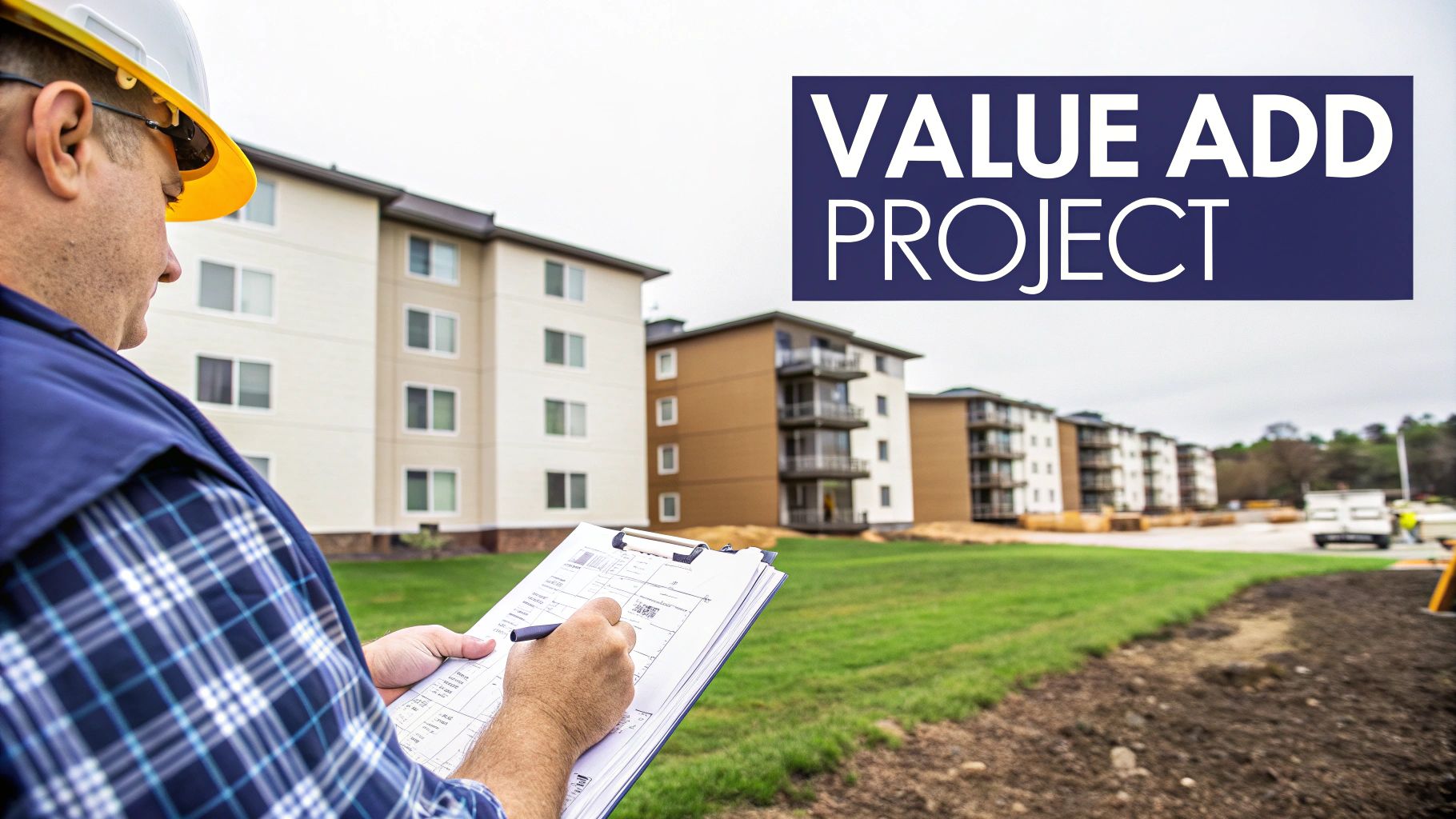
Consider a 200-unit, Class B apartment complex built in the late 1990s, located in a desirable Dallas-Fort Worth suburb with excellent schools and access to major job centers. The issue? It’s tired. The property's dated laminate countertops and worn-out amenities cause its rents to lag 15-20% behind newer properties nearby.
That gap represents pure opportunity for a savvy sponsor.
The Acquisition and Business Plan
An experienced sponsor team identifies this diamond in the rough and acquires it for $30 million. Their business plan is to inject $4 million in capital improvements—$20,000 per unit—to execute a strategic renovation over two years.
To fund the deal, they assemble a capital stack:
Senior Debt: $22 million from a commercial lender.
LP Equity: $10 million from passive, accredited investors.
GP Equity: $2 million from the sponsor's own funds, ensuring alignment of interests.
The goal is a methodical plan to boost the property’s Net Operating Income (NOI). As old leases expire, the team modernizes units with quartz countertops, stainless steel appliances, and fresh flooring. They also upgrade common areas, perhaps adding a state-of-the-art fitness center or a secure package locker system.
Investor Takeaway: This plan is grounded in hard data showing proven rent premiums for renovated units in the specific submarket. By bringing the property up to current standards, the sponsor can systematically close the rent gap and force appreciation, dramatically increasing the asset's value.
Mapping the Project Timeline
A well-executed value-add project follows a predictable lifecycle. The sponsor's job is to manage each phase with precision to maintain schedule and budget.
Year 0 (Acquisition): The deal closes, and the initial capital is deployed. The renovation plan begins immediately.
Years 1-2 (Renovation & Stabilization): This is the heavy-lifting phase. The team renovates units and common areas systematically. As upgraded units come online, they are leased at higher market rates.
Year 3 (Stabilization): The renovation is complete. The property is operating efficiently with stabilized occupancy and a much healthier NOI.
Years 4-5 (Exit): With the business plan fully executed and a proven track record of higher income, the sponsor can either refinance the property to return capital to investors or sell the asset to realize the full profit.
This structured approach transforms an underperforming property into a premium, cash-flowing asset.
Illustrative Value-Add Multifamily Project Projections
Here’s a simplified model of the financial journey for our hypothetical 200-unit Texas apartment deal. This demonstrates how strategic improvements directly translate into a higher property valuation and strong investor returns.
Metric | At Acquisition (Illustrative) | Projected at Stabilization (Year 3) | Commentary |
|---|---|---|---|
Purchase Price | $30,000,000 | N/A | Based on current, in-place income. |
Capital Improvements | $4,000,000 | N/A | $20,000 per unit for renovations. |
Average Rent/Unit | $1,400/month | $1,750/month | Capturing the 25% rent premium after upgrades. |
Net Operating Income (NOI) | $1,500,000 | $2,100,000 | Increased rents and optimized expenses drive NOI growth. |
Cap Rate (at Exit) | 5.00% | 5.00% | Assumes a stable cap rate for the submarket. |
Projected Property Value | N/A | $42,000,000 | Calculated as Stabilized NOI / Exit Cap Rate. |
Total Profit on Sale | N/A | $8,000,000 | ($42M Value - $30M Purchase - $4M Capex). |
By executing this business plan, the sponsor generates a substantial increase in property value, creating a significant return for both the general partners and the limited partner investors who funded the deal. This is the power of value-add real estate investing.
Risk and Mitigation in the Texas Market
In Texas real estate, you make your money on the buy—and that starts with disciplined underwriting, not market hype. A smart investment strategy means looking potential challenges square in the eye and having a solid plan to mitigate them. You must stress-test every deal to see how it holds up, not just in a perfect world, but when conditions change.
For investors, this is how you protect capital. It’s about asking the tough questions upfront: What if interest rates rise? What if rent growth projections don't materialize? A sponsor’s ability to answer these questions with data separates professional investing from speculation.
The Metrics That Matter
Novice Lens (Persona A): Think of underwriting as a financial home inspection. Before buying a house, you hire an expert to check for hidden issues. In real estate investing, underwriting does the same for a deal's financials, ensuring the numbers are solid before anyone commits capital.
Two of the most important metrics you’ll see are:
Capitalization (Cap) Rate: A snapshot of a property's annual Net Operating Income (NOI) against its purchase price. A higher cap rate can indicate a higher potential return but may also signal more risk.
Internal Rate of Return (IRR): A more sophisticated metric that calculates the total annualized return of an investment, factoring in all cash flow received during the hold period plus the final profit at sale. It provides a complete picture of a project's profitability.
The Real Litmus Test: Sensitivity Analysis
For sophisticated investors, initial projections are just the starting point. The true test of a deal’s resilience is sensitivity analysis, where we model "what-if" scenarios to see how returns are affected when key assumptions change. A thorough analysis puts the following variables under a microscope:
What if the exit cap rate expands (we sell for less than planned)?
What if rent growth is slower than forecasted?
What if operating expenses are higher than expected?
What if property taxes jump unexpectedly?
By running these scenarios, a sponsor can identify a deal’s break-even points and build in sufficient cushion to protect investor capital, turning a forecast into a battle-tested plan.
Common Headwinds and Mitigation Strategies
Every deal has risks, but seasoned Texas operators know what to look for and how to prepare.
Risk: Runaway Property Taxes * Mitigation: Texas property taxes are a known factor. A prudent sponsor underwrites conservative tax increases annually and engages specialized local firms to aggressively protest valuations, protecting returns from being eroded.
Risk: A Glut of New Supply * Mitigation: This is managed with deep, submarket-level research. A top-tier sponsor focuses on areas with diverse job growth and high barriers to entry, ensuring demand remains strong even as new buildings are constructed nearby.
Risk: Spiking Interest Rates * Mitigation: Experienced operators use tools like interest rate caps or lock in fixed-rate debt on long-term deals to shield cash flow from volatility. For shorter-term projects, underwriting models include higher financing cost scenarios to ensure the deal remains profitable.
Your Due Diligence Checklist for Texas Real Estate Investing
Knowledge is your best defense against a poor investment. Before committing capital to any Texas real estate investing opportunity, a disciplined due diligence process is non-negotiable. It is the framework that separates smart investing from speculation.
Think of it as your pre-flight inspection. A quality sponsor will not just tolerate these questions—they will welcome them and have the answers ready.

Vetting the Sponsor and Their Track Record
The sponsor is the single most important variable in any passive real estate investment.
Local Experience: Does the sponsor have a proven track record in this specific Texas submarket and with this asset class? Ask for case studies of comparable completed projects.
Alignment of Interests: How much of their own capital is the sponsor investing in the deal? Significant "skin in the game" is a powerful indicator that their interests are directly aligned with yours.
Communication & Reporting: What is their system for keeping investors informed? Expect clear, professional, and timely updates on a consistent schedule.
Scrutinizing the Deal Structure and Assumptions
This is where you dig into the numbers to ensure projections are grounded in reality.
Investor Insight: A deal's pro forma is a story about the future. Your job during due diligence is to determine if that story is a well-researched forecast or optimistic fiction.
Key questions to ask include:
Rent Growth Assumptions: Are projected rent increases supported by independent, third-party market data for that specific neighborhood?
Exit Strategy: What are the primary and secondary exit plans? How sensitive is the projected return to a shift in the exit cap rate or hold period?
Debt Structure: Is the loan structured prudently? Get clarity on the interest rate, term, and any recourse provisions.
The state’s tax environment also enhances overall returns. Texas has no state income tax, a significant advantage for rental income. When combined with a stable market where average home values hovered around $303,321 in 2025, the appeal for disciplined investors is clear.
As you conduct due diligence, consider the long-term implications, including key real estate considerations in Texas estate planning. For a more granular breakdown, review your ultimate commercial property due diligence checklist for 2025.
Frequently Asked Questions About Texas Investing
Navigating a new market naturally brings questions. Here are straightforward answers to the most common queries we receive from accredited investors and family offices exploring Texas for the first time.
What Are the Biggest Risks for Texas Real Estate Investing Right Now?
The two primary risks we monitor closely are potential oversupply in certain booming multifamily submarkets and the relentless climb of property taxes, which can directly impact net operating income. Mitigating these risks requires discipline: selecting submarkets with diverse job growth, not just hype, and underwriting with realistic property tax figures while having an aggressive plan to appeal them annually.
How Does a Private Real Estate Syndication in Texas Work?
A syndication allows accredited investors to pool their capital to acquire a larger, institutional-quality asset than they could individually. You invest as a Limited Partner (LP) into a legal entity, typically structured under SEC Regulation D. The sponsor, or General Partner (GP), finds the deal, secures financing, and manages the asset. As a passive LP, you provide capital in exchange for a share of the cash flow and profits, governed by a "waterfall" agreement that typically includes a preferred return, ensuring LPs are paid first.
Which Texas Cities Offer the Best Value-Add Opportunities?
While opportunities exist across all major Texas metros, we see some of the most compelling value-add plays in established, first-ring suburbs around Dallas-Fort Worth and Houston. These areas have solid demographics and a deep job base, but their apartment stock (often built from the 1980s to the early 2000s) is ripe for renovation. This creates a perfect opportunity to modernize an asset and capture a significant rent premium on a lower cost basis than new construction.
Is It Better to Invest in Residential or Commercial Property in Texas?
The optimal choice depends on your portfolio goals. Residential, particularly multifamily, offers stable cash flow tied to the state's explosive population growth. Commercial assets like industrial and logistics properties capitalize on the massive e-commerce and trade boom. For most passive investors, commercial syndications are highly efficient, providing access to top-tier assets managed by professional operators and allowing for diversification without requiring deep operational expertise.
At Stiltsville Capital, we provide accredited investors with direct access to meticulously underwritten commercial real estate opportunities in high-growth Texas markets. If you are ready to explore how a disciplined, value-add strategy can align with your portfolio goals, we invite you to schedule a confidential call.
Information presented is for educational purposes only and does not constitute an offer to sell or a solicitation of an offer to buy securities. Any offering is made only through definitive offering documents (e.g., private placement memorandum, subscription agreement) and is available solely to investors who meet applicable suitability standards, including “Accredited Investor” status under Rule 501 of Regulation D. Investments in private real estate involve risk, including loss of capital, illiquidity, and no guarantee of distributions. Past performance is not indicative of future results. Verification of accredited status is required for participation in Rule 506(c) offerings.
Comments