


DST Real Estate: Your Ultimate Guide to 1031 Exchanges
- Ryan McDowell

- Dec 4, 2025
- 12 min read
Reading Time: 8 min | Good for: Novice Investors (A), Family Offices (B)
Ever thought about owning a piece of a high-end office building or a sprawling apartment complex without the late-night calls about leaky faucets? That's the simple idea powering DST real estate. A Delaware Statutory Trust (DST) is a savvy legal structure that lets a group of investors pool their money to buy institutional-grade commercial properties, making it a powerful tool for tax-deferred 1031 exchanges and passive income.
TL;DR: Key Takeaways on DST Real Estate
What it is: A DST is a legal trust that holds title to real estate, allowing multiple investors to own a fractional interest in a large commercial property.
Why it Matters for 1031 Exchanges: A beneficial interest in a DST is considered "like-kind" property by the IRS, making it a pre-packaged, ready-to-go solution for investors needing to meet tight 1031 exchange deadlines.
Who It's For: Ideal for accredited investors seeking passive income, portfolio diversification, and a way to defer capital gains taxes without the hassles of direct property management.
What Exactly is DST Real Estate?
Think of a DST as a professionally managed portfolio for direct real estate. Instead of owning a tiny piece of hundreds of stocks, you own a fractional share—what's called a "beneficial interest"—in a tangible asset, like a new logistics hub or a modern medical office building.
This structure is a game-changer for passive investors. You get the financial perks of direct ownership, like potential monthly income and appreciation, but a professional sponsor firm handles all the heavy lifting. They’re the ones dealing with tenants, managing maintenance, arranging financing, and eventually selling the property. For investors looking to step back from being a landlord or diversify their portfolio without taking on more work, the DST model is a nearly perfect fit.
The Legal and Tax Angles That Drive Its Power
Here's where it gets really interesting for wealth preservation. The IRS officially recognized the DST structure in its Revenue Ruling 2004-86. This ruling confirmed that an interest in a properly structured DST qualifies as "like-kind" property for a 1031 tax-deferred exchange.
That ruling is the foundation of modern DST investing. It means you can sell an investment property, roll the full proceeds into one or more DSTs, and defer the capital gains tax liability, potentially indefinitely. This makes DSTs an incredibly powerful tool for preserving wealth and compounding your portfolio's growth.
What makes a DST work under IRS rules?
Truly Passive Ownership: As an investor, you're a beneficiary. You have no day-to-day management duties or operational control, which is a key requirement for the structure to qualify for a 1031 exchange.
A Single Borrower: The trust holds the title to the property. This streamlines everything, as lenders work with one stable entity—the trust—not dozens of individual investors.
Ready-Made Investments: Sponsors perform all the upfront due diligence. They find the property, secure financing, and package the deal before you ever see it, making the investment process incredibly straightforward.
Novice Lens: Why it MattersA DST gives you a clear path to owning a piece of top-tier commercial real estate without the management headaches. The structure is tailor-made to qualify for a 1031 exchange, blending portfolio diversification with significant tax benefits.
For busy family offices and high-net-worth individuals, this unlocks access to properties and markets you could never realistically acquire and manage on your own. A DST lets you build a diversified portfolio of high-caliber assets across different regions and property types, all managed by seasoned pros. This efficient, simplified access is precisely why DSTs have become a go-to vehicle for sophisticated investors.
How DSTs Supercharge Your 1031 Exchange Strategy
If there’s one reason investors flock to DSTs, it’s this: they solve the intense pressure-cooker problem of a 1031 exchange. Anyone who’s sold an investment property knows the anxiety of that ticking IRS clock. DSTs offer an elegant, institutional-grade solution.
At its heart, Section 1031 of the tax code is a cornerstone of building real estate wealth. It lets you defer capital gains taxes by rolling the proceeds from a sale into a "like-kind" replacement property. Simple enough, right? But the rules are famously strict.
The 45-Day Identification Window: You have just 45 days from your closing to formally identify potential replacement properties.
The 180-Day Closing Window: You must then acquire one or more of those identified properties within 180 days of your original sale.
These deadlines create a frantic scramble. Trying to find, vet, negotiate, and close on a quality property in that tight timeframe is a huge lift that often leads to rushed decisions and compromises you wouldn't otherwise make.
The DST as a Pre-Packaged Solution
This is exactly where the DST model proves its worth. Sponsors do all the heavy lifting months ahead of time. They’ve already identified a high-quality asset, performed exhaustive due diligence, arranged the financing, and pre-packaged the entire deal into a trust.
So, when your 1031 clock starts ticking, you aren’t starting from scratch. Instead, you can review a menu of professionally vetted DST offerings that are ready to go. You simply select the DSTs that fit your goals, and your qualified intermediary wires the funds directly to the trust. That’s it. This simple process makes hitting those IRS deadlines not just possible, but completely straightforward.
This flowchart shows just how streamlined the investment process is.
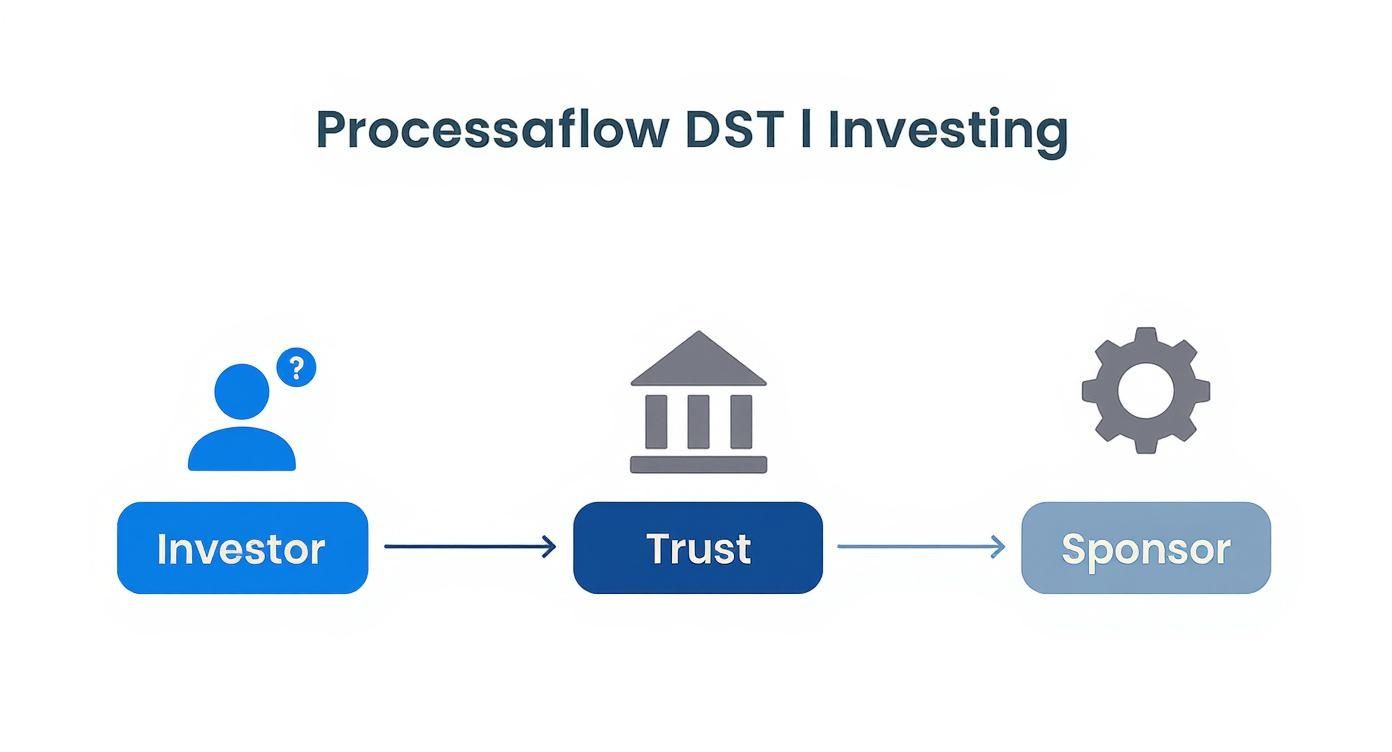
As you can see, the structure removes you from the nitty-gritty of direct acquisition. The sponsor takes the lead as the central manager of the trust's asset.
Building an Instantly Diversified Portfolio
Beyond simply meeting deadlines, DSTs unlock a strategic advantage that’s nearly impossible for an individual investor to achieve in a conventional 1031 exchange. Let’s say you sell an apartment building for $5 million. Instead of hunting for another single $5 million property, you could split those funds across several different DSTs.
Investor Takeaway: Using multiple DSTs lets you diversify your 1031 exchange proceeds across different property types, geographies, and sponsors. It's a sophisticated risk-mitigation strategy that used to be available only to large institutions.
For instance, you could place:
$1.5 million into a multifamily DST in the Sunbelt.
$1.5 million into a logistics and distribution center DST in the Midwest.
$1.0 million into a medical office building DST in the Southeast.
$1.0 million into a net-lease retail DST in Texas.
Trying to achieve this level of instant diversification through direct ownership within 180 days would be an operational nightmare. With DSTs, it becomes a practical and powerful strategy. For a deeper dive into how these tax-deferred structures work, check out our guide on 1031 exchange funds for passive real estate investing.
Market Why-Now: Following the Capital Flow
Smart investors follow the capital, and today, a significant flow of private wealth is moving into Delaware Statutory Trusts. This isn't a fleeting trend—it’s a structural shift in how accredited investors access institutional-quality real estate, particularly for 1031 exchanges.
The reasons are clear: a growing desire for passive, professionally managed assets combined with an increasing supply of high-quality DST offerings from reputable sponsors.
Market Signal Box (as of Q2 2024)* The Data: DST fundraising has shown remarkable growth. In 2023, the industry raised approximately $9.2 billion in new equity, and the forecast for 2024 and beyond remains strong as more 1031 investors seek passive replacement properties. (Source: Mountain Dell Consulting, 2024).* Interpretation: This is not niche-market activity. This sustained, multi-billion dollar capital flow demonstrates deep investor confidence in the DST structure as a durable component of a modern real estate portfolio.* Investor Take: The growing market maturity means more choices, higher-quality assets from experienced sponsors, and better potential liquidity options upon exit.
The heavy concentration of capital is flowing into two key sectors, revealing a clear strategy among sponsors: bet on essential needs.
Industrial & Logistics: The backbone of e-commerce, these properties often feature long-term leases with creditworthy tenants, providing predictable income.
Multifamily Housing: People always need a place to live, making apartments a resilient asset class, especially in high-growth markets like the Sunbelt.
Paying attention to these capital flows is a critical first step in aligning your own investment strategy with what’s performing in the current market. You can get more insights on this in the 2025 DST outlook from knpre.com.
Looking Under The Hood: DST Properties and Deal Structures
When you invest in a Delaware Statutory Trust, you're not just buying an abstract financial product. You're getting a beneficial interest in a real, tangible, income-producing property. Therefore, the most critical step is understanding what’s “under the hood” of any DST offering.
Sponsors worth their salt focus on institutional-quality properties. These are the kinds of assets that large pension funds and insurance companies buy—stable, well-located, and in sectors with strong economic tailwinds. This approach gives the underlying real estate the best possible chance of generating reliable cash flow and appreciating in value.

Common Property Types You'll Find in DSTs
While a DST can technically hold almost any kind of real estate, you’ll find that most institutional capital flows into a few core sectors known for their resilient demand.
Multifamily: Everyone needs a place to live, making apartments a perennially strong asset. DSTs often target communities in high-growth Sunbelt markets to capitalize on booming job growth and population shifts.
Industrial & Logistics: The explosion of e-commerce has made modern warehouses and distribution centers essential. These properties often come with long-term leases signed by giants like Amazon or FedEx, delivering highly predictable cash flow.
Medical Office Buildings: With an aging population and a shift toward outpatient care, medical office buildings (MOBs) are a defensive play. They're usually located near hospitals and have "sticky" tenants—doctors and healthcare systems rarely move.
Net-Lease Retail: Think of single-tenant properties leased to a national brand like CVS, Walgreens, or Dollar General. The tenant is responsible for most operating expenses (taxes, insurance, maintenance), creating a passive and predictable income stream.
Deal Lens: A Simple Multifamily DST Example
Let's illustrate how the numbers might work in a typical DST. Here’s a simplified, illustrative example of how a sponsor might structure a multifamily DST.
The Asset: "Sunbelt Gardens," a 200-unit, Class B apartment complex in a growing suburban market.
The Strategy: A light value-add plan. The sponsor will renovate unit interiors as they turn over, upgrade common area amenities, and increase rents to meet the current market rate.
The Capital Stack (Illustrative):
Acquisition Price: $30,000,000
Loan Amount (60% LTV): $18,000,000
Total Equity Needed: $12,000,000
The sponsor raises that $12 million in equity from a pool of 1031 exchange investors and other accredited investors, who all become beneficiaries of the DST.
Projected Returns (Illustrative):
Years 1-5 Cash Flow: After debt service and operating expenses, the property generates an average annual cash-on-cash return of 5.5%, distributed to investors monthly or quarterly.
The Exit (Year 5): With renovations complete and rents stabilized at a higher level, the sponsor sells the asset for $38,000,000.
Investor Payout: After repaying the $18M loan, the remaining $20,000,000 in proceeds is distributed to the DST investors. This represents their original capital plus appreciation, on top of the cash flow they received during the hold period.
This example shows the two primary ways a DST generates returns: steady income from operations and potential capital appreciation upon sale. It’s no wonder many people exploring how to invest $100k for passive income find DSTs an attractive way to gain real estate exposure without the landlord duties.
Your Practical Due Diligence Checklist for DSTs

While a DST simplifies the ownership process, it amplifies the importance of due diligence. As a passive investor, you are placing immense trust in the sponsor's ability to execute a business plan to profitable completion. Reading the offering memorandum is just the start. Real diligence means asking the tough questions about both the sponsor and the underlying asset.
Actionable Investor Checklist: Questions to Ask a Sponsor
1. Evaluating the Sponsor (The "Jockey")
What is your full-cycle track record? Ask for a list of past DSTs, including both successes and deals that underperformed. A history that includes navigating downturns (like 2008 or 2020) is more telling than one limited to a bull market.
How much of your own capital is co-invested in this deal? "Skin in the game" is the ultimate sign of alignment. A sponsor who invests significantly alongside you has a powerful incentive to protect the investment.
How is your fee structure aligned with my returns? Scrutinize all fees (acquisition, asset management, disposition). Look for structures where the sponsor's primary compensation is tied to the successful sale of the property (the "promote"), ensuring they win when you win.
2. Vetting the Real Estate (The "Horse")
How conservative are your rent growth and exit cap rate projections? These are the two biggest levers in any financial model. Ask the sponsor to provide the third-party market data supporting their assumptions. Optimistic projections can make a mediocre deal look like a grand slam on paper. A great way to understand this is to get familiar with a real estate comparative market analysis template.
What is the quality of the tenant base and lease terms? For a commercial property, what are the tenants' credit ratings and lease durations? For multifamily, what is the resident profile and local rent-to-income ratio? A property with long-term leases to creditworthy tenants is fundamentally less risky.
What are the loan terms and maturity date? Understand the leverage. Is the interest rate fixed or floating? When does the loan mature? A near-term maturity date in a rising interest rate environment is a significant risk that could erode profitability upon a forced refinancing.
For an even deeper dive into asset-level diligence, check out our ultimate commercial property due diligence checklist.
Navigating DST Risks and Exit Strategies
Every prudent investment strategy begins with a clear-eyed assessment of the risks. While DSTs offer compelling benefits, they are not without them. Understanding these factors and the eventual exit path is crucial before committing capital.
The central risk lies in the passive nature of the investment itself. You are relying entirely on the sponsor's expertise and integrity. Furthermore, DST investments are illiquid. There is no public market for your interest; capital is typically committed for a holding period of 5 to 10 years.
Risk & Mitigation Table
Risk: Illiquidity * Your capital is locked in for the life of the trust (typically 5-10 years). * Mitigation: Only invest capital you are certain you won't need for the long term. Ensure the DST fits within your overall portfolio's liquidity profile.
Risk: Sponsor Execution * Poor management or a flawed business plan can lead to underperformance. * Mitigation: Conduct rigorous due diligence on the sponsor's track record, financial strength, and alignment of interests as outlined in the checklist above.
Risk: Market Downturn * A recession or rising interest rates could reduce property values and cash flow. * Mitigation: Invest with sponsors who use conservative leverage and underwrite deals based on realistic, stress-tested assumptions. Diversifying across multiple DSTs can also reduce concentration risk.
The "Seven Deadly Sins" of a DST
The very IRS ruling that enables DSTs—Revenue Ruling 2004-86—imposes strict limitations on the sponsor's actions after the offering is closed. Violating these "Seven Deadly Sins" can disqualify the trust's 1031 status, triggering a taxable event for all investors.
The sponsor is strictly forbidden from:
Accepting new capital contributions after the offering closes.
Renegotiating the existing loan or borrowing new funds.
Reinvesting proceeds from the sale of the property.
Holding back more than reasonable cash reserves.
Making significant capital improvements (beyond planned repairs).
Entering into new leases or renegotiating existing ones (this is usually handled via a master lease structure).
Failing to distribute all available cash to investors.
Investor Takeaway: These rules are designed to ensure the DST remains a passive investment vehicle. An experienced sponsor understands these constraints intimately and builds a business plan that operates well within them, protecting your tax-deferred status.
Planning Your Exit
The exit strategy for a DST is straightforward: the sponsor sells the property. This typically occurs after the planned 5 to 10-year hold period, ideally into a strong market to maximize investor returns.
Upon sale, the loan is repaid, and the remaining proceeds are distributed to you and the other beneficiaries. At that point, you have a critical decision:
Cash Out: Receive your principal and profits, paying the capital gains taxes you've deferred plus taxes on any new appreciation.
Roll It Over Again: Execute another 1031 exchange, rolling your proceeds into a new DST (or several) or a directly-owned property. This allows you to continue the tax-deferral cycle.
The ability to "swap 'til you drop" by rolling from one DST to the next is a powerful wealth-building strategy. A good sponsor will communicate their exit plan and your options well in advance of a sale. For more context on this critical stage, explore a guide to real estate investment exit strategies.
Frequently Asked Questions About DST Real Estate
How are distributions from a DST taxed?Distributions are treated like rental income from a direct property investment. The cash flow is often partially or fully sheltered by the property's depreciation and mortgage interest expense, making it a highly tax-efficient income stream. At year-end, you receive a simple operating statement, not a complex K-1 form common in partnerships.
What is the typical minimum investment for a DST?The most common minimum for 1031 exchange investors is $100,000, as this amount aligns well with the need to place specific amounts of capital. For non-1031 cash investors, the minimum is often the same, though some offerings may accept as little as $25,000 or $50,000.
Can I use a self-directed IRA to invest in a DST?Yes, investing in a DST through a self-directed IRA is a common strategy. However, be aware that if the DST uses debt (leverage), it may trigger Unrelated Business Taxable Income (UBTI) within the IRA. It's essential to select a debt-free DST offering or consult with a financial advisor to navigate this complexity.
What happens if the property needs unexpected capital?Due to the "Seven Deadly Sins," a DST cannot raise new capital from investors after closing. To account for this, sponsors build a substantial capital reserve fund into the initial offering. This buffer is set aside to cover unforeseen repairs, tenant improvements, and leasing commissions, ensuring the property's operational health without violating IRS rules.
Well-structured real estate assets like DSTs can be a prudent, resilient component of a long-term wealth strategy. While they involve risks like illiquidity and reliance on sponsor performance, the mitigants of thorough due diligence and diversification can help create a durable, passive income stream.
Ready to see how a DST could fit into your 1031 exchange or passive income goals? The team at Stiltsville Capital has the institutional expertise and deal flow to help you make a smart, informed decision.
Schedule a confidential call with Stiltsville Capital to talk through your specific investment objectives.
Information presented is for educational purposes only and does not constitute an offer to sell or a solicitation of an offer to buy securities. Any offering is made only through definitive offering documents (e.g., private placement memorandum, subscription agreement) and is available solely to investors who meet applicable suitability standards, including “Accredited Investor” status under Rule 501 of Regulation D. Investments in private real estate involve risk, including loss of capital, illiquidity, and no guarantee of distributions. Past performance is not indicative of future results.
Comments