


What Is a 1031 Exchange? A Guide to Deferring Taxes & Compounding Wealth

Reading Time: 7 min | Good for: Novice & Informed Investors (A, B)
A 1031 exchange is one of the most powerful tax-deferral tools available to real estate investors. In short, Section 1031 of the U.S. Internal Revenue Code allows you to sell an investment property and roll 100% of the proceeds into a new, like-kind property without immediately paying capital gains tax.
Think of it as trading up your portfolio without taking an immediate tax hit. This strategy is a cornerstone for investors looking to build long-term wealth, allowing capital to compound more efficiently over time.
TL;DR: The 1031 Exchange in a Nutshell
What it is: A strategy under Section 1031 of the tax code that allows investors to defer capital gains taxes on the sale of an investment property by reinvesting the proceeds into a new, similar property.
Who it's for: Real estate investors—from individuals to family offices—seeking to scale their portfolios, diversify assets, or transition into different property types without triggering a major tax event.
The Big Picture: By deferring taxes, you keep your entire capital base working for you, dramatically accelerating portfolio growth and compounding returns over the long term.
The Foundation of Tax-Deferred Real Estate Investing
The 1031 exchange allows you to swap one investment property for another of "like-kind." This isn't about dodging taxes forever, but rather strategically postponing them. It’s a way to move from one asset to the next without a huge chunk of your money getting siphoned off by the IRS.
By rolling your gains forward, you can dramatically accelerate your portfolio's growth. Instead of losing 15% to 20% or more of your sale proceeds to taxes, you get to reinvest the entire amount. This keeps your full capital base working for you, compounding over time.
A Simple Analogy to Get You Started
Imagine you're playing a real estate board game. A 1031 exchange is like a special rule card that lets you trade one of your properties for another of equal or greater value without paying any penalty to the bank.
In the real world, this could mean selling a small rental house you’ve held for years and using the full proceeds to buy a larger apartment building. You get to upgrade your assets without an immediate tax bill on all the appreciation your first property earned.
Where Did the 1031 Exchange Come From?
This strategy isn't some new-fangled loophole. It has been a cornerstone of real estate investing for more than a century, with its roots in the Revenue Act of 1921.
The modern version we use today, however, was really defined by the landmark Starker v. United States case in 1979. This pivotal ruling made delayed exchanges possible, setting the stage for the strict 45-day identification and 180-day completion timelines that are critical to the process.
Novice Lens: Why It MattersIf you're new to real estate investing, here's the bottom line: a 1031 exchange lets you keep more of your money in the game. By deferring taxes, you can buy bigger and better properties much faster than if you had to pay taxes on every single sale.
This structure gives investors a clear path to scale their portfolios, pivot to different property types, or even move into new geographic markets—all without the friction of a major tax event. For a deeper look at how this works, check out our comprehensive guide on deferring taxes and compounding real estate wealth.
Key Rules of a 1031 Exchange
Getting these rules right is non-negotiable for a successful, tax-deferred transaction.
Like-Kind Property: Properties must be of the same nature or character, not necessarily the same grade or quality. You can exchange raw land for an office building. This offers incredible flexibility to adapt your portfolio to changing market trends.
Qualified Intermediary (QI): An independent third party must hold the sale proceeds. You cannot touch the money. Having "constructive receipt" of the funds disqualifies the exchange, making a QI essential.
45-Day Identification Period: You must formally identify potential replacement properties, in writing, to your QI within 45 calendar days of selling your original property. This is a strict, non-negotiable deadline.
180-Day Exchange Period: You must close on and acquire the replacement property within 180 calendar days of the original sale (or your tax return due date, whichever comes first). Solid planning is crucial to meet this deadline.
Navigating the 1031 Exchange Step by Step
Pulling off a successful 1031 exchange isn’t about luck—it’s a disciplined, step-by-step game. While the idea of deferring taxes sounds simple enough, the actual mechanics demand strict adherence to IRS rules and timelines. Getting the sequence right isn't just important; it's everything.
The whole process hangs on one critical rule: you, the investor, can never have actual or constructive receipt of the sale proceeds. If the money from selling your property so much as touches your bank account, even for a second, the exchange is busted. The tax deferral is gone.
This graphic lays out the essential flow of a 1031 exchange, from selling your first property to successfully closing on the next.
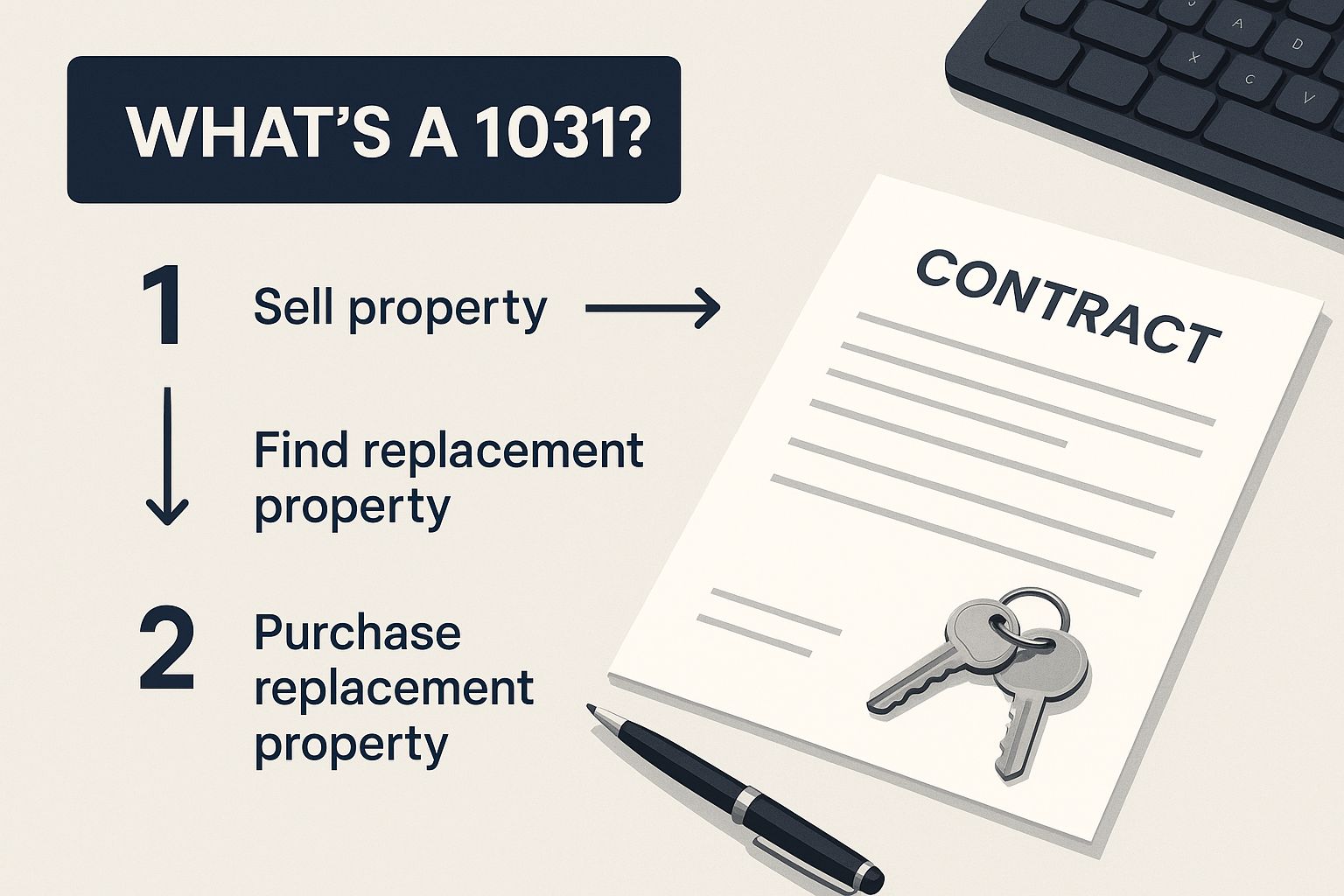
As you can see, it's a structured sequence, all managed by a Qualified Intermediary to keep the transaction compliant and protect its tax-deferred status.
The Central Role of the Qualified Intermediary
To avoid that dreaded "constructive receipt," you have to bring in a Qualified Intermediary (QI). You might also hear them called an accommodator or facilitator. This independent third party is the absolute linchpin of a successful exchange. Think of them as the neutral escrow agent for your 1031 deal.
Here’s what they handle:
They hold the funds from the sale of your original (relinquished) property.
They receive your official list of identified replacement properties.
They technically acquire the replacement property on your behalf.
They transfer the deed for the new property over to you at closing.
Picking a reputable QI is one of the most important calls you’ll make. It’s a non-negotiable step that safeguards the entire exchange.
The Two Critical Timelines You Cannot Miss
The 1031 exchange runs on two famously strict, non-negotiable clocks. Both start ticking the very day you close the sale on your relinquished property.
The 45-Day Identification Period: You have exactly 45 calendar days to formally identify potential replacement properties. This isn’t a verbal agreement; it must be in writing, signed by you, and delivered to your QI. Miss this by even one day, and the exchange is over.
The 180-Day Exchange Period: You have to complete the purchase and close on one or more of your identified properties within 180 calendar days of the original sale date (or your tax return due date for that year, whichever comes first).
Investor Takeaway: These deadlines are absolute and count weekends and holidays. Exceptions are incredibly rare, usually reserved for presidentially declared disasters. Meticulous planning is the only way to avoid running out of time. For more on planning your next move, check out our guide to commercial real estate investment opportunities.
Advanced Lens: The Rules of Identification
For investors with more complex goals, it’s crucial to understand the finer points of the identification rules. The IRS gives you three main ways to name properties within your 45-day window:
The Three-Property Rule: This is the most popular route. You can identify up to three potential replacement properties, no matter their value.
The 200% Rule: If you need to identify more than three properties, their combined fair market value can't go over 200% of what you sold your original property for.
The 95% Rule: In the rare case you blow past both the three-property and 200% rules, you must successfully purchase at least 95% of the total value of all the properties you identified.
Choosing the right identification strategy really depends on the market, what you're trying to acquire, and how much risk you can stomach if a deal falls apart. Talking through these options with your QI and legal team will help you pick the best path for your specific situation.
Defining Like-Kind Properties for Your Exchange
One of the most powerful—and frequently misunderstood—parts of a 1031 exchange is the idea of a “like-kind” property. Many investors hear this and assume it means they have to trade an apartment building for another apartment building. But the truth is, the IRS definition is far more flexible, creating some incredible strategic opportunities for your portfolio.
When it comes to real estate, the term "like-kind" refers to the nature or character of the property, not its specific type, grade, or quality. As long as the property you’re selling and the one you’re buying are both held for productive use in a business or for investment, they can qualify. This opens the door to some major portfolio pivots.
This broad definition means you can exchange a parcel of raw land for a fully leased retail center. You could sell an office building and roll the proceeds into a warehouse or distribution facility. The key is that both are real properties held for investment purposes within the United States.
What Qualifies as a Like-Kind Asset?
This flexibility allows investors to shift strategies, exit certain asset classes, and enter new ones without getting hit with an immediate tax bill. It’s a crucial tool for adapting to changing market cycles and evolving economic conditions.
Here are a few common examples of exchanges that fit squarely within the like-kind rules:
Swapping an apartment building for a medical office building.
Exchanging raw, undeveloped land for a portfolio of single-family rentals.
Trading a retail shopping center for an industrial warehouse.
Selling a farm or ranch to buy a multifamily complex.
Moving from an office building into an interest in a Delaware Statutory Trust (DST).
That last one is a big deal for many high-net-worth investors and family offices. The ability to transition from a hands-on asset like a rental property to a completely passive investment like a DST is a game-changer.
Assets That Do Not Qualify for an Exchange
While the rules are broad, they aren’t limitless. Knowing what falls outside the definition of like-kind property is just as important as knowing what’s in. Getting this wrong can invalidate your exchange and trigger a taxable event.
The following types of property are explicitly excluded from 1031 exchange eligibility:
Your primary residence or a second home used for personal enjoyment.
"Fix-and-flip" properties that are held primarily for quick resale, not long-term investment.
Partnership interests in a real estate company.
Real estate investment trust (REIT) shares.
Property located outside the United States (foreign property can only be exchanged for other foreign property).
Insight Edge: The Delaware Statutory Trust (DST)
For sophisticated investors looking for a passive, institutional-quality replacement property, the Delaware Statutory Trust (DST) has become an incredibly popular solution. A DST allows multiple investors to pool their 1031 exchange funds to co-own a large, high-quality commercial property that would be nearly impossible to buy on their own.
Investor Takeaway: The IRS officially considers an interest in a DST to be a direct interest in real estate (thanks to Revenue Ruling 2004-86), making it a valid like-kind replacement property. This structure offers a streamlined path to diversification and professional management, making it an excellent tool for investors looking to simplify their holdings while continuing to defer capital gains.
The Deal Lens: A 1031 Exchange in Action
Rules and timelines are one thing, but seeing the numbers in action is where the power of a 1031 exchange really hits home. Let's walk through an illustrative scenario to see just how this strategy protects and grows an investor's hard-earned capital.
Imagine an investor, we'll call her Alex, who bought an apartment building a decade ago. It's been a great run, but she's ready to sell and level up into a larger, institutional-grade property.
The Initial Investment Scenario
Here’s a breakdown of the property Alex is selling, which we call the relinquished property:
Original Purchase Price: $800,000
Total Depreciation Taken: $250,000
Adjusted Cost Basis: $550,000 ($800,000 - $250,000)
Current Sale Price: $2,000,000
With these numbers, we can figure out the total taxable gain if she were to just sell the property outright.
The Financial Outcome Without a 1031 Exchange
If Alex simply sells and cashes out, she’s looking at a hefty tax bill. The total gain is $1,450,000 (the $2,000,000 sale price minus her $550,000 adjusted basis). This gain gets taxed in two different ways.
First up is depreciation recapture, which is taxed at a flat 25%.
Depreciation Recapture Tax: $250,000 x 25% = $62,500
Then comes the long-term capital gains tax on the rest of the profit. Assuming a combined federal and state rate of 20%, the calculation looks like this:
Capital Gains Tax: ($1,450,000 total gain - $250,000 recaptured) x 20% = $240,000
The Bottom Line: By selling her property the traditional way, Alex would be hit with a tax bill of $302,500. That means only $1,697,500 of her $2,000,000 sale proceeds would be left to put into a new deal.
This is exactly the kind of capital erosion the 1031 exchange was created to avoid.
The Financial Outcome With a 1031 Exchange
Now, let's rewind and see what happens when Alex uses a 1031 exchange. She works with a Qualified Intermediary to sell her $2 million building and reinvests the entire amount into a new, like-kind property of equal or greater value.
The result is simple, yet incredibly powerful.
Total Taxes Paid: $0
Total Capital Reinvested: $2,000,000
By executing the exchange, Alex defers the entire $302,500 tax liability. That money isn't lost to taxes; it stays in her portfolio, working for her in the new property. This is the magic of compounding in action—it allows investors to scale their wealth significantly faster over time.
This isn't some niche strategy; it's a cornerstone for investors of all sizes. As you can see from Alex's story, the ability to defer taxes keeps a huge amount of capital in the game, fueling faster growth. For context, industry estimates suggest 1031 exchanges support hundreds of thousands of jobs and contribute billions to the U.S. economy annually (Source: 1031taxreform.com, 2021). You can learn more about the scale and impact of 1031 exchanges at 1031specialists.com.
Avoiding Common Pitfalls: An Investor Checklist
A 1031 exchange is an incredible tool for building wealth, but its rigid rules leave zero room for error. Even experienced investors can get tripped up. The best defense is a proactive approach and a solid professional team in your corner.

Investor Checklist: Questions to Ask Before Starting a 1031 Exchange
Is my team in place? Have I engaged a reputable Qualified Intermediary (QI) before my property sale closes? Is my CPA or tax advisor aware of the transaction and ready to model the financial implications?
Have I started my replacement property search? Do I have a pipeline of potential deals ready for consideration before my 45-day clock starts ticking?
Do I understand the debt and equity requirements? Will the replacement property have a value and mortgage amount equal to or greater than the property I'm selling? Am I prepared to add cash if needed to avoid taxable "boot"?
How will I manage the 45-day identification deadline? What is my strategy for formally identifying properties? Do I have backup options in case my primary target falls through?
What is my contingency plan for the 180-day closing? Have I pre-arranged financing? Is my due diligence plan for the new property realistic within the timeframe?
Investor Takeaway: A busted exchange is a costly lesson. Your best protection is a thorough due diligence process, not just for the property but for your entire exchange team. You can find key questions to ask in our guide to commercial real estate due diligence.
Risk & Mitigation: Common 1031 Exchange Traps
RISK: Failed Identification. You can't find and officially identify a suitable replacement property within the strict 45-day window, often due to a competitive market or lack of preparation.
MITIGATION: Start your search for replacement properties well before listing your old one. Keep multiple backup options in your pipeline and consider flexible alternatives like DSTs.
RISK: Creating Taxable "Boot". You receive cash from the exchange or fail to replace the full value of the debt, which creates a taxable event.
MITIGATION: Work closely with your CPA to model the transaction from day one. Ensure the new property's value and debt meet or exceed the old property's levels. Be prepared to add cash if needed.
RISK: Closing Delays. The purchase of your replacement property gets held up past the 180-day deadline because of financing hitches, inspection problems, or seller issues.
MITIGATION: Build a team with a proven track record in 1031s. Get financing pre-arranged, conduct exhaustive due diligence, and have backup properties identified in case your first choice falls apart.
RISK: Ineligible Intermediary. You use a QI who is a "disqualified person" (like your own agent, broker, or attorney), which immediately invalidates the entire exchange.
MITIGATION: Vet your Qualified Intermediary thoroughly. Choose an established, bonded, and insured firm that specializes in 1031 exchanges and is completely independent of your deal.
Your Top 1031 Exchange Questions, Answered (FAQ)
Here are some of the most common questions that come up when investors start planning a 1031 exchange.
Can I Use a 1031 Exchange for My Vacation Home?
This is a classic question, and the short answer is usually no—but there's a big "if." A 1031 exchange is strictly for investment properties. A second home you use purely for personal getaways doesn't make the cut.
However, if you convert your vacation property into a legitimate rental, it can become eligible. Under IRS safe harbor guidelines, you need to rent it out at a fair market rate for at least 14 days a year for two years before the exchange. During that time, your personal use can't exceed 14 days or 10% of the total days it was rented, whichever is greater.
What Happens If I Can't Find a Replacement Property in Time?
This is the biggest risk in any 1031 exchange. If you don't officially identify a property within that tight 45-day window, or if you can't close on one of your identified properties within the 180-day period, the exchange fails. The deal is then treated like a standard sale, meaning you're on the hook for all the capital gains and depreciation recapture taxes you were trying to defer.
How Does My Mortgage Factor Into a 1031 Exchange?
Mortgages are a make-or-break part of the deal. To defer 100% of your taxes, the value of your new property must be equal to or greater than the one you sold. Second, the debt you take on for the new property has to be equal to or greater than the debt you paid off on the old one. If your new mortgage is smaller than your old one, that difference is considered "mortgage boot," and you'll owe taxes on it.
Investor Takeaway: Balancing your debt and equity isn't just a suggestion; it's a fundamental rule for a fully tax-deferred exchange. Always run the numbers with your tax advisor before you commit to a replacement property to avoid a nasty tax surprise.
Can I Swap One Big Property for Several Smaller Ones?
Yes, absolutely. This is a smart and very common strategy for investors looking to diversify. You could sell one large apartment building and use the funds to buy a handful of single-tenant retail locations. The only rule is that the total value of all the new properties must be equal to or greater than the value of the single property you sold.
What Exactly Is a "Reverse" 1031 Exchange?
A reverse exchange flips the script: you buy the new property before you sell your old one. This can give you an advantage in a hot market where you need to move fast. To make it work, your QI sets up a special entity to "park" the new property for you until your old one sells. These are more complex and costly, so they're typically best for seasoned investors with a strong advisory team.
The 1031 exchange is a powerful vehicle for building and preserving wealth through real estate. When executed with discipline and expert guidance, it allows your investments to grow on a tax-deferred basis, creating a compounding effect that can significantly enhance your long-term returns. We believe that well-structured real assets, leveraged through smart strategies like the 1031 exchange, can be a prudent and resilient component of any long-term wealth strategy.
Take the Next Step
Navigating the complexities of a 1031 exchange requires careful planning and expert guidance. At Stiltsville Capital, we help accredited investors identify institutional-quality replacement properties to achieve their portfolio goals. To explore how our specialized strategies can fit into your wealth-building plan, schedule a confidential call with our team.
Disclaimer: Information presented is for educational purposes only and does not constitute an offer to sell or a solicitation of an offer to buy securities. Any offering is made only through definitive offering documents (e.g., private placement memorandum, subscription agreement) and is available solely to investors who meet applicable suitability standards, including “Accredited Investor” status under Rule 501 of Regulation D. Investments in private real estate involve risk, including loss of capital, illiquidity, and no guarantee of distributions. Past performance is not indicative of future results.
Comments